
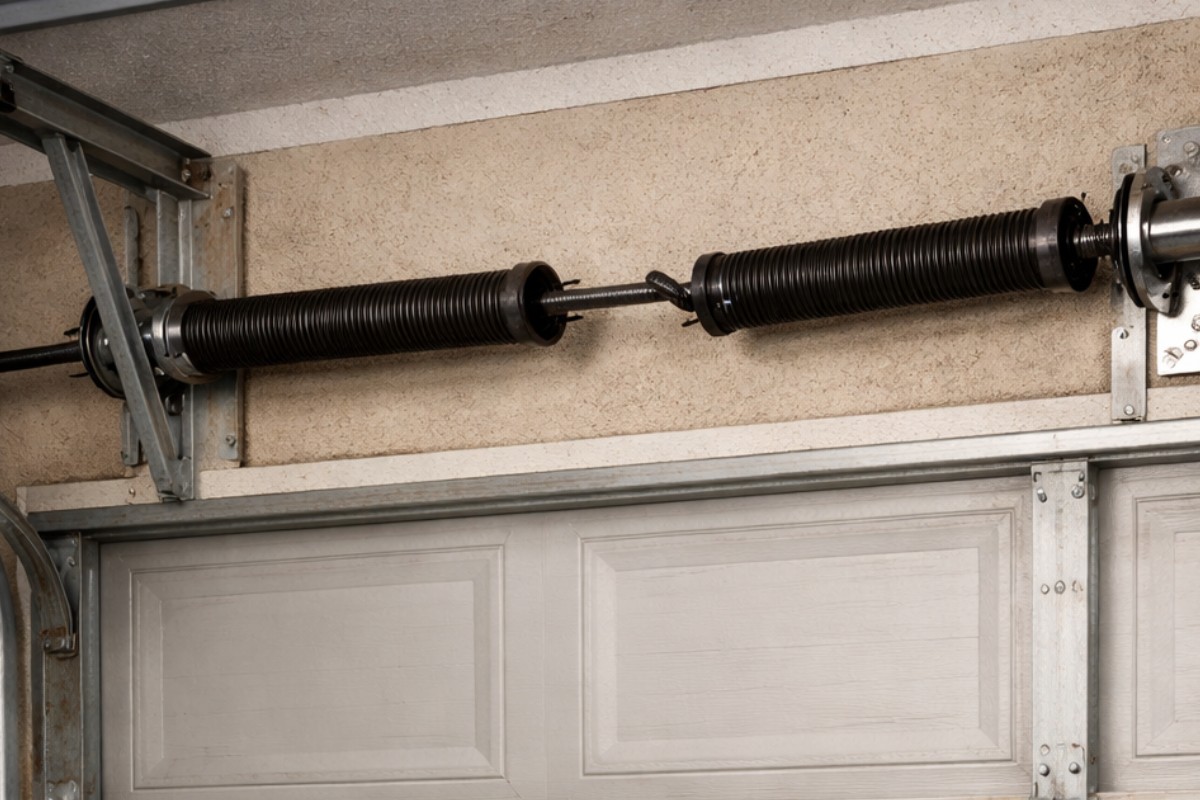
When a garage door spring snaps in Phoenix, the door becomes dead weight — the opener motor alone cannot lift it, and forcing it risks damaging the trolley carriage, bending the track, and burning out the motor within a few cycles. The spring is the load-bearing component of the entire system, and a failure almost always requires same-day repair to restore safe operation.
Phoenix homeowners face accelerated spring failures compared to the national average for one specific reason: thermal cycling. Summer temperatures inside an uninsulated garage routinely exceed 130°F, causing the steel coils to expand and contract with every degree of temperature change. That daily expansion and contraction creates micro-stress fractures inside the coil that accumulate invisibly — until the spring snaps without warning, often with a sound like a gunshot, while the car is parked inside or the door is mid-travel.
Our mobile technicians at AZ Locksmith & Garage Repair respond to spring failures across Phoenix day and night, seven days a week. We arrive with torsion springs sized for all standard residential door heights and weights, and we provide a written quote for your review and approval before any work begins — no surprises, no hidden fees. See our location and read reviews from Phoenix homeowners on Google Maps before you call.
Every spring repair starts with a full inspection of the spring system, cables, drums, and bearing plates — not just the broken coil. A spring rarely fails in isolation, and identifying related wear before it becomes a secondary failure is what separates a one-visit repair from a callback.
Why Phoenix Destroys Garage Door Springs Faster Than Anywhere Else
Torsion springs are rated by cycle count — the number of times the door opens and closes before the spring reaches the end of its designed lifespan. A standard builder-grade spring is rated for 10,000 cycles. In a moderate climate, with a household averaging 4 door cycles per day, that works out to roughly 7 years of service life.
In Phoenix, that math breaks down. The issue isn’t just use frequency — it’s the thermal environment the spring lives in. Steel expands when heated and contracts when cooled. In Phoenix, the delta between a 115°F summer afternoon and a 70°F desert night is roughly 45 degrees. Every day, the spring coil goes through that expansion and contraction cycle on top of its operational wind and unwind cycles. The stationary cone — the fixed anchor point of the torsion spring — is where this combined stress concentrates, and it’s where the vast majority of Phoenix spring failures originate.
Lubrication failure compounds the problem. Garage door springs require periodic lubrication to reduce friction between coil windings during operation. At 130°F, standard spring lubricant breaks down significantly faster than manufacturer service intervals assume. A dry spring in Phoenix generates more internal friction with every cycle, accelerating the micro-fracture process and shortening the effective service life by years.
What this means practically: a builder-grade 10,000-cycle spring installed during home construction in Phoenix may reach failure in 4–5 years rather than 7. If your home was built more than 5 years ago and the springs have never been replaced, they are likely operating well past their safe service life.
Torsion Springs vs. Extension Springs — What Your Phoenix Home Has
Most Phoenix homes built after the early 1990s use a torsion spring system: one or two springs mounted on a steel shaft centered above the door opening, connected via cables to drums on each end of the shaft. The spring stores energy by winding as the door closes and releases it as the door opens, doing the majority of the lifting work. When a torsion spring fails, the broken coil stays on the shaft — contained and visible as a gap in the coil.
Older homes and lighter single-car doors in Phoenix sometimes use extension springs: two springs mounted horizontally along the upper tracks on each side, stretching as the door closes and contracting as it opens. Extension springs are less expensive but more dangerous when they fail — without a properly installed safety cable running through the spring center, a broken extension spring can become a projectile.
Our garage door torsion spring installation and replacement service covers both types. We stock high-cycle springs rated for 25,000–30,000 cycles — the correct specification for Phoenix’s thermal environment — and we’ll confirm which system your door uses when you call.
Never attempt to remove or wind a torsion spring yourself. A fully wound torsion spring stores enough mechanical energy to cause severe injury or death if a winding bar slips or the spring is disturbed without proper equipment and technique.
| Symptom | Likely Cause | What a Pro Checks |
|---|---|---|
| Loud bang, door won’t move | Torsion spring snapped | Spring integrity, visible gap in coil, cable tension, drum alignment |
| Door opens a few inches then stops | Opener safety limit triggered by spring load | Spring condition, opener force settings, motor thermal state |
| Door crooked — one side lower | One spring failed in dual-spring system | Both springs — replace as a matched pair |
| Door feels extremely heavy manually | Spring losing tension near end of life | Remaining spring cycles, cable drum wear, balance test |
| Visible gap in spring coil above door | Spring already broken | Full spring replacement, safety cable and drum inspection |
| Cables hanging loose on both sides | Spring failure caused cables to unspool | Spring, cable, drum, and bearing plate — full system check |
What the Spring Repair Process Looks Like
When an AZ Locksmith & Garage Repair technician arrives at your Phoenix home, the repair follows a structured sequence — spring replacement is never just a parts swap.
The first step is a full system assessment: spring type, wire diameter, coil count, drum condition, cable integrity, bearing plate wear, and bottom bracket condition. This takes 10–15 minutes and determines whether the repair is isolated to the spring or whether cables, drums, or other hardware need attention in the same visit. We provide a written quote at this point — you approve the work before anything is touched.
Spring removal is performed using proper winding bars to safely unwind the remaining tension in the broken spring before the hardware is disturbed. The replacement spring — sized to your door’s weight and height — is installed on the shaft, tensioned to the correct wind count, and the cables are re-tensioned to match.
After installation, we run a balance test: the door is released at mid-travel and should hold position without drifting up or down. An unbalanced door means the spring wind count needs adjustment. We then verify the opener’s force calibration settings, since a new spring changes the load profile the motor operates against.
If the garage door track, rollers, or cables took any damage during the spring failure — which happens when the door drops unevenly — we address those in the same visit. Most Phoenix spring repairs are completed in 45–75 minutes. You can also see the full scope of our garage door repair services and our opener installation and repair options if the spring failure caused opener damage.
Frequently Asked Questions
How do I know if my garage door spring is broken? +
Can I use my garage door opener with a broken spring? +
How long do garage door springs last in Phoenix? +
Should I replace both springs if only one broke? +
What does garage door spring repair cost in Phoenix? +
Do you service all garage door brands? +
How long does spring repair take? +
Before You Touch That Spring
A broken torsion spring is one of the few garage door repairs where the risk of DIY is severe enough that no qualified technician will recommend attempting it without proper training and equipment. The right next step is a same-day inspection and written quote — not a parts order.
AZ Locksmith & Garage Repair serves Phoenix homeowners from our base at 9830 S 51st St, B-122 in the Ahwatukee area, with mobile technicians available day and night, seven days a week. We stock high-cycle torsion springs on every truck and provide a written quote before any work begins — no pressure, no hidden fees.
Call (602) 806-7771 to request service. You can also visit our contact page or learn more about our team on our about page. We’re available Monday through Sunday, 7:00 AM to 9:30 PM.