In This Article
A loose, rattling door handle on a high-traffic entry is one of the most overlooked security weaknesses in any building. Worn residential-grade knobs fail under constant use, and once the latch stops seating properly, the door no longer secures the space behind it. The solution is purpose-built hardware: commercial lever handle sets engineered for heavy cycling, forced-entry resistance, and ADA-compliant operation. In this guide, we break down how grade, materials, and locking function separate top-rated lever sets from the hardware that fails early — and how to match the right set to each door.
What Sets Commercial Lever Handle Sets Apart
A residential knob and a commercial lever may look like simple variations of the same idea, but the engineering underneath is built for entirely different demands. Standard knobs rely on a small spring-cam mechanism that wears quickly under repeated turning. A professional locksmith sees the result constantly: knobs that spin freely, latches that no longer retract, and doors that stop locking altogether.
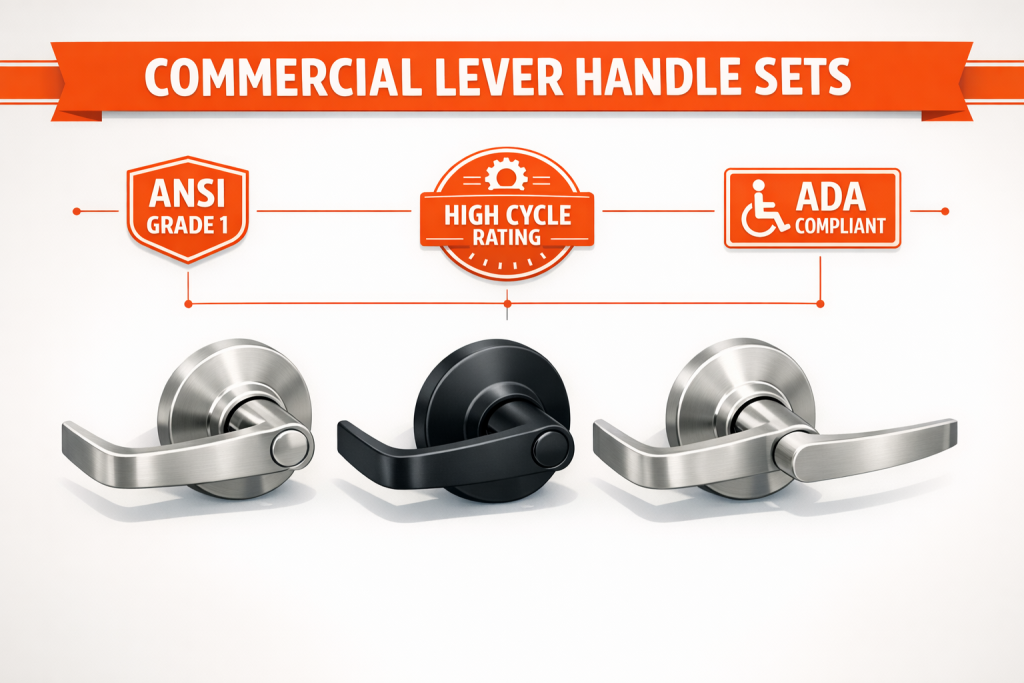
Commercial lever handle sets use a heavier internal chassis, reinforced spindles, and stronger return springs designed for thousands of daily operations. The lever itself is also an accessibility feature — it can be operated with a closed fist, an elbow, or a forearm, which is why building codes and the ADA accessibility standards require lever-style hardware on most public entrances. The same qualities that make a lever easier to use also make it more rugged over the long run.
How Grade and Cycle Ratings Define Durability
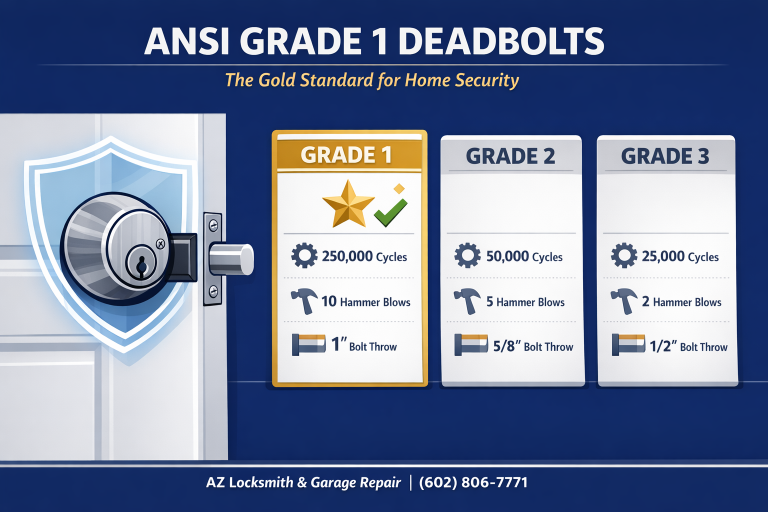
Durability in door hardware is not a marketing claim — it is measured. The ANSI/BHMA grading standard tests lever sets for cycles, strength, and security, then assigns a Grade 1, 2, or 3 rating.
Grade 1 represents the highest level of performance and is the correct specification for commercial and high-traffic openings. Grade 2 suits light commercial and demanding residential doors, while Grade 3 covers basic residential use only. The cycle rating tells you how many open-close operations the mechanism survived in testing, which is the single most useful number when comparing sets for a busy entrance.
Materials Matter as Much as Grade
Solid forged brass, stainless steel, and zinc-alloy levers resist the bending and surface wear that hollow stamped hardware cannot. On exterior doors across the Phoenix metro, where extreme heat cycles cause frames and hardware to expand and contract, corrosion-resistant finishes and through-bolted mounting keep a lever set seated and secure season after season.
Commercial Lever Handle Sets — Durability & Security at a Glance
| Lever Set Type | ANSI/BHMA Grade | Cycle Durability | Locking Security | Best Application |
|---|---|---|---|---|
| Mortise Lever (Grade 1) | Grade 1 | Highest | Highest | Main entrances, high-traffic public doors |
| Cylindrical Lever (Grade 1) | Grade 1 | Very High | High | Offices, stockrooms, busy interior doors |
| Storeroom Function Lever | Grade 1 | Very High | Keyed Outside | Server rooms, supply rooms, secured areas |
| Cylindrical Lever (Grade 2) | Grade 2 | Moderate | Moderate | Light commercial, heavy residential doors |
| Fire-Rated Lever Set | Grade 1 | Very High | Listed / Latched | Stairwells, fire-rated corridor doors |
| Privacy Lever (Thumbturn) | Grade 2 | Moderate | Interior Only | Restrooms, private offices, break rooms |
| Passage Lever | Grade 2 | Moderate | None | Hallways, closets, non-secured openings |
| Tubular Lever (Grade 3) | Grade 3 | Basic | Basic | Low-use residential interior doors |
Security Features That Separate the Top-Rated Sets
A lever handle controls how a door is used; the locking function controls who gets through it. The strongest configurations pair a quality lever set with dedicated deadbolt security rather than relying on the latch alone.
A storeroom-function lever, for example, stays locked on the outside at all times and requires a key for entry, while always allowing free exit — a common choice for stockrooms, server rooms, and back-of-house doors. For interior offices and connecting doors, a thumbturn lock on the inside lets occupants secure the room from within without a key. Pairing these functions with a Grade 1 deadbolt and a reinforced strike plate anchored into the structural frame is what transforms a door from a convenience point into a genuine security barrier. Our certified locksmiths assess each opening to determine which combination fits its use and exposure.
✅ Pro Tip from the Field: After servicing hardware on hundreds of commercial doors across the Valley, one failure pattern stands out: the strike plate, not the lever, is usually the first thing to give. Installers mount a top-rated Grade 1 lever set, then secure the strike with the short screws that ship in the box — screws that bite into trim instead of the structural stud. A determined push splits the jamb long before the lever ever fails. We replace those with 3-inch screws driven into the framing on every commercial install. The lever set is only as strong as what holds it to the door.
Matching Hardware to the Door and the Use Case
The “best” lever set is the one specified correctly for its opening. A glass storefront entry, a fire-rated stairwell door, and an interior office each call for a different function and grade.
Fire-rated openings require listed hardware that keeps the door latched under heat — never substitute a passage set on a labeled fire door. Entrances handling steady public traffic need Grade 1 cylindrical or mortise levers. Lower-traffic interior doors can use Grade 2 hardware sized to their actual demand instead of capacity they will never use. The same logic carries into the home: a busy garage-to-house connecting door benefits from commercial-grade hardware far more than a rarely used guest room, which is why thoughtful home safety planning often borrows directly from commercial specification. If a door is a candidate for keyless access, a smart lock can be integrated with a compatible lever trim during the same visit.
Frequently Asked Questions — Commercial Lever Handle Sets
What makes a lever set “commercial grade”?
Commercial grade refers to hardware tested and certified to ANSI/BHMA Grade 1 standards, with a reinforced internal chassis and high cycle ratings built for constant use. A residential knob is not engineered for that demand and wears out under it. Our professional locksmith team specifies the correct grade for each door so the hardware matches how the opening is actually used.
Are lever handles more secure than knobs?
The lever itself is about accessibility and durability, not locking strength — security comes from the lock function and the deadbolt behind it. A Grade 1 lever set paired with a dedicated deadbolt and a framing-anchored strike plate is far stronger than any knob. Lever hardware also resists wear better, so the latch keeps seating correctly over the long run.
What is a storeroom function lever?
A storeroom function lever stays locked on the outside at all times and requires a key to enter, while the inside lever always allows free exit for safe egress. It is a common choice for supply rooms, server rooms, and secured back-of-house doors. Our certified locksmiths help match the right lock function to each space during a hardware assessment.
What is a thumbturn lock and where is it used?
A thumbturn lock is a small interior knob that lets someone lock or unlock a door from inside without a key. It is ideal for restrooms, private offices, and interior connecting doors where occupants need to secure a room from within. For exterior or high-security openings, a keyed deadbolt is the better pairing.
Do commercial lever sets work on a home?
Yes. High-use residential doors — especially a garage-to-house connecting door — benefit from commercial-grade hardware that outlasts standard residential sets. Borrowing commercial specifications is a practical way to improve home safety on the doors that get the most traffic, while standard hardware is fine for rarely used interior rooms.
Can a lever set be combined with a smart lock?
Many keyless systems integrate with a compatible lever trim, so you keep the durability of a commercial lever while adding app or PIN access. If a door is a candidate for keyless entry, our team can install a smart lock and align the lever hardware in the same visit, then confirm every access method works correctly before leaving.
Specifying the Right Lever Set for Your Building
Choosing among commercial lever handle sets comes down to three questions: how heavily the door is used, what level of security the space behind it needs, and which code requirements apply to that opening. A storefront, a stairwell, and a private office each land in a different place on the grade-and-function map — and getting the specification right the first time prevents the early failures that send most knobs and lightweight levers to the scrap bin.
If you are upgrading hardware on a commercial property or a high-use door at home in Phoenix or the surrounding area, contact AZ Locksmith & Garage Repair for a hands-on hardware assessment. Our licensed team will spec the correct grade, function, and locking configuration for every opening, then handle the installation with framing-anchored strike plates and proper alignment.
📍 Find us on Google Maps and see what Phoenix property owners say about our work.
📞 Schedule a hardware and security assessment with AZ Locksmith & Garage Repair and put proven, top-rated hardware on every door that matters.
Locked Out or Garage Door Stuck?
AZ Locksmith & Garage Repair · Mobile service across Phoenix, 7 days a week, 7 AM–9:30 PM.

AZ Locksmith & Garage Repair
Written by the AZ Locksmith & Garage Repair team — mobile locksmiths and garage door technicians based at 9830 S 51st St in Phoenix, AZ. We handle lockouts, rekeys, car keys, commercial hardware and garage door repair across Phoenix and the East Valley, 7 days a week.