
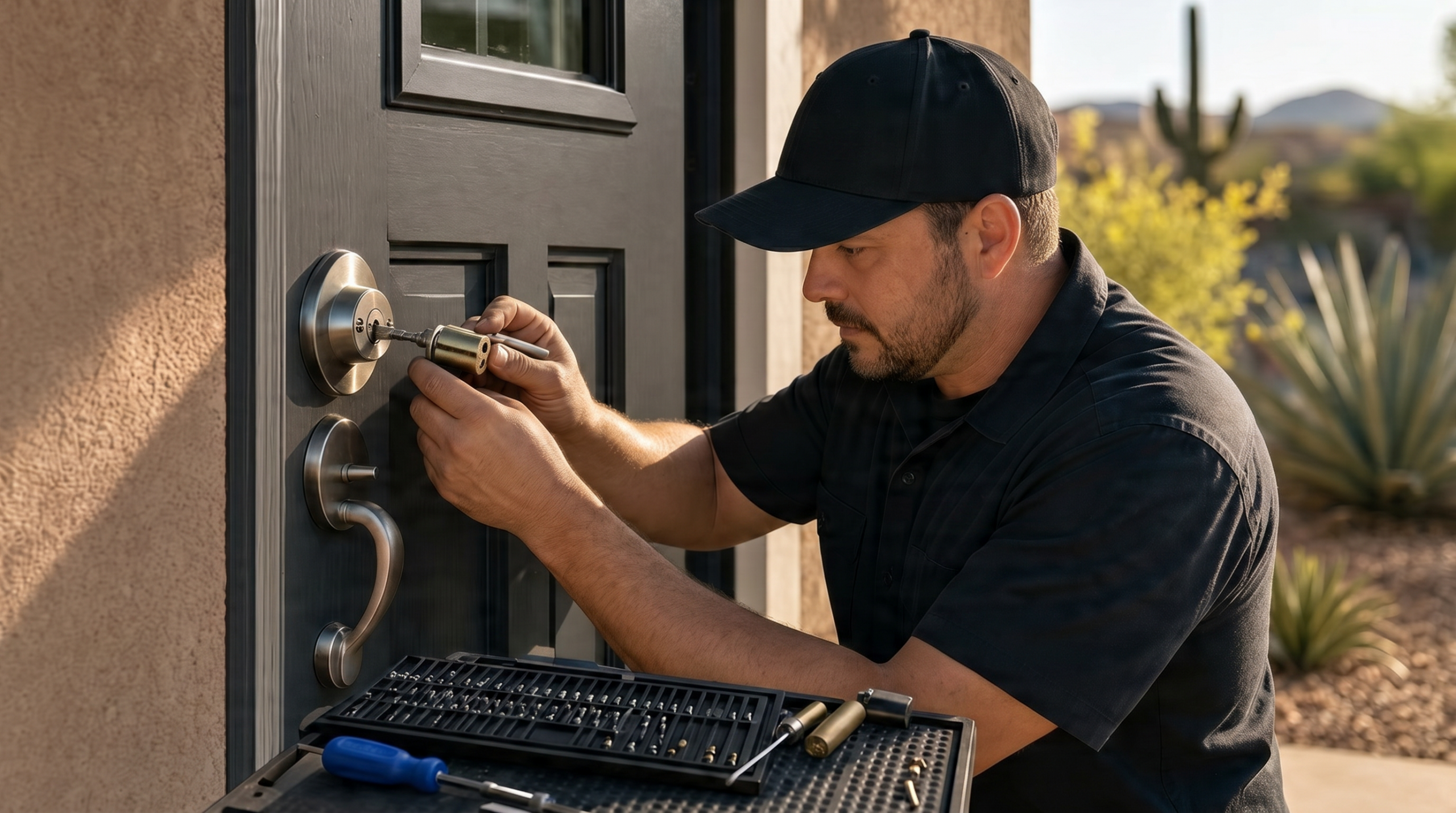
Most new homeowners install cameras, set up alarm systems, and update the Wi-Fi password before unpacking the kitchen — but leave their front door accessible to every key ever cut from the previous owners’ copies. An alarm tells you someone entered; rekeying locks after moving prevents unauthorized entry before any sensor fires. In this guide, we break down exactly why rekeying belongs at the top of every new-home security checklist — and what a complete first-day locksmith visit should cover.
What Rekeying Locks Actually Means
When a professional locksmith rekeyes a lock, the hardware stays in place. The technician opens the cylinder and rearranges the internal pin stack — the spring-loaded pins that determine which key profile operates the lock. After rekeying, every previously cut key stops working. A new key, matched to the updated pin configuration, is the only one that opens the lock.
This is exactly what a home sale creates: a circulation problem. Dozens of keys may have been cut over the years, and none of them are accounted for. A lock rekey service eliminates all of them in a single visit. Every door on the property can be brought to one new master key for convenience — front door, back door, side entries, and garage — without replacing a single piece of hardware.
Full lock replacement makes sense when hardware is worn, graded too low for the door’s exposure, or incompatible with new security goals. But for a home with locks in sound condition, rekeying is the direct, effective first action.
Rekeying vs. Other Home Security Measures — At a Glance
| Security Measure | Stops Unauthorized Key Entry | Works Without Power | Requires Locksmith | Addresses Forced Entry | Best Use Case |
|---|---|---|---|---|---|
| Rekeying Locks | ✔ Yes | ✔ Yes | Yes | ✘ No | First step after any home purchase or key loss |
| Lock Replacement | ✔ Yes | ✔ Yes | Recommended | Partially | Worn or low-grade hardware needing upgrade |
| Grade 1 Deadbolt | With Rekey | ✔ Yes | Yes | ✔ Yes | All exterior doors — non-negotiable minimum |
| Thumbturn Lock | ✘ No | ✔ Yes | Recommended | Partially | Interior-facing doors — quick secure from inside |
| Smart Lock | ✔ Yes | Battery Backup | Recommended | Partially | Keyless access + remote control via smartphone |
| Alarm System | ✘ No | Battery/Cellular | No | Deters/Alerts | Intrusion detection and monitoring layer |
| Security Camera | ✘ No | Requires Power | No | ✘ No | Evidence collection and visual deterrent |
Who Has a Copy of Your Keys Right Now?
This question doesn’t get asked often enough — and the answer is rarely comfortable.
After a home sale, keys may be in the hands of: the sellers and everyone in their household, adult family members who had emergency copies, real estate agents from both sides of the transaction, cleaning crews hired before listing, contractors brought in to satisfy repair conditions during escrow, neighbors given access for mail or plant care, and — if the home was previously a rental — property management staff and prior tenants.
None of these parties have your contact information. None face any obligation to return or destroy their copy. According to FBI Uniform Crime Report data, a significant portion of residential break-ins involve no signs of forced entry — meaning access via an existing key is a documented pattern, not a theoretical one.
No alarm system closes this gap. A camera records after the threshold is crossed. Rekeying locks after moving eliminates every previous key in circulation. That single step does more to control who can physically enter your home than any monitoring system available.
Deadbolt Security: Why Lock Grade Matters
Rekeying a weak lock still leaves a weak lock. When our team at AZ Locksmith & Garage Repair evaluates a newly purchased home, we assess every deadbolt against ANSI/BHMA grading standards.
A Grade 1 deadbolt withstands substantially more kick force and picking resistance than the Grade 3 builder hardware commonly installed on new construction to meet minimum code requirements. In Phoenix, where door frames dry and contract through extreme heat cycles, a properly anchored Grade 1 deadbolt secured with 3-inch strike plate screws into the structural stud is the correct minimum for any exterior door.
A thumbturn lock on the interior side of a deadbolt lets occupants lock or unlock the door from inside without a key — practical for most interior configurations. On high-exposure exterior doors, a double-cylinder deadbolt (keyed on both sides) adds an additional layer of protection. Our certified locksmiths assess each door individually to determine which configuration fits the home’s specific layout and risk profile.
✅ Pro Tip from the Field: After completing hundreds of move-in security evaluations across the Phoenix metro area, one pattern stands out: the door connecting the garage to the home interior is almost always the weakest point on the property. Buyers rekey the front door, the back door, and side entries — but this connecting door often carries original builder hardware with no deadbolt at all. Because it’s used constantly and frequently left unlocked during the day, it’s the lowest-friction entry point on the property. Any thorough home safety review for a new home must treat this door with the same priority as the front entry.
What a Rekeying Locks After Moving Visit Covers
A comprehensive first-day visit from AZ Locksmith & Garage Repair covers every keyed entry point on the property: front door, back door, side entries, garage pedestrian door, and the garage-to-home connecting door.
Beyond the rekey, our licensed technicians evaluate:
- Deadbolt grade and integrity — hardware that falls below ANSI Grade 1 on an exterior door is flagged for upgrade
- Strike plate anchoring — plates must penetrate the structural stud, not just the door trim
- Thumbturn lock function — confirming interior locking mechanisms on every door operate correctly
- Smart lock compatibility — if any entry point is a candidate for a keyless smart lock, we assess bore preparation and integration options during the same visit
- Full home security posture — identifying any access point that presents a vulnerability worth addressing
You leave the visit with unified key control across every lock in the property and a clear picture of any hardware upgrades worth making next.
Frequently Asked Questions — Rekeying Locks After Moving
What’s the difference between rekeying and replacing a lock?
Rekeying changes the internal pin configuration inside the existing cylinder so old keys no longer work — the hardware stays in place. Lock replacement removes and installs entirely new hardware. Rekeying is the right call when the hardware is in good condition and the goal is simply to eliminate previous key access. Replacement makes sense when the lock is worn or the wrong grade for the door. Our residential locksmith team will advise which approach fits each door on your property.
Do I need to rekey every lock in my new home?
Every keyed exterior entry point should be rekeyed: front door, back door, side entries, garage pedestrian door, and the door between the garage and home interior. Interior room doors that use privacy pins are lower priority, but any door that connects to the outside — or to the garage — should be addressed. The good news is that all locks can typically be rekeyed to a single master key during one visit, so you carry one key for the entire property. Visit our lock rekey services page for details.
Can I rekey locks myself?
DIY rekey kits exist for specific lock brands, but they require the original working key, the correct brand-specific rekey kit, and a functional pin set for the new key profile. A mistake in pin stacking leaves the lock inoperable or permanently set to the wrong key. A professional locksmith brings the correct tools for any lock brand, ensures the cylinder is reassembled correctly, and can identify worn or damaged components during the process that a DIY approach would miss.
What is a thumbturn lock and do I need one?
A thumbturn lock is a small rotating knob on the interior face of a deadbolt that lets you lock or unlock the door from inside without a key. For interior-facing doors — like the door between the garage and your living space — a thumbturn allows quick locking from inside. For high-risk exterior doors, a double-cylinder configuration (keyed on both sides, no thumbturn) may be appropriate. Our team evaluates the right setup for each door during a home security assessment.
Does rekeying work alongside smart locks?
Yes. Many smart lock systems include a keyed cylinder backup that can be rekeyed just like a traditional deadbolt. If you’re adding a smart lock as part of a move-in upgrade, rekeying the cylinder ensures that even the physical key backup is unique to you. Our technicians handle both the smart lock installation and the cylinder rekey in the same visit, so every access method — app, PIN, and physical key — is set up correctly before we leave.
Why isn’t a home alarm system enough on its own?
An alarm system detects and reports unauthorized entry — it does not prevent it. If someone holds an old key to your door, they can enter without triggering a forced-entry sensor, and a monitoring response arrives after the fact. Rekeying locks after moving closes the access gap that alarm systems cannot address: physical key control. The two systems work best in combination — rekeying controls who can enter, an alarm detects any breach that bypasses the locks.
Control Who Has a Key Before Day One
Your alarm activates after someone crosses the threshold. Your cameras record after they’ve already entered. Rekeying puts you in control before any of that — by ensuring the only keys that open your doors are the ones you personally issued.
If you’ve recently purchased a home in Phoenix or the surrounding area, contact AZ Locksmith & Garage Repair to schedule a complete rekey and home security evaluation. Our licensed team covers every entry point and ensures your property is secured from the day you move in.
📍 Find us on Google Maps and read what Phoenix homeowners say about our work.
📞 Schedule your rekey consultation — and take home safety into your own hands from the start.