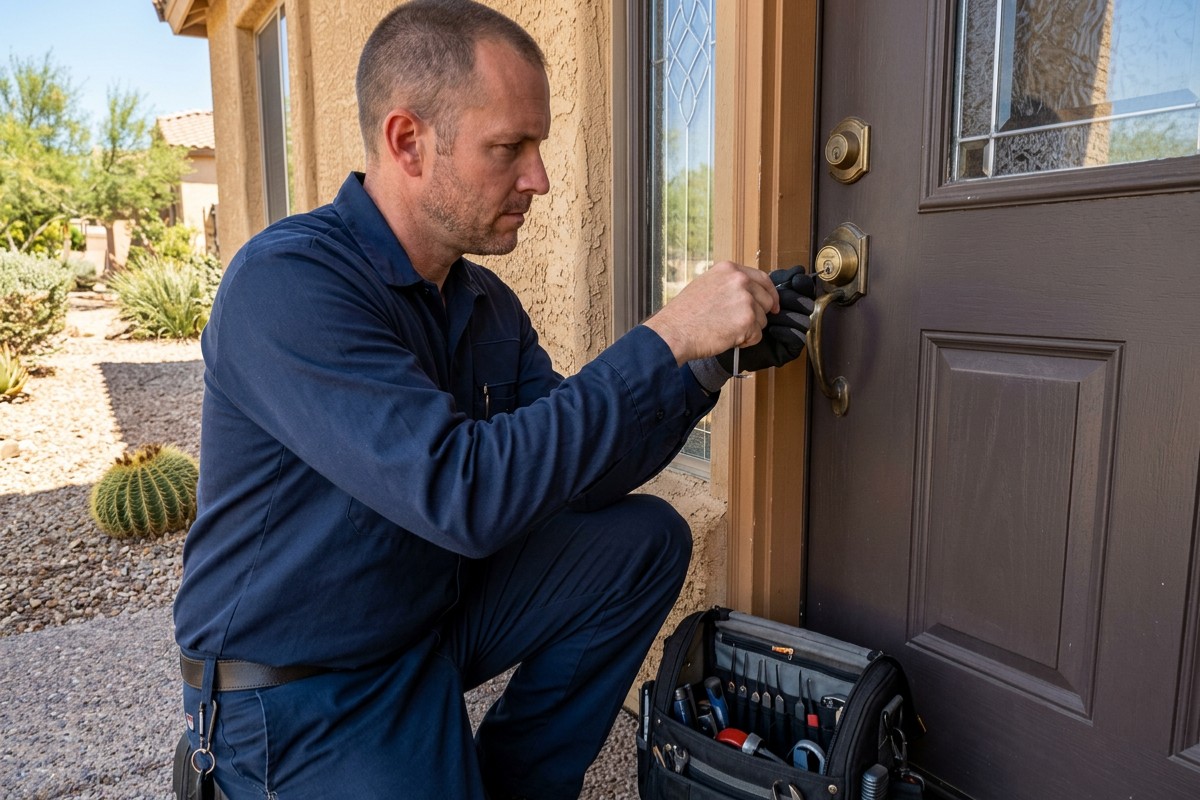
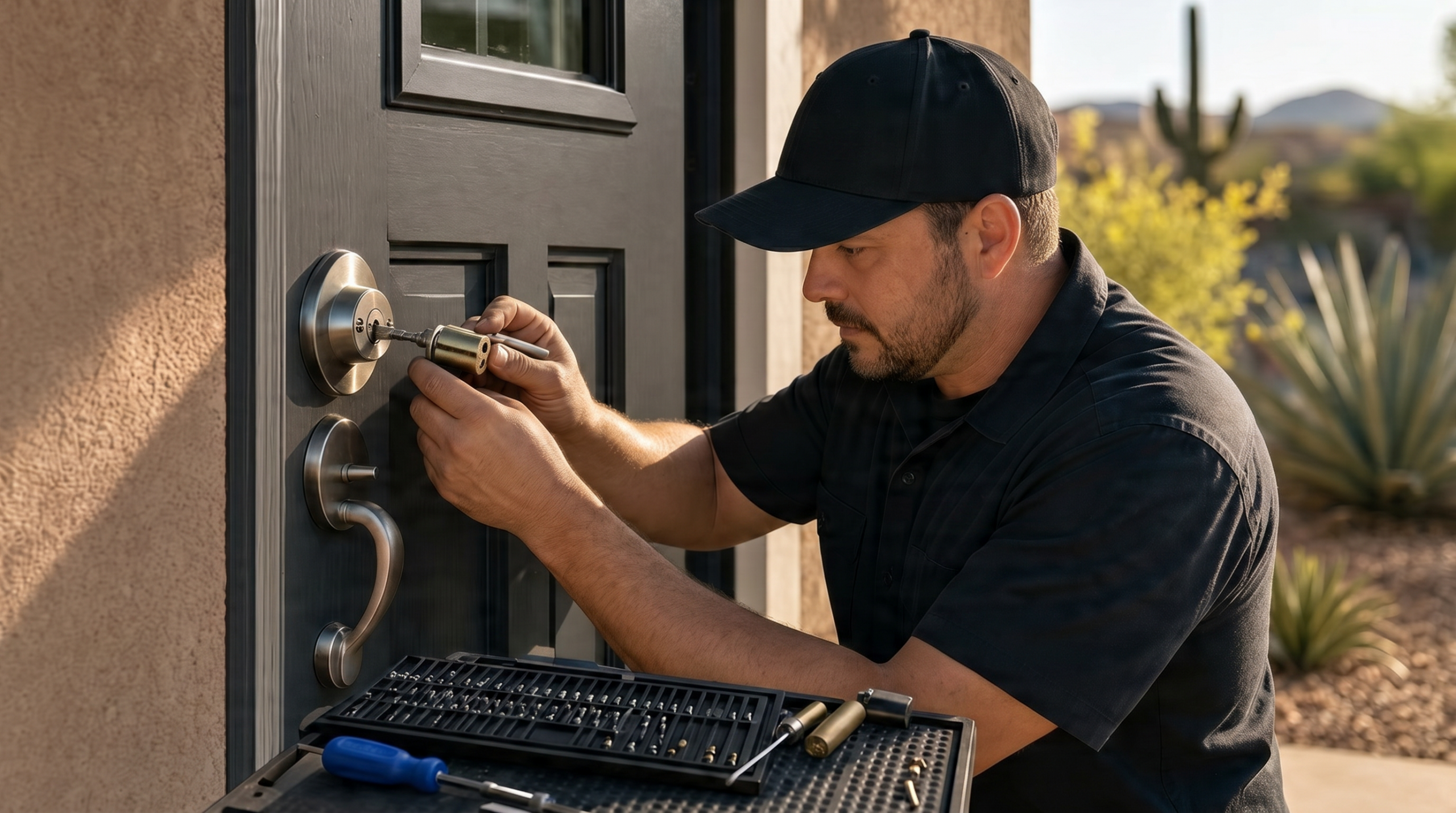
Licensed locksmith rekeying a Grade 1 deadbolt on a charcoal craftsman-style front door in Phoenix, Arizona

New Home? Why Rekeying Locks After Moving Is More Important Than Your Security System

Most new homeowners install cameras, set up alarm systems, and update the Wi-Fi password before unpacking the kitchen — but leave their front door accessible to every key ever cut from the previous owners’ copies. An alarm tells you someone entered; rekeying locks after moving prevents unauthorized entry before any sensor fires. In this guide, we break down exactly why rekeying belongs at the top of every new-home security checklist — and what a complete first-day locksmith visit should cover.

What Rekeying Locks Actually Means

When a professional locksmith rekeyes a lock, the hardware stays in place. The technician opens the cylinder and rearranges the internal pin stack — the spring-loaded pins that determine which key profile operates the lock. After rekeying, every previously cut key stops working. A new key, matched to the updated pin configuration, is the only one that opens the lock.

This is exactly what a home sale creates: a circulation problem. Dozens of keys may have been cut over the years, and none of them are accounted for. A lock rekey service eliminates all of them in a single visit. Every door on the property can be brought to one new master key for convenience — front door, back door, side entries, and garage — without replacing a single piece of hardware.

Full lock replacement makes sense when hardware is worn, graded too low for the door’s exposure, or incompatible with new security goals. But for a home with locks in sound condition, rekeying is the direct, effective first action.

Rekeying vs. Other Home Security Measures — At a Glance

Security Measure Stops Unauthorized Key Entry Works Without Power Requires Locksmith Addresses Forced Entry Best Use Case
Rekeying Locks ✔ Yes ✔ Yes Yes ✘ No First step after any home purchase or key loss
Lock Replacement ✔ Yes ✔ Yes Recommended Partially Worn or low-grade hardware needing upgrade
Grade 1 Deadbolt With Rekey ✔ Yes Yes ✔ Yes All exterior doors — non-negotiable minimum
Thumbturn Lock ✘ No ✔ Yes Recommended Partially Interior-facing doors — quick secure from inside
Smart Lock ✔ Yes Battery Backup Recommended Partially Keyless access + remote control via smartphone
Alarm System ✘ No Battery/Cellular No Deters/Alerts Intrusion detection and monitoring layer
Security Camera ✘ No Requires Power No ✘ No Evidence collection and visual deterrent

Who Has a Copy of Your Keys Right Now?

This question doesn’t get asked often enough — and the answer is rarely comfortable.

After a home sale, keys may be in the hands of: the sellers and everyone in their household, adult family members who had emergency copies, real estate agents from both sides of the transaction, cleaning crews hired before listing, contractors brought in to satisfy repair conditions during escrow, neighbors given access for mail or plant care, and — if the home was previously a rental — property management staff and prior tenants.

None of these parties have your contact information. None face any obligation to return or destroy their copy. According to FBI Uniform Crime Report data, a significant portion of residential break-ins involve no signs of forced entry — meaning access via an existing key is a documented pattern, not a theoretical one.

No alarm system closes this gap. A camera records after the threshold is crossed. Rekeying locks after moving eliminates every previous key in circulation. That single step does more to control who can physically enter your home than any monitoring system available.

Deadbolt Security: Why Lock Grade Matters

Rekeying a weak lock still leaves a weak lock. When our team at AZ Locksmith & Garage Repair evaluates a newly purchased home, we assess every deadbolt against ANSI/BHMA grading standards.

A Grade 1 deadbolt withstands substantially more kick force and picking resistance than the Grade 3 builder hardware commonly installed on new construction to meet minimum code requirements. In Phoenix, where door frames dry and contract through extreme heat cycles, a properly anchored Grade 1 deadbolt secured with 3-inch strike plate screws into the structural stud is the correct minimum for any exterior door.

A thumbturn lock on the interior side of a deadbolt lets occupants lock or unlock the door from inside without a key — practical for most interior configurations. On high-exposure exterior doors, a double-cylinder deadbolt (keyed on both sides) adds an additional layer of protection. Our certified locksmiths assess each door individually to determine which configuration fits the home’s specific layout and risk profile.

Pro Tip from the Field: After completing hundreds of move-in security evaluations across the Phoenix metro area, one pattern stands out: the door connecting the garage to the home interior is almost always the weakest point on the property. Buyers rekey the front door, the back door, and side entries — but this connecting door often carries original builder hardware with no deadbolt at all. Because it’s used constantly and frequently left unlocked during the day, it’s the lowest-friction entry point on the property. Any thorough home safety review for a new home must treat this door with the same priority as the front entry.

What a Rekeying Locks After Moving Visit Covers

A comprehensive first-day visit from AZ Locksmith & Garage Repair covers every keyed entry point on the property: front door, back door, side entries, garage pedestrian door, and the garage-to-home connecting door.

Beyond the rekey, our licensed technicians evaluate:

  • Deadbolt grade and integrity — hardware that falls below ANSI Grade 1 on an exterior door is flagged for upgrade
  • Strike plate anchoring — plates must penetrate the structural stud, not just the door trim
  • Thumbturn lock function — confirming interior locking mechanisms on every door operate correctly
  • Smart lock compatibility — if any entry point is a candidate for a keyless smart lock, we assess bore preparation and integration options during the same visit
  • Full home security posture — identifying any access point that presents a vulnerability worth addressing

You leave the visit with unified key control across every lock in the property and a clear picture of any hardware upgrades worth making next.

Frequently Asked Questions — Rekeying Locks After Moving

What’s the difference between rekeying and replacing a lock?

Rekeying changes the internal pin configuration inside the existing cylinder so old keys no longer work — the hardware stays in place. Lock replacement removes and installs entirely new hardware. Rekeying is the right call when the hardware is in good condition and the goal is simply to eliminate previous key access. Replacement makes sense when the lock is worn or the wrong grade for the door. Our residential locksmith team will advise which approach fits each door on your property.

Do I need to rekey every lock in my new home?

Every keyed exterior entry point should be rekeyed: front door, back door, side entries, garage pedestrian door, and the door between the garage and home interior. Interior room doors that use privacy pins are lower priority, but any door that connects to the outside — or to the garage — should be addressed. The good news is that all locks can typically be rekeyed to a single master key during one visit, so you carry one key for the entire property. Visit our lock rekey services page for details.

Can I rekey locks myself?

DIY rekey kits exist for specific lock brands, but they require the original working key, the correct brand-specific rekey kit, and a functional pin set for the new key profile. A mistake in pin stacking leaves the lock inoperable or permanently set to the wrong key. A professional locksmith brings the correct tools for any lock brand, ensures the cylinder is reassembled correctly, and can identify worn or damaged components during the process that a DIY approach would miss.

What is a thumbturn lock and do I need one?

A thumbturn lock is a small rotating knob on the interior face of a deadbolt that lets you lock or unlock the door from inside without a key. For interior-facing doors — like the door between the garage and your living space — a thumbturn allows quick locking from inside. For high-risk exterior doors, a double-cylinder configuration (keyed on both sides, no thumbturn) may be appropriate. Our team evaluates the right setup for each door during a home security assessment.

Does rekeying work alongside smart locks?

Yes. Many smart lock systems include a keyed cylinder backup that can be rekeyed just like a traditional deadbolt. If you’re adding a smart lock as part of a move-in upgrade, rekeying the cylinder ensures that even the physical key backup is unique to you. Our technicians handle both the smart lock installation and the cylinder rekey in the same visit, so every access method — app, PIN, and physical key — is set up correctly before we leave.

Why isn’t a home alarm system enough on its own?

An alarm system detects and reports unauthorized entry — it does not prevent it. If someone holds an old key to your door, they can enter without triggering a forced-entry sensor, and a monitoring response arrives after the fact. Rekeying locks after moving closes the access gap that alarm systems cannot address: physical key control. The two systems work best in combination — rekeying controls who can enter, an alarm detects any breach that bypasses the locks.

Control Who Has a Key Before Day One

Your alarm activates after someone crosses the threshold. Your cameras record after they’ve already entered. Rekeying puts you in control before any of that — by ensuring the only keys that open your doors are the ones you personally issued.

If you’ve recently purchased a home in Phoenix or the surrounding area, contact AZ Locksmith & Garage Repair to schedule a complete rekey and home security evaluation. Our licensed team covers every entry point and ensures your property is secured from the day you move in.

📍 Find us on Google Maps and read what Phoenix homeowners say about our work.

📞 Schedule your rekey consultation — and take home safety into your own hands from the start.

The Benefits of Ultra-Quiet Belt Drive Openers: A Complete Guide to a Quiet Garage Door Opener

Most homeowners don’t realize their garage door opener is disturbing the whole house until a baby is asleep, someone is on a work call, or a neighbor knocks on the door at 7 a.m. The relentless rattling of a chain drive opener is one of the most common — and most tolerated — noise complaints in residential settings. Belt drive garage door openers eliminate this problem entirely, delivering smooth, whisper-level operation that modern households require. Read on to discover how this technology works, why it matters for home safety, and what a complete garage security setup actually looks like.

What Makes a Belt Drive Opener Different From a Chain Drive?

Traditional chain drive openers use a metal chain — similar in structure to a bicycle chain — to move the trolley that raises and lowers the door. The metal-on-metal contact creates vibration that travels through the ceiling, walls, and framing of the home. For attached garages, this means every operation sends a wave of mechanical noise directly into the living space.

A quiet garage door opener based on belt drive technology replaces the metal chain with a reinforced rubber or fiberglass belt, often with embedded steel cord for tensile strength. The result is a drive system with no metal contact points in the belt itself — which is where virtually all chain drive noise originates.

Leading manufacturers like LiftMaster and Chamberlain engineer their belt drive units with vibration-isolation mounting systems built into the motor head. This decouples the motor’s mechanical movement from the ceiling structure, cutting down on noise transmitted through framing into adjacent rooms. The combination of a smooth belt and an isolated motor makes belt drive units the quietest garage door opener technology currently available for residential use.

Garage Door Opener Types — Feature Comparison

Feature Belt Drive Chain Drive Screw Drive
Noise Level Lowest High Moderate
Vibration Transmission Minimal High Moderate
Maintenance Required Low Medium (lubrication) Low–Medium
Durability High High Moderate in extreme heat
Best For Attached garages, bedrooms above Detached garages, heavy doors Moderate climates
Smart Home Compatibility Full (most models) Partial Partial
Phoenix Climate Performance Excellent Excellent Reduced — heat expands screw
Vibration Isolation Option Available Limited Limited
Typical Lifespan 10–15+ years 10–15 years 8–12 years

Why a Quiet Garage Door Opener Is a Home Safety Asset

A belt drive opener is more than a comfort upgrade — it’s a meaningful home safety decision.

When an opener runs at a consistently low noise level, mechanical deviations become immediately detectable. A new scraping sound, a slight hesitation, or an unusual vibration stands out clearly against a quiet baseline. With a chain drive, these warning signs are often masked by the ambient noise of normal operation. Catching mechanical issues early — worn trolley carriages, track misalignment, binding rollers — prevents the kind of sudden failures that leave a door stuck open or partially closed.

There is also a security dimension. A properly functioning garage door opener that has been correctly installed and maintained is a hardened entry point. One that fails intermittently or operates erratically is a vulnerability. Our licensed team at AZ Locksmith & Garage Repair sees this regularly during service calls: a mechanical issue with the opener contributed to a door that wouldn’t fully close, leaving the property exposed.

For homes where the garage is attached, treating it as a secondary entry point — rather than a storage room — is the correct security posture.

Deadbolt Security, Thumbturn Locks, and Your Garage Entry Points

Installing a quiet garage door opener addresses the overhead panel. But a complete home safety plan for the garage covers two additional critical doors.

The exterior pedestrian door — the side door into the garage — is frequently the weakest link on residential properties. A knob lock alone on this door can be defeated in seconds. An ANSI Grade 1 deadbolt paired with a reinforced strike plate is the correct hardware for this entry point. Grade 1 is the highest residential security rating and what a professional locksmith will recommend for any exterior-facing garage door.

The interior connecting door — between the garage and the living space — is the last line of defense if the overhead door or pedestrian door is breached. A thumbturn lock on the interior face allows the household to secure this door from inside without a key, while a keyed deadbolt on the exterior face prevents access from the garage side. This two-cylinder configuration turns the connecting door into a genuine barrier rather than a symbolic one.

During a security walkthrough, our residential locksmith team evaluates all three points — the opener, the pedestrian door, and the connecting door — and provides a prioritized upgrade plan based on what’s actually in place.

Pro Tip from the Field: If your belt drive opener motor mounts directly against drywall with no isolation hardware, you’re leaving noise reduction performance on the table. Add rubber vibration-isolation mounts between the motor bracket and the ceiling joist. This small addition — frequently skipped during standard installation — significantly reduces sound transmission through framing into adjacent rooms. It’s especially impactful in homes with a bedroom or office directly above the garage.

Frequently Asked Questions — Quiet Garage Door Openers

Is a belt drive opener significantly quieter than a chain drive?

Yes — the difference is substantial, not marginal. Chain drives use metal-on-metal contact that transmits vibration through the ceiling into adjacent living spaces. Belt drives use a rubber or fiberglass belt with no metal contact points in the drive mechanism. In homes with bedrooms or offices directly above the garage, the noise reduction is immediately noticeable. Adding rubber vibration-isolation mounts during installation amplifies this effect further.

Do belt drive openers work well in Phoenix’s extreme heat?

Belt drive openers perform well in Phoenix’s climate. The rubber or fiberglass belt handles temperature extremes without significant expansion or degradation. Screw drive openers are more sensitive to extreme heat because thermal expansion affects the helical screw’s tolerances. For Phoenix homeowners, belt drive is one of the most appropriate opener technologies available. Our team at AZ Locksmith & Garage Repair can recommend the right model for your door weight and panel type.

What deadbolt security do I need for my garage doors?

For the exterior pedestrian door, an ANSI Grade 1 deadbolt paired with a reinforced strike plate is the correct specification. For the interior connecting door, a thumbturn lock on the inside and a keyed deadbolt on the outside creates a two-layer barrier. A professional locksmith can evaluate your existing hardware and identify what needs upgrading.

What is a thumbturn lock, and where should one be installed in a garage?

A thumbturn lock is operated by a small rotating knob from the interior side of a door — no key required from inside. For the door connecting your garage to your home’s interior, a thumbturn on the inside allows any household member to lock the door without a key, while a deadbolt cylinder on the garage-facing side requires a key to enter. This is a standard recommendation from our residential locksmith team for attached garages.

Can I integrate a smart lock with my belt drive garage door opener?

Yes. Most belt drive openers from LiftMaster and Chamberlain are compatible with smart home platforms, and the pedestrian and connecting doors can be fitted with smart locks that integrate with the same app ecosystem. Our team installs and fully configures smart lock hardware — including app pairing and access credential setup — so the system is fully operational before we leave the property.

How do I know if my current garage setup has security gaps?

The most common gaps our team finds during home security assessments in Phoenix: a pedestrian garage door secured only by a knob lock, an interior connecting door with no deadbolt, and decorative handles with no functional locking cylinder. A security walkthrough from a licensed locksmith produces a clear, prioritized list of what needs to be addressed. Contact us to schedule one.

Smart Lock Integration: Completing the Garage Security System

Belt drive openers pair naturally with smart lock installation on both the pedestrian entry and the connecting door. Keypad access, remote locking, and access event logs give homeowners clear visibility into who accesses the garage and when — without distributing physical keys.

For households managing access for contractors, housekeepers, or extended family, smart locks allow individual access codes to be created or revoked without rekeying any hardware. This is the correct access management model for a modern attached garage.

Our team at AZ Locksmith & Garage Repair installs and fully configures smart lock systems compatible with major belt drive opener platforms from LiftMaster and Chamberlain. The installation includes device setup, app pairing, and access credential configuration — the complete workflow, not just the hardware.

Why Belt Drive Installation Requires Professional Setup

A belt drive opener performs at its best only when the belt tension, rail alignment, and limit switch configuration are calibrated correctly for the specific door weight and panel type. An improperly tensioned belt will produce noise comparable to a chain drive and accelerate wear on the drive system.

Beyond alignment, the opener’s force settings must match the door’s torsion spring tension. Springs that are improperly adjusted place excess load on the motor — shortening its service life and reducing the precision of the door’s movement. Professional installation ensures every variable is set correctly from the start, so the opener performs at the level it was designed to deliver.

Our Phoenix-area customers consistently note the difference in performance between a professionally installed belt drive and a DIY setup. See verified reviews from homeowners across the metro area on our Google listing.

Make Your Garage as Quiet as It Is Secure

A belt drive opener combined with proper deadbolt security on your pedestrian and connecting doors, a configured thumbturn lock on the connecting door, and smart lock integration on the pedestrian entry creates a garage that operates quietly and holds up to scrutiny from a security standpoint. These are not independent upgrades — they work together.

If you’re planning a belt drive opener installation, or want a complete security evaluation of your current garage setup, contact AZ Locksmith & Garage Repair to schedule a consultation with our licensed team. You can also find us on the map and read verified customer reviews at our Google listing — and see firsthand what a properly secured Phoenix garage looks like.

📞 Request your consultation today — and let’s build an entry point that performs as well as it sounds.

Professional safe cracking service in Phoenix AZ

Safe Cracking Service: What to Do When You Forget Your Safe Combination

Every year, Phoenix homeowners open a drawer, look at their safe, and realize the combination is gone — lost to a faded sticky note, a dead battery, or simply time. Attempting to force the lock yourself risks destroying both the mechanism and the valuables inside. The right call is a professional safe cracking service from a trained locksmith who can recover access without damage. In this guide, we break down exactly how the process works, which method applies to your safe type, and the mistakes you must avoid.

Understanding Your Safe: Types That Require a Safe Cracking Service

Not every safe opens the same way. A professional locksmith diagnoses the mechanism before touching a single tool. At AZ Locksmith & Garage Repair, our technicians are trained across every major residential and commercial safe category:

Combination dial safes use a rotary dial and an internal disc stack that must align at precise points. Common in homes across Ahwatukee, Glendale, and Scottsdale, these are among the most secure — and the most mishandled during DIY attempts.

Electronic keypad safes store your PIN in onboard memory. A forgotten code, a dead battery, or a lockout triggered by too many wrong entries are the three most frequent failure modes we see in residential locksmith calls.

Biometric safes use fingerprint sensors that degrade over time or struggle with dry skin — common in Arizona’s desert climate. Sensor failure is the leading cause of lockout on these units.

Fireproof and TL-rated safes feature anti-drill plates, hardened bolt work, and internal relockers. These are found in commercial environments and high-end homes, and they demand specialized tooling that no consumer hardware store carries.

Before calling our emergency locksmith team, locate your safe’s brand label and model number — this single step cuts diagnostic time significantly.

Safe Type Most Common Lockout Cause Recommended Opening Method DIY Damage Risk Technician Required
Combination Dial Forgotten combination Manipulation High Certified Safe Tech
Electronic Keypad Dead battery / forgotten PIN Override code or decoding Medium Licensed Locksmith
Biometric Fingerprint Sensor failure / data corruption Manufacturer override High Licensed Locksmith
Fireproof / TL-Rated Relocker triggered Controlled drilling + repair Very High Certified Safe Tech
Wall Safe Forgotten combination Manipulation or scoping High Certified Safe Tech
Floor Safe Combination drift Manipulation Very High Certified Safe Tech
Hotel / Travel Safe Forgotten PIN Battery pull + override Low General Locksmith

How Professional Safe Opening Actually Works

A certified safe technician follows a structured diagnostic process — not guesswork, not brute force.

Manipulation is the preferred method for combination dial safes. Using precision listening equipment, the technician detects micro-resistance points as the dial rotates and identifies the true combination without touching the lock body destructively. It takes training and patience — and it leaves the safe fully intact.

Borescope scoping involves drilling a precisely placed observation hole to view the internal disc stack directly. This is only used when manipulation fails. A skilled technician from our residential locksmith team can then plug and refinish the drill point.

Override codes and manufacturer backdoor access apply to electronic and biometric models. Many manufacturers embed emergency codes retrievable via serial number — our team maintains direct manufacturer relationships and can access these codes with proper identity verification.

Button-wear decoding is a lesser-known technique used when an electronic keypad shows visible wear patterns on specific keys, narrowing the possible combination to a small number of sequences.

All methods are designed to protect the safe’s contents and leave the locking mechanism functional wherever possible. You can visit our Phoenix location to confirm credentials and service coverage before booking.

Pro Tip: Before making any call, check your safe’s battery compartment for a factory reset sticker. Mid-range electronic safes — brands like Sentry, First Alert, and Stack-On — often ship with a 4- or 6-digit emergency override code printed on a label inside the door or behind the battery tray. It’s overlooked far more often than manufacturers would like to admit.

What Not to Do When Locked Out of Your Safe

Our emergency locksmith team sees the same DIY damage patterns every month. Here’s what to avoid absolutely:

Drilling without training. An off-center drill bit will trigger the internal relocker — a spring-loaded pin designed to permanently fuse the bolt work if tampering is detected. What was a lockout becomes a total loss.

Prying the door. Safe bodies are engineered to absorb prying force. The door frame will bend before the lock gives, leaving you with a warped unit that can’t be opened even by a professional without destruction.

Entering wrong codes repeatedly. Most electronic safes initiate penalty lockout modes after three to five failed entries. Each additional wrong attempt compounds the delay.

Following online “how-to” content. Videos filmed on consumer-grade practice units don’t transfer to real residential or commercial safes. Applying those techniques on a quality unit causes damage that turns a service call into a replacement.

For households that also need a broader home safety review — deadbolts, door hardware, thumbturn locks — our contact page lists all available services and lets you bundle a safe opening with a full security audit in one visit.

Deadbolts, Thumbturn Locks, and the Full Security Picture

A safe is one layer of a complete home safety strategy — not a standalone solution. Homeowners who call us for a safe cracking service often haven’t reviewed the rest of their door hardware in years.

A thumbturn lock on an interior door gives you single-handed locking convenience, but without a properly installed deadbolt on the exterior, that control point is undermined. The Associated Locksmiths of America (ALOA) recommends that homeowners have their safe inspected every two to three years to prevent combination drift on mechanical dials and battery failure on electronic units. The Safe and Vault Technicians Association (SAVTA) also provides certification standards that verify a technician is qualified to work on high-security units.

Our residential locksmith team regularly bundles safe service with rekeying, smart lock installation, and deadbolt security upgrades — all in one appointment.

Frequently Asked Questions — Safe Opening Service

Can a locksmith open my safe without the combination?

Yes — a certified safe technician can open virtually any combination, electronic, or biometric safe using manipulation, scoping, or manufacturer override codes. At AZ Locksmith & Garage Repair, our technicians are trained in non-destructive opening across all major residential and commercial safe models.

Will my safe be damaged during a professional opening?

In most cases, no. Dial manipulation and electronic override leave the mechanism fully intact. Scoping is a last resort, leaving only a small repairable hole. Our professional safe cracking service always prioritizes preserving both the safe and its contents.

What information should I have ready before calling?

Have your safe’s brand, model number, and serial number ready — usually found on a label inside the door. Also note the lock type and any error messages. This lets our locksmith team confirm override options before arriving on site.

Is it legal to hire a locksmith to open my own safe?

Yes — entirely legal. A reputable technician always asks for proof of ownership before starting. Our team follows all Arizona locksmith licensing regulations and documents ownership verification on every service call.

What safe brands can a professional locksmith open?

We work with Sentry, First Alert, Stack-On, Gardall, Browning, Liberty, Fort Knox, AMSEC, Mesa, and more. If you’re unsure your brand is covered, contact us with the model info and we’ll confirm before scheduling.

Should I rekey or replace my safe after opening?

For electronic safes, reset the PIN immediately after access is restored. For dial safes, our technician can set a new combination on the spot. Replacement is only needed if the mechanism was damaged. Our residential locksmith team can also assess if an upgrade is warranted.

Get Your Safe Opened by a Certified Phoenix Locksmith

Don’t let a forgotten combination turn into a destroyed safe. Our professional locksmith team at AZ Locksmith & Garage Repair uses non-destructive, manufacturer-approved techniques to recover access to combination, electronic, biometric, and fireproof safes across the entire Phoenix metro area — including Scottsdale, Mesa, Tempe, Chandler, and Gilbert.

Contact AZ Locksmith & Garage Repair today and verify our credentials on Google Maps before you call. Our certified safe technicians serve all of Maricopa County and are ready to help you regain access the right way.

Carriage house garage doors

Carriage House Garage Doors: A Timeless Look for Your Home

Most homeowners spend years upgrading their interiors while their garage door — the largest single panel on the home’s facade — remains a plain, uninspired slab. Carriage house garage doors are the solution: they bring the warmth and character of traditional craftsmanship to modern homes, without sacrificing functionality or security. Read on to discover the styles, materials, and security hardware that turn a garage door into a defining architectural feature.

What Are Carriage House Garage Doors?

Carriage house garage doors are engineered to replicate the swing-out doors that once graced 18th- and 19th-century carriage houses. Today’s models operate on standard overhead tracks — no actual swinging — but the visual design stays faithful to the original, featuring:

  • Crossbuck overlays — the signature X-shaped panel patterns
  • Decorative hardware — strap hinges, clavos (ornamental nail heads), and door handles
  • Window inserts — arched or rectangular glass panels that admit natural light
  • Textured finishes — embossed steel or real wood that replicates timber grain

Unlike flat or standard raised-panel doors, carriage house designs introduce architectural depth that complements craftsman, colonial, farmhouse, and Spanish revival homes — all styles common throughout the Phoenix metro area. For a full overview of our installation services, visit our garage door services page. You can also find us on Google Maps to see verified reviews from homeowners across Phoenix.

Carriage House Garage Door Materials — Feature Comparison

Feature Steel (Wood-Look) Real Wood Composite / Fiberglass
Curb Appeal High Highest High
Heat & Sun Durability Excellent Moderate Good
Maintenance Required Low High Low–Medium
Insulation Options Yes (polyurethane) Limited Limited
Security Hardware Full Full Full
Weight Medium–Heavy Heavy Light–Medium
Rust / Moisture Resistance Excellent Moderate Excellent
Typical Lifespan 20–30 years 15–25 years 15–20 years
Best For Most Phoenix homes Premium custom builds Pool homes & humid zones

Carriage House Garage Doors: Materials and What to Look For

Steel with Wood-Look Finish

Steel doors with embossed wood grain textures are the most popular choice for Arizona homeowners. They resist warping and cracking in extreme heat, require minimal upkeep, and still deliver a convincing carriage house aesthetic. Manufacturers like Clopay and Wayne Dalton offer polyurethane-insulated steel carriage doors built for desert climates. Our garage door installation team can walk you through every available model and finish before you commit.

Real Wood

Genuine wood — typically cedar, redwood, or hemlock — delivers unmatched natural warmth and character. In Phoenix’s intense sun, real wood demands regular sealing and repainting to prevent warping and UV degradation. It’s a premium choice for homeowners who commit to ongoing care. The Woodworking Network provides detailed finishing guides that apply directly to wood garage door maintenance in arid climates.

Fiberglass and Composite

Composite doors made from fiber-reinforced materials offer a strong middle ground. They mimic wood’s appearance without the maintenance burden, and they’re lighter than steel — a practical advantage for homes with older opener motors. They also resist rust, which matters in homes with poolside garages. Our licensed technicians can assess your garage’s specific conditions during an on-site consultation.

Security Hardware for Carriage House Garage Doors

A carriage house door that looks stunning but isn’t properly secured is a liability, not an asset. At AZ Locksmith & Garage Repair, we frequently find that decorative handles and dummy hardware are installed with no actual locking mechanism behind them. The American National Standards Institute (ANSI) grades residential locks on a scale of 1–3, with Grade 1 being the highest residential security standard.

Deadbolt Security

A deadbolt lock is the most effective upgrade for any garage side entry or pedestrian door. A Grade 1 ANSI-rated deadbolt resists kick-in attacks and picking attempts far better than standard knob locks. Deadbolt installation must be performed by a professional locksmith who can verify proper strike plate alignment and door frame integrity — two factors that determine whether a deadbolt actually holds under force.

Thumbturn Lock Systems

A thumbturn lock lets you secure the interior garage-to-home door from the inside without a key. For added security on exterior-facing pedestrian doors, pair a thumbturn lock with a double-cylinder deadbolt so that both sides require a key.

Smart Lock Integration

Modern carriage house hardware is increasingly compatible with smart lock systems that allow keyless entry via PIN pad or smartphone app. Our team at AZ Locksmith & Garage Repair installs and programs smart locks that integrate with most major garage door opener platforms. The Associated Locksmiths of America (ALOA) recommends smart lock systems as part of a layered residential security approach.

Garage Door Lock Bar

A steel security bar that drops into a floor-mounted bracket prevents a garage door from being forced open horizontally, even if the overhead lock is compromised. This is a simple, high-impact addition to any home safety setup. Combined with a properly installed deadbolt on the pedestrian entry, it creates a two-layer physical barrier.

✅ Pro Tip from the Field: After handling hundreds of garage door hardware installs across the Phoenix area, one pattern stands out: decorative pull handles on carriage house doors are almost always the weakest point of entry. If your handle doesn’t have a working keyed cylinder behind it, replace it with a lockable handleset or add a surface-mounted deadbolt immediately. This single step addresses the most common vulnerability we encounter on carriage house door setups.

Choosing the Right Carriage House Style for Your Phoenix Home

Stile-and-rail overlays should be proportionate to the door’s width. A standard two-car door — typically 16 feet wide — looks most natural with a four-panel layout. Wider doors benefit from six-panel configurations that maintain visual balance.

Window inserts add light to the garage and break up the door’s surface. Arched-top windows pair well with Spanish colonial and craftsman homes common in Scottsdale, Chandler, and Gilbert. Square-top inserts suit contemporary or ranch-style properties. The Door & Access Systems Manufacturers Association (DASMA) publishes technical design bulletins worth reviewing before making a final selection.

Hardware finishes — matte black, oil-rubbed bronze, or brushed nickel — should coordinate with your home’s other exterior elements. Explore the full range of styles on our garage door installation page.

Why Professional Installation Matters for Home Safety

Carriage house doors are heavier than standard doors and require precise torsion spring calibration. Springs under tension store significant energy — improper adjustment is a documented cause of serious injury. Every access point introduced by a new garage door should be evaluated for home security by a trained professional.

At AZ Locksmith & Garage Repair, our licensed team handles both the mechanical installation and the complete security hardware setup in a single visit. We’re certified locksmiths trained to assess vulnerabilities most homeowners overlook. The U.S. Department of Homeland Security publishes residential security guidelines aligned with what licensed locksmiths evaluate during a proper home security assessment.

Frequently Asked Questions

Are carriage house garage doors more secure than standard doors?

The door panel itself offers similar structural protection to other steel or wood doors in its category. The real security difference comes from the hardware you pair with it. A carriage house door equipped with a Grade 1 deadbolt, reinforced strike plate, and a garage door lock bar provides substantially better protection than a standard door with only a knob lock. Our team at AZ Locksmith & Garage Repair can evaluate and upgrade your hardware during installation.

What is a thumbturn lock, and do I need one on my garage door?

A thumbturn lock is operated by a small rotating knob from the inside of the door, eliminating the need for a key from within the space. For the interior door connecting your garage to your living space, a thumbturn paired with a deadbolt on the exterior face creates a strong two-layer barrier. We install and configure thumbturn lock systems compatible with most door frames common in Phoenix homes.

Can I install a smart lock on a carriage house garage door?

Yes. Most carriage house doors have standard mortise or cylindrical bore preparations that accept smart lock hardware. Our smart lock installation service covers both the device installation and app configuration, ensuring every access credential is properly set up before we leave.

Do carriage house garage doors perform well in Phoenix’s extreme heat?

Steel carriage house doors with polyurethane insulation are specifically engineered for extreme temperatures. Insulated steel doors with reflective finishes outperform real wood and uninsulated options in Phoenix summers. Ask us about insulation R-value recommendations when you request a garage door consultation.

How do I know if my garage entry needs a deadbolt security upgrade?

If your garage pedestrian entry or the door between the garage and your home interior uses only a knob lock — no deadbolt — it is time for an upgrade. Knob locks can be defeated in seconds. A home security assessment from a licensed locksmith will identify every vulnerable entry point. Contact AZ Locksmith & Garage Repair to schedule an evaluation.

What decorative hardware finishes work best for Phoenix homes?

Matte black is the most versatile finish — it coordinates with both warm Adobe tones and cooler contemporary palettes without showing dust or sun oxidation. Oil-rubbed bronze suits Spanish colonial and Tuscan-style homes. Brushed nickel pairs well with modern or transitional architecture. Consistency with your front entry hardware creates a cohesive look across the entire facade.

Make Your Garage Door Work as Hard as It Looks

Carriage house garage doors are one of the most impactful visual upgrades available to a homeowner. But a beautiful door that isn’t properly secured leaves your property exposed. If you’re planning an upgrade — or want a security audit of your current garage entry — contact AZ Locksmith & Garage Repair today.

Our licensed professionals will evaluate your specific setup, recommend the right residential locksmith services, and make sure your new door performs as well as it looks. You can also schedule a lock rekey at the same time to unify your property’s key system.

📞 Request a consultation — and let’s build an entry point your home can be proud of.

Master key system for home

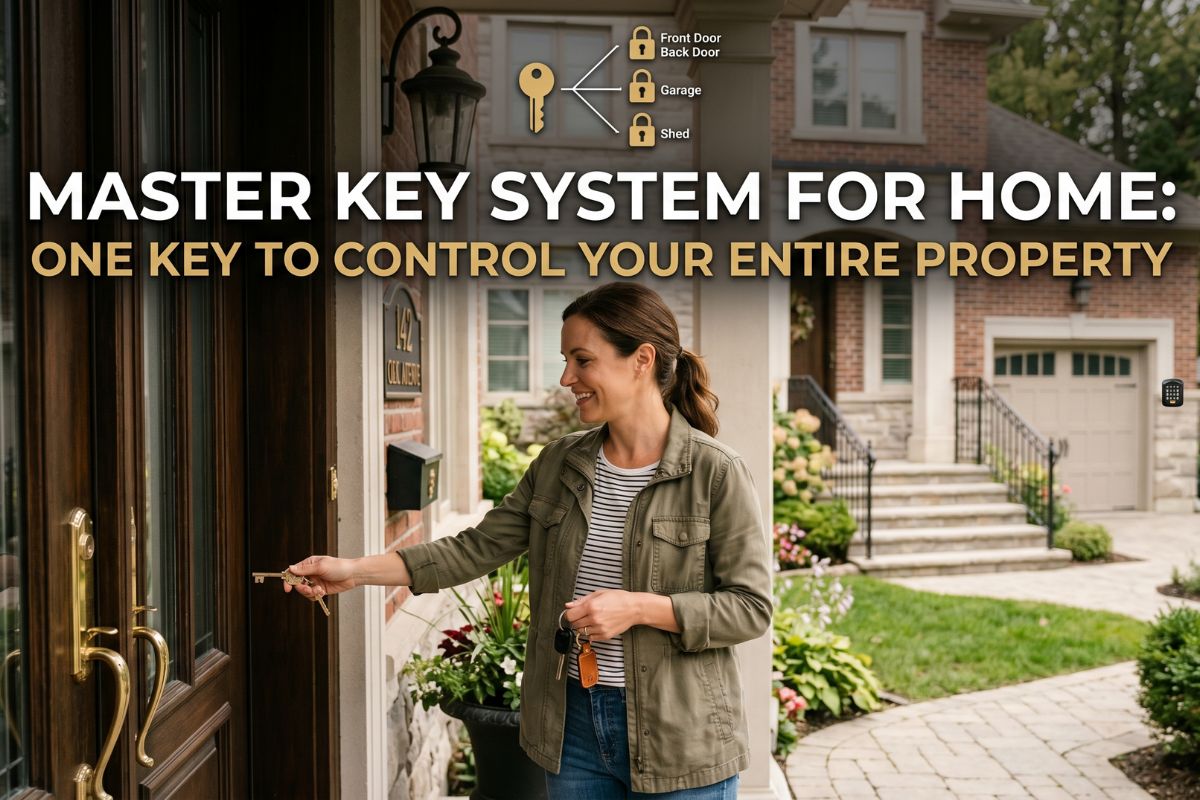
Master Key System for Home: One Key to Control Your Entire Property

Juggling separate keys for the front door, back door, garage entry, and side gate quickly turns into a cluttered keyring and a frustrating daily routine. When one of those keys goes missing, every lock suddenly feels vulnerable, and most Phoenix homeowners eventually ask if there’s a smarter way to manage access across their property. A master key system for home use is exactly that solution, allowing one single key to operate every lock on your home while still permitting individual keys for specific doors. Keep reading to learn how this setup works, how it pairs with modern deadbolt security, and how our professional locksmith team helps Arizona households upgrade without compromising home safety.

What Is a Master Key System and How Does It Work?

A master key system for home use is a carefully pinned lock configuration that allows a single “master” key to open multiple locks, while each lock also accepts its own unique “change” key. Inside each cylinder, the locksmith adds an additional wafer or pin known as a master wafer, creating two valid shear lines instead of one. That small mechanical adjustment is what makes the entire hierarchy possible.

As a professional locksmith team serving Phoenix homes, we see this configuration most often in properties with detached casitas, pool houses, guest suites, or home offices. The homeowner carries one master key that opens every lock on the property, while a housekeeper, nanny, or tenant may carry a change key that only opens specific doors. The result is controlled access without a heavy keyring weighing down your pocket.

The Real Convenience Behind One Key for Your Entire House

Master key system for home Phoenix locksmith

Convenience is the most immediate benefit, but it isn’t the only one. With a unified home master key system, you no longer need to fumble through keys in the dark, label them with colored caps, or keep spare sets hidden in flowerpots. Our technicians have rekeyed hundreds of Phoenix households, and the feedback is consistent: homeowners feel more in control of their property when one key handles everything from the garage side door to the back patio slider.

Beyond daily ease, this approach improves home safety in ways that matter during an emergency. If a family member needs to grab something from the garage or let a trusted neighbor into a guest room, any authorized key works across the property. You can also upgrade the entire system as a single cohesive unit rather than tracking which lock was last serviced.

Master Key Systems vs. Standard Rekeying vs. Smart Locks

Homeowners sometimes confuse a master key system with a simple lock rekey service. The two are related, but not identical. Smart locks add another layer of comparison, since many households are weighing mechanical versus digital options. The table below breaks down the key differences so you can see where a master key system fits into your home security plan.

Feature Master Key System Standard Rekey Smart Lock
One Key for All Doors Yes No Partial (via app)
Tiered Access Levels Yes No Yes
Mechanical Dependability High High Medium
Battery Required No No Yes
Works During Power Outage Yes Yes Limited
Ideal For Multi-Door Homes Excellent Basic Good
Resistant to App/Firmware Issues Yes Yes No
Recommended Hardware Grade Grade 1 / Grade 2 Grade 2 / Grade 3 Grade 2

A master key system delivers the best of both worlds: mechanical dependability combined with tiered access that most smart systems can’t replicate without app dependencies and firmware updates.

Deadbolt Security and the Role of the Thumbturn Lock

A master key system is only as strong as the hardware it’s built into. That’s why we recommend pairing the configuration with Grade 1 or Grade 2 deadbolts on every exterior door. Deadbolt security matters here because a master-keyed cylinder still relies on the bolt to resist kick-ins, prying, and bump attacks.

The thumbturn lock on the interior side of the deadbolt also plays an important role. A solid-metal thumbturn paired with a reinforced strike plate prevents someone from reaching through a broken sidelight window and turning the bolt by hand. When we install a residential master key system in Phoenix, we inspect each thumbturn, strike plate, and door frame before pinning the cylinders, because the mechanical chain is only as strong as its weakest link.

Pro Tip: Plan the Key Hierarchy Before the Locksmith Arrives

After pinning thousands of Phoenix homes, our team has learned that the most successful installations start with a written key map. Before the locksmith arrives, walk through your property and list every door that locks. Next to each door, decide three things: who should have access with a personal change key, which doors the master key must open, and which doors should also accept a secondary “sub-master” for extended family or service providers.

This short exercise prevents rework, keeps cylinder pinning consistent, and ensures the hierarchy matches how your household actually lives. Our certified technicians are also happy to walk through this plan with you during the initial consultation — it’s part of the service we provide for every home security upgrade.

Common Mistakes Homeowners Make

Even a well-designed system can fall short if the basics are overlooked. Two issues we frequently correct in Phoenix homes stand out. First, many properties still use builder-grade locks, and the original hardware installed by most homebuilders is not designed for master keying. We typically replace those cylinders with higher-grade commercial-residential hybrids that hold pinning tolerances correctly.

Second, Arizona properties often have a side gate, pool gate, or shed padlock that gets forgotten during the master-keying process, leaving a weak point in the home safety chain. Our Phoenix locksmith team covers every access point during the audit, including garage man-doors, sheds, and gate padlocks that accept key-in-knob cylinders.

Frequently Asked Questions

Is a master key system for home use as secure as individual locks?
Yes. When installed with Grade 1 or Grade 2 deadbolts and reinforced strike plates, a master key system maintains the same pick and bump resistance as standard residential locks while offering more flexible access control.
Can any existing lock be converted to a master key system?
Most brand-name residential cylinders can be master-keyed, but builder-grade locks often lack the pinning tolerances required. A professional locksmith will inspect your current hardware and recommend replacements where needed.
What happens if I lose the master key?
If the master key is lost, we recommend rekeying the entire system to maintain full home safety. This resets the master and change key combinations so the missing key no longer functions on any door.
Does a master key system work with a thumbturn lock?
Absolutely. The thumbturn lock operates the interior side of the deadbolt and is independent of the keyway. Your master key controls the exterior cylinder while the thumbturn continues to work normally from inside.
How many doors can a single master key open?
A standard residential master key system comfortably handles up to 15 doors. Larger properties with multiple outbuildings, casitas, or guest suites can be scaled up with sub-master keys organized into logical zones.
Do I need a professional locksmith to install it?
Yes. Master keying requires precise cylinder pinning and a written key schedule. A certified locksmith ensures the hierarchy is built correctly and that every lock maintains its intended deadbolt security rating.

Ready to Simplify and Secure Your Home?

One key, one cohesive system, one locksmith partner who understands Arizona homes. If you’re considering a master key system for home access, or simply want a straightforward home security audit, reach out to our certified professional locksmith team. We’ll walk your property, review your current hardware, and design a key hierarchy that fits how your family actually uses the space.

Schedule a consultation with AZ Locksmith & Garage Repair or visit our local Google Maps listing to see verified reviews from Phoenix homeowners who’ve already upgraded their home safety with us.

Mobile locksmith opening a residential front door lock during a home lockout service call in Phoenix AZ

Locked Out in the Phoenix Heat? Here’s What to Do (And Who to Call)

It happens to the best of us. You step outside to grab the mail, the door clicks shut behind you, and suddenly you’re standing in 110-degree Phoenix heat with no keys, no wallet, and no way back inside. Whether it’s your front door, car, or garage, a lockout in the Valley of the Sun isn’t just inconvenient — it can be genuinely dangerous when temperatures spike the way they do here from May through September.

At AZ Locksmith & Garage Repair, we get calls like this every single day. So we put together this quick guide to help Phoenix homeowners and drivers know exactly what to do — and what not to do — when they’re locked out.

Stay Calm and Stay Safe First

Before you do anything else, get out of the sun. Phoenix heat is no joke, and heat exhaustion can set in faster than most people expect. If you’re locked out of your home, move to a shaded area — a porch overhang, a neighbor’s entryway, or inside your vehicle if you have access to it. If you’re locked out of your car in a parking lot, find a shaded area nearby or step into a nearby store.

If you have children or pets locked inside a hot vehicle, call 911 immediately. That is always the first call in that situation — no exceptions.

Don’t Try to Force It

We know it’s tempting. But attempting to force open a locked door — whether it’s your front door, a deadbolt, or your garage — almost always makes the situation worse. Here’s what we see on a regular basis:

  • Bent door frames from people trying to “credit card” a deadbolt (that only works in the movies)
  • Broken door handles from forcing the mechanism
  • Damaged garage door panels from trying to manually override the system without knowing how
  • Locked out permanently after a DIY attempt jams the lock cylinder

What costs $80–$150 for a professional lockout service can turn into a $400–$800 repair job when the wrong tool meets the wrong lock. Save yourself the headache and the money.

Check Your Options Before You Call

Before you call a locksmith, it’s worth doing a quick 60-second check:

  • Back door or side door: Did you leave another entry point unlocked?
  • Garage door keypad: Many Phoenix homeowners have a keypad on the outside of the garage. If you know the code, this is your fastest way in.
  • Spare key with a neighbor: This is exactly why we recommend leaving one with a trusted neighbor.
  • Smart lock app: If you have a smart lock installed, check your phone — you may be able to unlock remotely.

If none of those work, it’s time to call a professional.

What to Expect When You Call a Local Phoenix Locksmith

When you call AZ Locksmith & Garage Repair at (602) 806-7771, here’s what happens:

We’ll ask for your location, the type of lock or entry point you’re dealing with, and a quick description of the situation. We’ll give you an honest estimated arrival time — we serve the greater Phoenix area and work hard to get to you fast, especially during extreme heat situations.

When our technician arrives, they’ll verify your identity and ownership (this is standard practice for any legitimate locksmith — if a company skips this step, that’s a red flag). Then we get to work using professional tools that open the lock without damaging it. In most standard residential lockout situations, you’ll be back inside in under 15 minutes.

A Word About Locksmith Scams in Phoenix

Unfortunately, locksmith scams are real and they’re common in metro areas like Phoenix. Watch out for companies that quote you one price on the phone and then dramatically inflate it at the door, or arrive in unmarked vehicles with no ID. Always ask for a business name, check their Google reviews, and confirm pricing before work begins. AZ Locksmith & Garage Repair is a locally owned Phoenix business with a 5-star rating — you can read our reviews before you ever pick up the phone.

Be Ready Before It Happens Again

Once you’re back inside, take 10 minutes to prevent this from happening again:

  • Hide a spare key with a trusted neighbor (not under the mat)
  • Set up a garage door keypad if you don’t already have one
  • Consider upgrading to a smart lock for keyless entry
  • Save a local locksmith number in your phone — (602) 806-7771

Locked Out in Phoenix? We’re Ready to Help

Whether you’re stuck in Scottsdale, Tempe, Chandler, or right in the heart of Phoenix, AZ Locksmith & Garage Repair is your local, trusted solution for lockouts, garage door issues, and more. We’re real people, based right here in the Valley, and we treat every call like it matters — because to us, it does.

Call us anytime at (602) 806-7771 or visit az-locksmith-garage.com to learn more about our services.

Garage door replacement cost

Garage Door Replacement Cost: Average Prices for a Double Garage Door in Phoenix

Replacing a double garage door in Phoenix typically costs between $800 and $2,500 installed — and knowing exactly what drives that number can save you hundreds of dollars. When a door starts rattling every time the Arizona heat expands its panels, or when a fender-bender leaves a crease that won’t come out, most homeowners jump straight to Google without a clear sense of what fair pricing actually looks like. At AZ Locksmith & Garage Repair, we’ve replaced, installed, and serviced garage doors across the Valley for years, and we’ve put together this honest, line-by-line breakdown so you can make a confident decision before anyone steps on your driveway.

We serve Phoenix homeowners every day from our mobile service fleet — you can find us on Google Maps and read verified customer reviews that reflect our commitment to transparent pricing and reliable work. Whether you’re upgrading for curb appeal, improving home security, or dealing with an outright mechanical failure, this guide covers every cost factor you need to know.

Our garage door services team handles everything from single-panel swaps to full double-door replacements with smart home integration — and we’ll walk you through the numbers before we ever touch a tool.

Understanding the Average Garage Door Replacement Cost

Before we break down individual line items, here’s a realistic snapshot of what Phoenix homeowners pay for a double garage door replacement based on our field experience and current supplier pricing:

Door Type / Material Material Cost Labor Cost Total Installed (Est.)
Steel (Single Layer) $300 – $600 $200 – $350 $500 – $950
Steel (Insulated / Double Layer) $500 – $900 $200 – $400 $700 – $1,300
Steel (Triple-Layer Insulated) $700 – $1,200 $250 – $450 $950 – $1,650
Carriage-Style / Wood-Look Steel $900 – $1,600 $300 – $500 $1,200 – $2,100
Aluminum / Glass Panel $1,000 – $1,800 $300 – $600 $1,300 – $2,400
Wood (Custom) $1,200 – $2,500+ $400 – $700 $1,600 – $3,200+

These figures reflect double-door sizing (typically 16 ft wide × 7 ft tall) with standard installation in the Phoenix metro area. Prices shift based on the factors we detail below — and understanding each one is the key to avoiding surprise invoices.

What Factors Drive Your Garage Door Replacement Cost in Phoenix?

Door Size and Configuration

A double garage door — the most common type in Phoenix neighborhoods — measures 16 feet wide by 7 feet tall. Larger openings (18-ft wide or 8-ft tall “high-lift” configurations) cost more to fabricate and require additional structural hardware. If your home was built with a non-standard opening, expect custom sizing to add $200–$500 to the base price. Our garage door installation team measures every opening precisely before ordering any materials.

Material Selection and Insulation Grade

Steel dominates Phoenix installations for good reason — it resists the warping and cracking that Arizona’s intense UV exposure inflicts on lower-grade materials. However, not all steel doors are equal. Single-layer steel panels offer the lowest upfront cost but no insulation value. In a climate where garage temperatures can hit 150°F in summer, an insulated door (R-value of 9–18) can meaningfully reduce cooling costs in attached garages. Polyurethane-injected triple-layer doors carry the best thermal performance and also reduce noise from the street — a genuine quality-of-life upgrade for Phoenix households near major arterials like I-10 or the 101.

Wood offers unmatched visual warmth and curb appeal, but it demands regular sealing and repainting to survive Phoenix summers. Composite wood-look steel panels offer a practical middle ground that our garage door repair team consistently recommends for homeowners who want the aesthetic without the maintenance burden.

Style and Design Options

Raised-panel steel doors sit at the affordable end of the design spectrum. Carriage-house or barn-style doors — with decorative hinges, windows, and hardware — run $300–$700 more than equivalent plain-panel models. If you’re making a move toward smart home integration, we can pre-plan wiring conduit during installation so a smart garage door opener like a LiftMaster 84501 or Chamberlain B4545T can be added cleanly, either now or in the future.

Hardware: Springs, Tracks, and Rollers

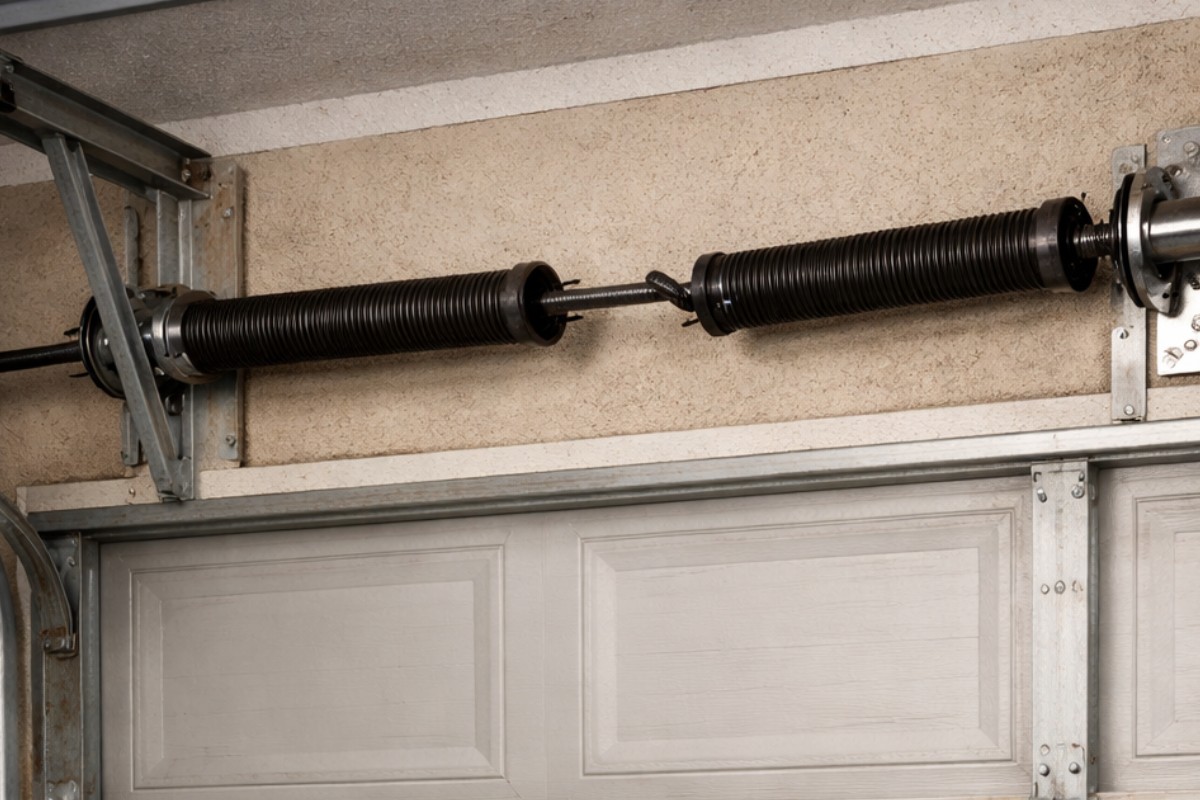
This is where many low-ball quotes hide their true cost. A double garage door replacement that doesn’t include new torsion springs is an incomplete job. Torsion springs bear the full weight of the door and have a rated cycle life (typically 10,000–20,000 cycles). If your existing springs are near end-of-life, installing a new door on old springs is a liability waiting to happen.

⚠️ Safety Warning: Torsion springs are under extreme tension — a broken spring can release hundreds of pounds of force in milliseconds. NEVER attempt to adjust, remove, or replace torsion springs without professional training and proper tools. Every year, DIY spring replacement causes serious injuries across the U.S. Our torsion spring repair technicians are trained and equipped to handle this safely. If your spring breaks, call us — don’t touch it.

New torsion spring sets for a double door run $80–$200 in parts, plus $100–$200 in labor. Tracks, rollers, and cables are typically replaced as a set when doing a full door replacement and add $75–$150 to the total. Our garage door cable repair service addresses these components individually if only partial hardware renewal is needed.

Garage Door Opener: Include It or Not?

A new door pairs naturally with a new opener, especially if yours is more than 10–12 years old. Modern openers from Genie, LiftMaster, and Chamberlain offer Wi-Fi connectivity, battery backup (critical during Phoenix monsoon-season power outages), and integration with Google Home or Amazon Alexa. Budget openers start around $150; mid-range belt-drive units with smart features run $250–$400; commercial-grade or ultra-quiet models top out near $600.

Our garage door opener repair team can assess your current unit and advise honestly whether repair or replacement makes more financial sense for your situation. We work with all major brands and can program new openers to your existing remotes or keypad in most cases.

Removal and Disposal of the Old Door

Disposal of an old double door adds $50–$150 to most quotes. Some contractors include it; some don’t. Ask explicitly before signing anything. At AZ Locksmith & Garage Repair, our quotes include haul-away so you’re not left with a pile of steel panels on your driveway.

DIY vs. Professional Installation: The Real Cost Comparison

We understand the appeal of saving money on labor. But garage door replacement — particularly for a heavy double door — is one of the home improvement projects where DIY creates more risk than reward. Consider the full picture:

  • Torsion spring danger: As noted above, improperly handled springs can cause severe injury. Professional liability and workers’ comp exist for this reason.
  • Structural alignment: A misaligned door binds, wears unevenly, and voids most manufacturer warranties. Getting the tracks perfectly plumb requires experience and calibration tools.
  • Warranty coverage: Most brand warranties (LiftMaster, Clopay, Wayne Dalton) require professional installation to remain valid.
  • Time investment: A crew experienced in residential garage door installation completes a double-door swap in 3–5 hours. First-time DIYers often spend a full weekend — and still need a professional correction visit.
  • Hidden part costs: When you discover mid-installation that you also need a new header bracket, bottom weatherseal, or strut reinforcement, you’re making an emergency hardware run on a Saturday. Professionals carry those parts on the truck.

Our residential garage door services include a written quote, same-day or next-day scheduling across the Phoenix metro, and a warranty on both parts and labor. Visit our service areas page to confirm we cover your neighborhood — we serve Scottsdale, Tempe, Mesa, Glendale, Chandler, Peoria, and surrounding communities.

Additional Cost Factors Phoenix Homeowners Often Overlook

Weatherstripping and Seals

Phoenix dust storms (haboobs) push fine particulate under and around garage doors relentlessly. A full perimeter weatherseal replacement costs $50–$120 and is well worth including in a door replacement project. Our repair team always inspects existing seals during installation and replaces them when worn.

Structural Repairs to the Opening

If your existing header or jamb framing shows rot, insect damage, or deterioration from years of water intrusion (even in Phoenix, monsoon season takes a toll on improperly flashed openings), that framing must be addressed before a new door goes in. Wood repairs to a garage opening run $150–$400 depending on extent. We flag these issues during our pre-installation inspection rather than discovering them mid-job.

Permits

The City of Phoenix generally does not require a permit for a like-for-like garage door replacement unless structural modifications are involved. However, if you’re widening the opening or changing the door type significantly, a permit may be required. We navigate this on your behalf and pull any necessary permits as part of our service.

Smart Home and Security Upgrades

Many Phoenix homeowners pair a door replacement with a home security upgrade — adding a garage keypad, a camera-integrated opener, or a dedicated smart lock on the door-to-home entry. These additions typically cost $100–$350 and meaningfully improve home security beyond the garage door itself.

How to Get an Accurate Quote — and Avoid Getting Overcharged

Three practices protect you when soliciting garage door replacement quotes in Phoenix:

  1. Get itemized quotes. A reputable contractor will break out door cost, hardware cost, opener cost (if applicable), labor, and disposal separately. A lump-sum number with no line items is a warning sign.
  2. Ask about brand and model. “Steel insulated door” is not a specification. Ask for the manufacturer name, model number, R-value, and gauge of steel. You should be able to look it up yourself before you agree.
  3. Verify licensing and insurance. Arizona requires licensed contractors for garage door work. Ask for the ROC (Registrar of Contractors) number and verify it at the Arizona ROC website. Our team is fully licensed, bonded, and insured — details available on our about page.

We also recommend checking a company’s Google review profile before calling. Our listing at Google Maps shows verified reviews from real Phoenix homeowners who have used our garage door services — read what they say about our technicians, our pricing transparency, and our response time.

Frequently Asked Questions About Garage Door Replacement Cost

How much does a double garage door replacement cost in Phoenix?

Most Phoenix homeowners pay between $800 and $2,500 for a full double garage door replacement installed — including removal of the old door. The exact number depends on the material (steel, wood, aluminum), insulation grade, style, hardware condition, and whether you’re also replacing the opener. We provide itemized quotes so there are no surprises on installation day.

Is it cheaper to repair or replace a garage door?

Repair makes sense for isolated issues — a broken torsion spring, a damaged panel, or a worn roller. Replacement becomes the better investment when the door has multiple failing components, significant rust or structural damage, or when it’s simply beyond its useful life (typically 15–30 years depending on material). Our technicians will give you an honest assessment of repair vs. replacement cost before recommending either path.

How long does garage door installation take?

A standard double-door replacement — including removal of the existing door, installation of the new door, hardware, and springs — takes our crew approximately 3 to 5 hours. If we’re also installing a new opener, add 1 to 2 hours. We work efficiently and clean up before we leave so your garage is fully operational the same day.

What is the best garage door material for Phoenix weather?

Insulated steel is our top recommendation for Phoenix homeowners. It withstands extreme UV exposure and temperature swings without warping, requires minimal maintenance, and provides meaningful thermal insulation that helps manage garage temperatures during summer. For homeowners prioritizing aesthetics, carriage-style steel doors with a polyurethane core offer both beauty and durability in our desert climate.

Do I need a permit to replace my garage door in Phoenix?

For a standard like-for-like garage door replacement, the City of Phoenix typically does not require a permit. However, if structural modifications are involved — such as widening the opening or altering the header — a permit may be necessary. We assess permit requirements during our pre-installation review and handle the paperwork on your behalf when needed.

Does a new garage door add value to my home?

Yes — consistently. According to Remodeling Magazine’s annual Cost vs. Value Report, garage door replacement has one of the highest return on investment percentages of any home improvement project, routinely recovering 90–100% of costs at resale. In Phoenix’s competitive real estate market, improved curb appeal from a new door can meaningfully reduce days on market and support listing price.

Can you install a smart garage door opener at the same time?

Absolutely. We install and program smart openers from LiftMaster, Chamberlain, Genie, and other leading brands. Wi-Fi-enabled openers let you monitor and control your garage door from your phone, integrate with existing smart home systems, and receive alerts if the door is left open. We handle the full installation and setup so you leave with a working smart garage on day one.

Are your technicians licensed and insured in Arizona?

Yes. AZ Locksmith & Garage Repair is fully licensed, bonded, and insured in the state of Arizona. Our technicians carry current credentials and complete ongoing training on the latest door systems and opener technology. We also verify identification on every service call and provide written quotes before any work begins.

What You Should Expect to Pay — and Who to Call

Garage door replacement cost in Phoenix is real and manageable — once you know what drives it. Materials, insulation, hardware, labor, and any opener or smart-home additions all factor into the final number, and the range is wide enough that the right door for your home and budget absolutely exists within it. The mistake we see most often is homeowners either going with the cheapest quote without scrutinizing what’s included, or delaying a replacement until a failed spring or collapsed panel becomes a weekend emergency.

If your door is showing its age, rattling through every Phoenix windstorm, or simply looking tired against the rest of your home’s facade, now is a good time to get an honest assessment. Our garage door services team is ready to walk you through your options with no pressure and a written quote you can compare against any other bid you receive. We also recommend reading our related guide on garage door repair vs. replacement — it covers the exact decision criteria we use in the field to help homeowners choose correctly.

We’re licensed, bonded, and insured in Arizona. Our technicians arrive in marked vehicles, carry photo ID, and follow strict professional standards on every job. Verified customer reviews from Phoenix-area homeowners are posted publicly on our Google Business listing — we encourage you to read them before calling anyone.

Ready to get started? Contact AZ Locksmith & Garage Repair today to schedule your free on-site estimate. Same-day and next-day appointments are available throughout Phoenix, Scottsdale, Mesa, Tempe, Glendale, Chandler, and surrounding communities. Call us, fill out our online form, or find us on Google Maps — whichever is easiest for you. We’re ready when you are.

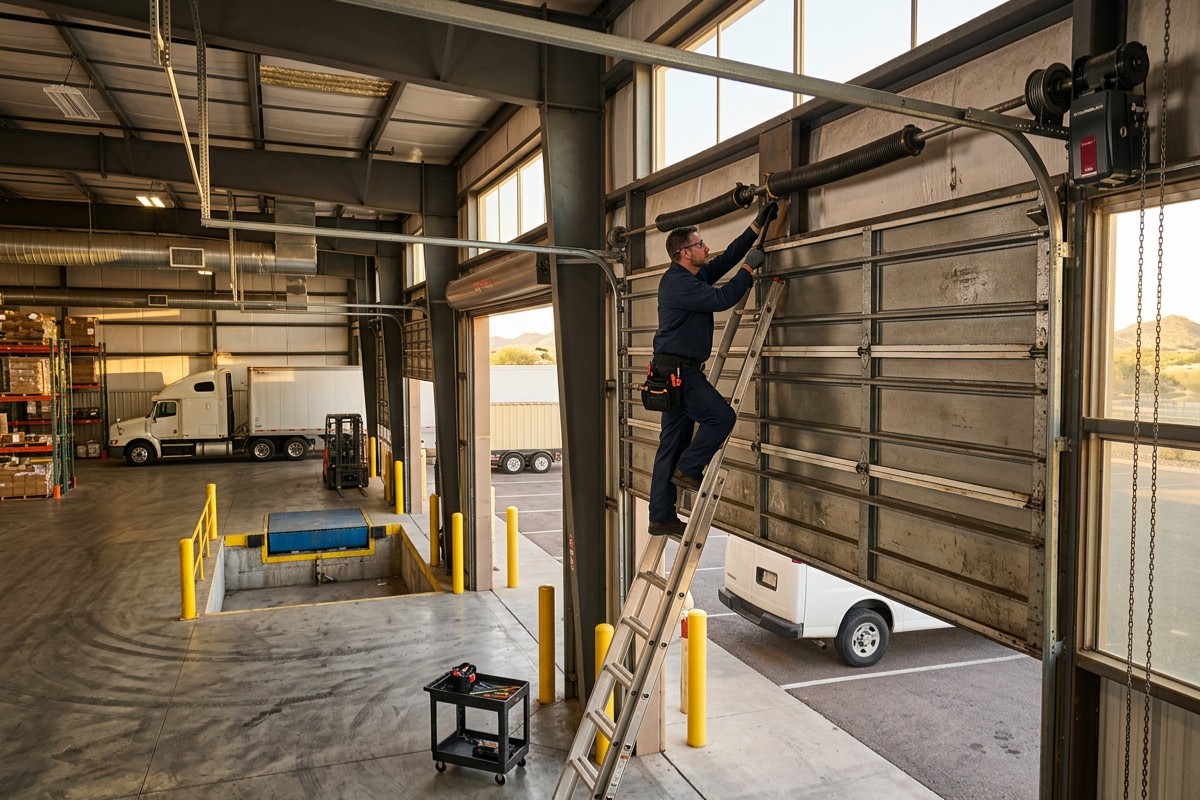
Mobile technician repairing a commercial overhead garage door at a warehouse facility in Phoenix AZ

Commercial Garage Door Repair in Phoenix AZ

A commercial garage door that fails mid-shift doesn’t just cause inconvenience — it stops operations, creates a security gap, and in loading dock or cold storage environments, every hour of downtime has a direct cost. Commercial overhead doors, rolling steel doors, and loading dock systems operate under load cycles that residential hardware isn’t designed for, and the failure modes are correspondingly different. Diagnosing the right component before ordering parts is what determines whether the repair takes one visit or three.

Phoenix conditions accelerate commercial door wear in specific ways. Industrial and warehouse environments in the Phoenix metro regularly see interior temperatures above 120°F in summer, which degrades rubber seals, dries out track lubrication, warps aluminum and steel components under repeated thermal stress, and shortens the cycle life of torsion springs and operator motors. A commercial door running 20–40 cycles per day in a Phoenix warehouse accumulates stress at a rate most manufacturers’ service schedules don’t account for.

Our mobile technicians at AZ Locksmith & Garage Repair respond to commercial door failures across Phoenix day and night, seven days a week. We carry commercial-grade hardware for overhead doors, rolling steel systems, and operator units on every truck. See our location and read reviews on Google Maps before you call — most commercial jobs are assessed and quoted within the first 20 minutes on site.

Every commercial repair starts with a written quote for your review and approval before any work begins. No hidden fees, no surprise line items. We identify the failed component, explain the repair path, and give you the full cost upfront.


Commercial Door Failures Phoenix Businesses See Most

Torsion spring failure is the most common commercial door repair call we receive. Commercial torsion springs are wound to higher torque ratings than residential springs to handle heavier door weights — a standard commercial steel door weighs 300–600 lbs depending on size and insulation. In Phoenix, the combination of high cycle counts and extreme heat shortens commercial spring life significantly. A spring rated for 25,000 cycles under normal conditions may reach failure in 3–4 years on a high-traffic Phoenix loading dock.

Operator motor failure is the second most common call. Commercial door operators — jackshaft, trolley, or hoist-style depending on the door configuration — run under sustained load in high-temperature environments. The motor windings, capacitors, and circuit boards in a standard commercial operator degrade faster at 120°F+ than at the 70°F ambient temperature the unit was tested at. Intermittent operation, slow door movement, and complete motor failure are all common presentations.

Track misalignment and roller failure appear frequently in high-cycle commercial environments. Commercial door rollers are steel rather than nylon, and the tracks are heavier gauge — but both accumulate wear faster when the door is cycling 30+ times per day without scheduled lubrication maintenance. A misaligned track or worn roller that would take years to cause a problem on a residential door can disable a commercial door within weeks under warehouse use conditions.

Bottom seal and weatherstrip failure is a maintenance issue that becomes an operational problem in Phoenix specifically. Commercial door seals keep conditioned air inside refrigerated or climate-controlled facilities. When the rubber degrades in the heat and the seal fails, HVAC costs spike immediately. We replace commercial bottom seals and side weatherstripping as a standalone service or as part of a broader repair visit.


Commercial Door Types We Service in Phoenix

Sectional overhead doors are the most common commercial door type in Phoenix warehouses, distribution centers, and retail service bays. They operate on the same torsion spring and cable system as residential doors, scaled up for heavier panels and higher cycle requirements. Our garage door torsion spring service covers commercial spring replacement at the correct torque specifications for your door weight and height.

Rolling steel doors — also called coiling doors or roll-up doors — use a steel curtain that coils around a barrel above the opening rather than operating on a track system. These doors are common in commercial storage units, fire stations, and retail storefronts. Failure modes include broken spring tension on the barrel, curtain damage from impact, hood misalignment, and operator motor failure. We carry replacement slats, springs, and operator hardware for standard rolling steel configurations.

High-speed doors are increasingly common in Phoenix distribution and cold-chain facilities where cycle frequency and seal integrity are critical. These doors operate at higher speeds and use different drive systems than standard commercial doors — fabric curtains on high-speed drums with soft-stop sensors and variable frequency drives on the operator motor. Repairs on high-speed systems require familiarity with the specific manufacturer’s drive configuration.

Our garage door track, roller, and cable service covers the mechanical components across all three door types. For operator and electrical system repairs, our opener installation and repair service covers both residential and commercial operator units.


Quick Diagnosis — What Your Commercial Door Is Telling You
Symptom Likely Cause What a Pro Checks
Door stuck open — won’t close Operator failure or limit switch fault Operator motor, limit switch calibration, safety sensor alignment
Door stuck closed — won’t open Broken torsion spring or operator motor failure Spring condition, motor response, cable and drum integrity
Door moves slower than normal Spring losing tension or operator motor degrading Spring tension, motor amperage draw, track lubrication
Loud grinding or metal-on-metal noise Worn rollers or dry track Roller wear pattern, track lubrication, hinge condition
Door reverses before fully closing Safety sensor obstruction or limit switch misset Sensor alignment, lens condition, close limit adjustment
Visible gap at bottom when door is closed Bottom seal worn or floor threshold damaged Seal condition, door level, threshold alignment

What a Commercial Repair Call Looks Like

When an AZ Locksmith & Garage Repair technician arrives at your Phoenix business, the assessment follows a structured sequence designed for commercial environments — not a residential checklist applied to a bigger door.

First we identify the operational impact: is the door stuck open, stuck closed, or intermittently failing? A door stuck open is a security and environmental emergency — that gets addressed before anything else. A door stuck closed with product or vehicles trapped inside is an operational emergency. Intermittent failures allow for a more methodical diagnostic approach.

From there we inspect the full mechanical system: spring condition and tension, cable and drum integrity, roller and track wear, operator motor response, limit switch calibration, and safety sensor function. Commercial door systems have more interdependencies than residential systems — a misaligned track affects spring tension, which affects motor load, which affects operator lifespan. We trace the failure to its root cause before recommending parts.

After the inspection we provide a written quote covering all required repairs, with line items for parts and labor. You approve the quote before any work begins. Most standard commercial repairs — spring replacement, operator repair, track realignment — are completed in a single visit. Panel replacement or custom hardware orders may require a second visit for installation.

For ongoing commercial accounts, we can establish a preventive maintenance schedule — typically quarterly inspections covering lubrication, spring tension check, cable condition, roller wear, and operator calibration. Preventive maintenance on a high-cycle Phoenix commercial door costs significantly less than the emergency repair and downtime it prevents.


Frequently Asked Questions

How long do commercial garage door springs last in Phoenix? +
Commercial torsion springs are typically rated for 25,000–100,000 cycles depending on wire gauge and coil diameter. On a Phoenix loading dock running 20–30 cycles per day in sustained heat, a 25,000-cycle spring can reach failure in 3–4 years. Higher-cycle springs cost more upfront but significantly reduce replacement frequency and unplanned downtime on high-traffic doors.
Can you repair our commercial door the same day? +
Most standard commercial repairs — spring replacement, operator repair, track realignment, roller replacement — are completed same-day with parts already on the truck. Custom panel orders or specialty hardware for high-speed or custom-size doors may require a second visit for installation. Call (602) 806-7771 and describe the failure — we’ll confirm parts availability before we dispatch.
Do you provide written quotes for commercial repairs? +
Yes — always. We provide a written quote with line items for parts and labor after the on-site inspection and before any work begins. No work starts without your written approval. This applies to all commercial calls regardless of urgency or job size.
Do you offer preventive maintenance for commercial doors? +
Yes. For high-cycle commercial doors in Phoenix, quarterly preventive maintenance covering lubrication, spring tension check, cable and roller inspection, and operator calibration is the most cost-effective way to avoid emergency repairs and unplanned downtime. Contact us to set up a maintenance schedule for your facility.
What commercial door brands and operator systems do you service? +
We service all major commercial door brands including Clopay, Amarr, Wayne Dalton, CHI, and Cornell, and operator systems including LiftMaster, Chamberlain, Genie, Linear, and Dorma. Call (602) 806-7771 with your door model and operator brand — we’ll confirm compatibility and parts availability before dispatch.
Are you available for after-hours commercial emergencies? +
Yes. We are available Monday through Sunday from 7:00 AM to 9:30 PM for both scheduled repairs and emergency calls. A commercial door stuck open overnight is a security emergency — call (602) 806-7771 and we will dispatch the closest available technician to your Phoenix location.

Keep Your Business Moving

A commercial door failure in Phoenix doesn’t resolve itself — and every hour a loading dock or service bay is out of operation has a measurable cost. The right call is a same-day inspection and written quote from a technician who knows commercial door systems, not a residential crew applying residential solutions to a 400-lb steel door.

AZ Locksmith & Garage Repair serves Phoenix businesses from our base at 9830 S 51st St, B-122 in Ahwatukee, with mobile technicians available day and night, seven days a week. We carry commercial-grade springs, operator components, and track hardware on every truck.

Call (602) 806-7771 to request service. Visit our contact page for non-urgent scheduling, or see our full garage door services menu for the complete scope of what we cover. Our about page has more on how our team operates and what to expect on a service call.

Mobile locksmith opening a residential front door lock during a home lockout service call in Phoenix AZ

Home Lockout Service in Phoenix AZ

Being locked out of your house in Phoenix means one thing: you need a mobile locksmith who can reach you, verify your identity, and get you inside without damaging your door or lock hardware. The method a trained locksmith uses depends on the lock type — a standard pin tumbler deadbolt, a smart lock with a dead battery, or a high-security cylinder all require different techniques. Forcing entry without the right approach damages the lock, the strike plate, and sometimes the door frame itself.

Phoenix adds one layer of urgency that most cities don’t: heat. Standing outside in 110°F+ summer temperatures for an extended period is a genuine health risk, not just an inconvenience. A lockout at 2pm in July is a situation that warrants the same response urgency as a midnight emergency.

Our mobile locksmiths at AZ Locksmith & Garage Repair serve Phoenix homeowners day and night, seven days a week. We dispatch from our base in the Ahwatukee area and cover the full Phoenix metro. Find us on Google Maps and see reviews from Phoenix homeowners who have used our lockout service. We provide a written quote before any work begins and require ID verification before opening any door — no exceptions.

Every lockout call starts with identity confirmation. We verify that you are the resident or authorized occupant before proceeding. This protects you as much as it protects your neighbors — a locksmith who opens doors without verification is a security liability, not a service provider.


What Happens During a Home Lockout Call

The process from your call to your door opening follows a consistent sequence regardless of lock type or time of day.

When you call, we confirm your address, your location relative to the property, and the lock type if you know it. This lets us dispatch the right technician with the right tools already loaded. A standard residential deadbolt requires different picks and tension wrenches than a Schlage Primus, a Medeco, or a smart lock with a failed electronic module.

On arrival, the technician asks for photo ID and proof of residency — a utility bill, lease agreement, or piece of mail with your name and address. This verification step is non-negotiable and takes less than two minutes. After verification, the technician assesses the lock and selects the entry method that causes zero damage to the hardware — picking, bypass, or in rare cases with severely damaged locks, controlled drilling with immediate replacement.

After entry, we inspect the lock to confirm it’s functioning correctly and hasn’t been compromised during the lockout. If the lock needs to be rekeyed — which we recommend any time a lockout involved a lost or stolen key — we can handle that in the same visit. See our rekey house locks service for details on what rekeying covers and when it’s the right call versus a full lock change.


Common Lockout Scenarios in Phoenix — and What Each Involves

Left keys inside on the way out. The most common scenario. The lock is intact, the door is closed, and the key is visible on the counter. Standard pick entry or bypass — 10–20 minutes from arrival.

Key broken in the lock. A broken key jammed in the cylinder prevents normal lock function and blocks entry. Extraction requires specific broken key extractors and, depending on how deep the fragment is and whether the pins have been damaged, may require the cylinder to be removed and replaced. We carry replacement cylinders for all major residential lock brands.

Smart lock with dead battery. Most smart locks have a mechanical key override or an external battery terminal that accepts a 9V battery to power the electronics temporarily. If neither is available or functional, entry through the mechanical bypass or adjacent entry point is the next step. Our locksmiths are trained on all major smart lock platforms including Schlage Encode, Kwikset Halo, and Yale. See our smart lock deadbolt installation service if you want to upgrade to a lock with a more reliable backup access method after your lockout is resolved.

Lock damaged or malfunctioning. Sometimes a lockout happens because the lock itself has failed — a worn cam, a seized tailpiece, or a latch that won’t retract. In these cases entry and lock replacement happen in the same visit. We carry handleset and deadbolt hardware and high-security lock options on every truck for immediate replacement.


Quick Diagnosis — What Your Situation Calls For
Situation Likely Solution What the Tech Does
Left keys inside, door locked Pick entry or bypass ID verification, non-destructive lock entry, 10–20 min
Key broken inside cylinder Broken key extraction Extractor tools, cylinder inspection, replacement if pins damaged
Smart lock — dead battery External power or mechanical bypass 9V terminal test, mechanical key override, platform-specific bypass
Lost or stolen key Entry + rekey same visit Open door, rekey cylinder to new key — old key no longer works
Lock seized or malfunctioning Entry + lock replacement Diagnose failure point, replace deadbolt or handleset same visit
High-security lock — Medeco or Schlage Primus Specialized pick or controlled bypass High-security cylinder techniques, longer service time, ID required

What to Do While You Wait

A few steps make the lockout process faster and safer while you wait for the technician.

Stay in a shaded area or your vehicle with the AC running — Phoenix heat is not a minor factor, and heat exhaustion can develop within 30 minutes of standing in direct sun above 110°F. If you have a neighbor you trust, waiting inside with them is the best option.

Locate your ID and any proof of residency before the technician arrives. A driver’s license plus one piece of mail or a lease document is sufficient. Having this ready saves 5–10 minutes on arrival.

Do not attempt to pick the lock yourself with improvised tools. Hairpins and credit cards are depicted as effective in movies — in reality they damage the pin stacks and cylinder tolerances, which can turn a straightforward pick entry into a cylinder replacement. Do not attempt to remove the door hinges — this rarely works on a properly installed exterior door and damages the frame.

If you believe your home has been broken into rather than that you’ve simply locked yourself out, call the police before calling a locksmith. We will not enter a property where a break-in is suspected until law enforcement has cleared the scene.


Frequently Asked Questions

How long does it take for a locksmith to arrive in Phoenix? +
Response time depends on your location and current technician availability. We dispatch from the Ahwatukee area in south Phoenix, so response is typically faster in the south valley. Call (602) 806-7771 and we’ll give you an honest estimated arrival time based on where our closest available technician is at that moment.
What ID do I need for a home lockout? +
A government-issued photo ID plus one piece of proof of residency — a utility bill, lease agreement, piece of mail, or mortgage statement with your name and the property address. If you’re a tenant and your name isn’t on the lease yet, contact your landlord or property manager who can authorize access. We cannot open a door without completed verification regardless of circumstances.
Will a locksmith damage my lock or door? +
A trained locksmith using proper technique should cause zero damage to a standard residential lock. Pick entry and bypass methods are non-destructive by design. Drilling is a last resort used only when a lock is severely damaged or seized and cannot be opened any other way — and in that case the lock is replaced in the same visit. We will not attempt entry with a method that risks damaging your hardware without explaining the situation and getting your approval first.
Should I rekey my locks after a lockout? +
If your lockout happened because you lost your keys or had them stolen, yes — rekeying is the right call. Rekeying reconfigures the pin tumblers inside the cylinder so the old key no longer works, at a fraction of the cost of replacing the entire lock. If you simply locked yourself out with your key still inside, rekeying is optional. We can handle rekeying in the same visit as the lockout service.
How much does home lockout service cost in Phoenix? +
We provide a written quote before any work begins — you’ll know the full cost before we touch the lock. Cost varies based on lock type, time of day, and whether additional services like rekeying or lock replacement are needed. Call (602) 806-7771 for a phone estimate based on your specific situation.
Do you service the whole Phoenix metro area? +
Yes. We cover the full Phoenix metro including Ahwatukee, Tempe, Chandler, Gilbert, Scottsdale, Glendale, and surrounding areas. Our base is in south Phoenix at 9830 S 51st St, so response times are typically fastest in the south valley, but we dispatch across the entire metro seven days a week from 7:00 AM to 9:30 PM.

What to Do Right Now

If you’re locked out in Phoenix right now, call (602) 806-7771. Our mobile technicians are available Monday through Sunday from 7:00 AM to 9:30 PM and respond to lockout calls across the full Phoenix metro.

AZ Locksmith & Garage Repair dispatches from 9830 S 51st St in the Ahwatukee area — south Phoenix coverage is our fastest response zone, but we serve the full city. We provide a written quote before any work begins, require ID verification before opening any door, and carry replacement hardware on every truck for same-visit lock changes or rekeying if needed.

Visit our home lockout service page for more on what the service includes, or go to our contact page to send a message if your situation is not urgent.

Garage Door Spring Repair in Phoenix AZ

Garage Door Spring Repair in Phoenix AZ

When a garage door spring snaps in Phoenix, the door becomes dead weight — the opener motor alone cannot lift it, and forcing it risks damaging the trolley carriage, bending the track, and burning out the motor within a few cycles. The spring is the load-bearing component of the entire system, and a failure almost always requires same-day repair to restore safe operation.

Phoenix homeowners face accelerated spring failures compared to the national average for one specific reason: thermal cycling. Summer temperatures inside an uninsulated garage routinely exceed 130°F, causing the steel coils to expand and contract with every degree of temperature change. That daily expansion and contraction creates micro-stress fractures inside the coil that accumulate invisibly — until the spring snaps without warning, often with a sound like a gunshot, while the car is parked inside or the door is mid-travel.

Our mobile technicians at AZ Locksmith & Garage Repair respond to spring failures across Phoenix day and night, seven days a week. We arrive with torsion springs sized for all standard residential door heights and weights, and we provide a written quote for your review and approval before any work begins — no surprises, no hidden fees. See our location and read reviews from Phoenix homeowners on Google Maps before you call.

Every spring repair starts with a full inspection of the spring system, cables, drums, and bearing plates — not just the broken coil. A spring rarely fails in isolation, and identifying related wear before it becomes a secondary failure is what separates a one-visit repair from a callback.


Why Phoenix Destroys Garage Door Springs Faster Than Anywhere Else

Torsion springs are rated by cycle count — the number of times the door opens and closes before the spring reaches the end of its designed lifespan. A standard builder-grade spring is rated for 10,000 cycles. In a moderate climate, with a household averaging 4 door cycles per day, that works out to roughly 7 years of service life.

In Phoenix, that math breaks down. The issue isn’t just use frequency — it’s the thermal environment the spring lives in. Steel expands when heated and contracts when cooled. In Phoenix, the delta between a 115°F summer afternoon and a 70°F desert night is roughly 45 degrees. Every day, the spring coil goes through that expansion and contraction cycle on top of its operational wind and unwind cycles. The stationary cone — the fixed anchor point of the torsion spring — is where this combined stress concentrates, and it’s where the vast majority of Phoenix spring failures originate.

Lubrication failure compounds the problem. Garage door springs require periodic lubrication to reduce friction between coil windings during operation. At 130°F, standard spring lubricant breaks down significantly faster than manufacturer service intervals assume. A dry spring in Phoenix generates more internal friction with every cycle, accelerating the micro-fracture process and shortening the effective service life by years.

What this means practically: a builder-grade 10,000-cycle spring installed during home construction in Phoenix may reach failure in 4–5 years rather than 7. If your home was built more than 5 years ago and the springs have never been replaced, they are likely operating well past their safe service life.


Torsion Springs vs. Extension Springs — What Your Phoenix Home Has

Most Phoenix homes built after the early 1990s use a torsion spring system: one or two springs mounted on a steel shaft centered above the door opening, connected via cables to drums on each end of the shaft. The spring stores energy by winding as the door closes and releases it as the door opens, doing the majority of the lifting work. When a torsion spring fails, the broken coil stays on the shaft — contained and visible as a gap in the coil.

Older homes and lighter single-car doors in Phoenix sometimes use extension springs: two springs mounted horizontally along the upper tracks on each side, stretching as the door closes and contracting as it opens. Extension springs are less expensive but more dangerous when they fail — without a properly installed safety cable running through the spring center, a broken extension spring can become a projectile.

Our garage door torsion spring installation and replacement service covers both types. We stock high-cycle springs rated for 25,000–30,000 cycles — the correct specification for Phoenix’s thermal environment — and we’ll confirm which system your door uses when you call.

Never attempt to remove or wind a torsion spring yourself. A fully wound torsion spring stores enough mechanical energy to cause severe injury or death if a winding bar slips or the spring is disturbed without proper equipment and technique.


Quick Diagnosis — What Your Door Is Telling You
Symptom Likely Cause What a Pro Checks
Loud bang, door won’t move Torsion spring snapped Spring integrity, visible gap in coil, cable tension, drum alignment
Door opens a few inches then stops Opener safety limit triggered by spring load Spring condition, opener force settings, motor thermal state
Door crooked — one side lower One spring failed in dual-spring system Both springs — replace as a matched pair
Door feels extremely heavy manually Spring losing tension near end of life Remaining spring cycles, cable drum wear, balance test
Visible gap in spring coil above door Spring already broken Full spring replacement, safety cable and drum inspection
Cables hanging loose on both sides Spring failure caused cables to unspool Spring, cable, drum, and bearing plate — full system check

What the Spring Repair Process Looks Like

When an AZ Locksmith & Garage Repair technician arrives at your Phoenix home, the repair follows a structured sequence — spring replacement is never just a parts swap.

The first step is a full system assessment: spring type, wire diameter, coil count, drum condition, cable integrity, bearing plate wear, and bottom bracket condition. This takes 10–15 minutes and determines whether the repair is isolated to the spring or whether cables, drums, or other hardware need attention in the same visit. We provide a written quote at this point — you approve the work before anything is touched.

Spring removal is performed using proper winding bars to safely unwind the remaining tension in the broken spring before the hardware is disturbed. The replacement spring — sized to your door’s weight and height — is installed on the shaft, tensioned to the correct wind count, and the cables are re-tensioned to match.

After installation, we run a balance test: the door is released at mid-travel and should hold position without drifting up or down. An unbalanced door means the spring wind count needs adjustment. We then verify the opener’s force calibration settings, since a new spring changes the load profile the motor operates against.

If the garage door track, rollers, or cables took any damage during the spring failure — which happens when the door drops unevenly — we address those in the same visit. Most Phoenix spring repairs are completed in 45–75 minutes. You can also see the full scope of our garage door repair services and our opener installation and repair options if the spring failure caused opener damage.


Frequently Asked Questions

How do I know if my garage door spring is broken? +
The most common signs are a loud bang from the garage followed by a door that won’t move, a visible gap in the spring coil above the door, or cables hanging loose on one or both sides. The opener may still run but the door will only move a few inches before the motor’s safety limit stops it. Do not force the door open manually — without spring tension, the full weight rests on the track and hardware.
Can I use my garage door opener with a broken spring? +
No. Running the opener without spring tension forces the motor to lift 150–300 lbs of dead weight, which overloads the drive gear, triggers the thermal cutoff, and can burn out the motor within a few cycles. Most modern openers will stop the door after a few inches as a safety measure — this is the system working correctly. Leave the door in place and call for service.
How long do garage door springs last in Phoenix? +
Builder-grade springs rated for 10,000 cycles typically last 4–6 years in Phoenix with average daily use. High-cycle springs rated for 25,000–30,000 cycles can reach 15–20 years under the same conditions. Arizona’s extreme heat and daily thermal cycling accelerate metal fatigue significantly faster than the same hardware performs in cooler climates.
Should I replace both springs if only one broke? +
Yes. Both springs have accumulated the same number of cycles and lived through the same thermal stress. If one failed, the other is at the same risk level and will likely fail within weeks or months. Replacing both together costs less than two separate service calls and keeps the door lifting evenly from day one.
What does garage door spring repair cost in Phoenix? +
Cost depends on spring type, wire gauge, cycle rating, and whether one or both springs need replacement. We provide a written quote before any work begins — call (602) 806-7771 and describe what you’re seeing and we’ll give you an estimate before we dispatch. There are no hidden fees and no work starts without your written approval.
Do you service all garage door brands? +
Yes. Our technicians carry springs sized for all standard residential door heights and weights and work on all major brands including Clopay, Amarr, Wayne Dalton, and CHI. Call (602) 806-7771 with your door model if you have it — we’ll confirm parts availability before we dispatch.
How long does spring repair take? +
A standard torsion spring replacement — single or dual — takes 45–75 minutes on most Phoenix residential doors. If cables or drums also need attention, add 20–30 minutes. We carry all standard spring sizes on every truck to complete most jobs in a single visit.

Before You Touch That Spring

A broken torsion spring is one of the few garage door repairs where the risk of DIY is severe enough that no qualified technician will recommend attempting it without proper training and equipment. The right next step is a same-day inspection and written quote — not a parts order.

AZ Locksmith & Garage Repair serves Phoenix homeowners from our base at 9830 S 51st St, B-122 in the Ahwatukee area, with mobile technicians available day and night, seven days a week. We stock high-cycle torsion springs on every truck and provide a written quote before any work begins — no pressure, no hidden fees.

Call (602) 806-7771 to request service. You can also visit our contact page or learn more about our team on our about page. We’re available Monday through Sunday, 7:00 AM to 9:30 PM.