The Benefits of Ultra-Quiet Belt Drive Openers: A Complete Guide to a Quiet Garage Door Opener

Most homeowners don’t realize their garage door opener is disturbing the whole house until a baby is asleep, someone is on a work call, or a neighbor knocks on the door at 7 a.m. The relentless rattling of a chain drive opener is one of the most common — and most tolerated — noise complaints in residential settings. Belt drive garage door openers eliminate this problem entirely, delivering smooth, whisper-level operation that modern households require. Read on to discover how this technology works, why it matters for home safety, and what a complete garage security setup actually looks like.

What Makes a Belt Drive Opener Different From a Chain Drive?

Traditional chain drive openers use a metal chain — similar in structure to a bicycle chain — to move the trolley that raises and lowers the door. The metal-on-metal contact creates vibration that travels through the ceiling, walls, and framing of the home. For attached garages, this means every operation sends a wave of mechanical noise directly into the living space.

A quiet garage door opener based on belt drive technology replaces the metal chain with a reinforced rubber or fiberglass belt, often with embedded steel cord for tensile strength. The result is a drive system with no metal contact points in the belt itself — which is where virtually all chain drive noise originates.

Leading manufacturers like LiftMaster and Chamberlain engineer their belt drive units with vibration-isolation mounting systems built into the motor head. This decouples the motor’s mechanical movement from the ceiling structure, cutting down on noise transmitted through framing into adjacent rooms. The combination of a smooth belt and an isolated motor makes belt drive units the quietest garage door opener technology currently available for residential use.

Garage Door Opener Types — Feature Comparison

Feature Belt Drive Chain Drive Screw Drive
Noise Level Lowest High Moderate
Vibration Transmission Minimal High Moderate
Maintenance Required Low Medium (lubrication) Low–Medium
Durability High High Moderate in extreme heat
Best For Attached garages, bedrooms above Detached garages, heavy doors Moderate climates
Smart Home Compatibility Full (most models) Partial Partial
Phoenix Climate Performance Excellent Excellent Reduced — heat expands screw
Vibration Isolation Option Available Limited Limited
Typical Lifespan 10–15+ years 10–15 years 8–12 years

Why a Quiet Garage Door Opener Is a Home Safety Asset

A belt drive opener is more than a comfort upgrade — it’s a meaningful home safety decision.

When an opener runs at a consistently low noise level, mechanical deviations become immediately detectable. A new scraping sound, a slight hesitation, or an unusual vibration stands out clearly against a quiet baseline. With a chain drive, these warning signs are often masked by the ambient noise of normal operation. Catching mechanical issues early — worn trolley carriages, track misalignment, binding rollers — prevents the kind of sudden failures that leave a door stuck open or partially closed.

There is also a security dimension. A properly functioning garage door opener that has been correctly installed and maintained is a hardened entry point. One that fails intermittently or operates erratically is a vulnerability. Our licensed team at AZ Locksmith & Garage Repair sees this regularly during service calls: a mechanical issue with the opener contributed to a door that wouldn’t fully close, leaving the property exposed.

For homes where the garage is attached, treating it as a secondary entry point — rather than a storage room — is the correct security posture.

Deadbolt Security, Thumbturn Locks, and Your Garage Entry Points

Installing a quiet garage door opener addresses the overhead panel. But a complete home safety plan for the garage covers two additional critical doors.

The exterior pedestrian door — the side door into the garage — is frequently the weakest link on residential properties. A knob lock alone on this door can be defeated in seconds. An ANSI Grade 1 deadbolt paired with a reinforced strike plate is the correct hardware for this entry point. Grade 1 is the highest residential security rating and what a professional locksmith will recommend for any exterior-facing garage door.

The interior connecting door — between the garage and the living space — is the last line of defense if the overhead door or pedestrian door is breached. A thumbturn lock on the interior face allows the household to secure this door from inside without a key, while a keyed deadbolt on the exterior face prevents access from the garage side. This two-cylinder configuration turns the connecting door into a genuine barrier rather than a symbolic one.

During a security walkthrough, our residential locksmith team evaluates all three points — the opener, the pedestrian door, and the connecting door — and provides a prioritized upgrade plan based on what’s actually in place.

Pro Tip from the Field: If your belt drive opener motor mounts directly against drywall with no isolation hardware, you’re leaving noise reduction performance on the table. Add rubber vibration-isolation mounts between the motor bracket and the ceiling joist. This small addition — frequently skipped during standard installation — significantly reduces sound transmission through framing into adjacent rooms. It’s especially impactful in homes with a bedroom or office directly above the garage.

Frequently Asked Questions — Quiet Garage Door Openers

Is a belt drive opener significantly quieter than a chain drive?

Yes — the difference is substantial, not marginal. Chain drives use metal-on-metal contact that transmits vibration through the ceiling into adjacent living spaces. Belt drives use a rubber or fiberglass belt with no metal contact points in the drive mechanism. In homes with bedrooms or offices directly above the garage, the noise reduction is immediately noticeable. Adding rubber vibration-isolation mounts during installation amplifies this effect further.

Do belt drive openers work well in Phoenix’s extreme heat?

Belt drive openers perform well in Phoenix’s climate. The rubber or fiberglass belt handles temperature extremes without significant expansion or degradation. Screw drive openers are more sensitive to extreme heat because thermal expansion affects the helical screw’s tolerances. For Phoenix homeowners, belt drive is one of the most appropriate opener technologies available. Our team at AZ Locksmith & Garage Repair can recommend the right model for your door weight and panel type.

What deadbolt security do I need for my garage doors?

For the exterior pedestrian door, an ANSI Grade 1 deadbolt paired with a reinforced strike plate is the correct specification. For the interior connecting door, a thumbturn lock on the inside and a keyed deadbolt on the outside creates a two-layer barrier. A professional locksmith can evaluate your existing hardware and identify what needs upgrading.

What is a thumbturn lock, and where should one be installed in a garage?

A thumbturn lock is operated by a small rotating knob from the interior side of a door — no key required from inside. For the door connecting your garage to your home’s interior, a thumbturn on the inside allows any household member to lock the door without a key, while a deadbolt cylinder on the garage-facing side requires a key to enter. This is a standard recommendation from our residential locksmith team for attached garages.

Can I integrate a smart lock with my belt drive garage door opener?

Yes. Most belt drive openers from LiftMaster and Chamberlain are compatible with smart home platforms, and the pedestrian and connecting doors can be fitted with smart locks that integrate with the same app ecosystem. Our team installs and fully configures smart lock hardware — including app pairing and access credential setup — so the system is fully operational before we leave the property.

How do I know if my current garage setup has security gaps?

The most common gaps our team finds during home security assessments in Phoenix: a pedestrian garage door secured only by a knob lock, an interior connecting door with no deadbolt, and decorative handles with no functional locking cylinder. A security walkthrough from a licensed locksmith produces a clear, prioritized list of what needs to be addressed. Contact us to schedule one.

Smart Lock Integration: Completing the Garage Security System

Belt drive openers pair naturally with smart lock installation on both the pedestrian entry and the connecting door. Keypad access, remote locking, and access event logs give homeowners clear visibility into who accesses the garage and when — without distributing physical keys.

For households managing access for contractors, housekeepers, or extended family, smart locks allow individual access codes to be created or revoked without rekeying any hardware. This is the correct access management model for a modern attached garage.

Our team at AZ Locksmith & Garage Repair installs and fully configures smart lock systems compatible with major belt drive opener platforms from LiftMaster and Chamberlain. The installation includes device setup, app pairing, and access credential configuration — the complete workflow, not just the hardware.

Why Belt Drive Installation Requires Professional Setup

A belt drive opener performs at its best only when the belt tension, rail alignment, and limit switch configuration are calibrated correctly for the specific door weight and panel type. An improperly tensioned belt will produce noise comparable to a chain drive and accelerate wear on the drive system.

Beyond alignment, the opener’s force settings must match the door’s torsion spring tension. Springs that are improperly adjusted place excess load on the motor — shortening its service life and reducing the precision of the door’s movement. Professional installation ensures every variable is set correctly from the start, so the opener performs at the level it was designed to deliver.

Our Phoenix-area customers consistently note the difference in performance between a professionally installed belt drive and a DIY setup. See verified reviews from homeowners across the metro area on our Google listing.

Make Your Garage as Quiet as It Is Secure

A belt drive opener combined with proper deadbolt security on your pedestrian and connecting doors, a configured thumbturn lock on the connecting door, and smart lock integration on the pedestrian entry creates a garage that operates quietly and holds up to scrutiny from a security standpoint. These are not independent upgrades — they work together.

If you’re planning a belt drive opener installation, or want a complete security evaluation of your current garage setup, contact AZ Locksmith & Garage Repair to schedule a consultation with our licensed team. You can also find us on the map and read verified customer reviews at our Google listing — and see firsthand what a properly secured Phoenix garage looks like.

📞 Request your consultation today — and let’s build an entry point that performs as well as it sounds.
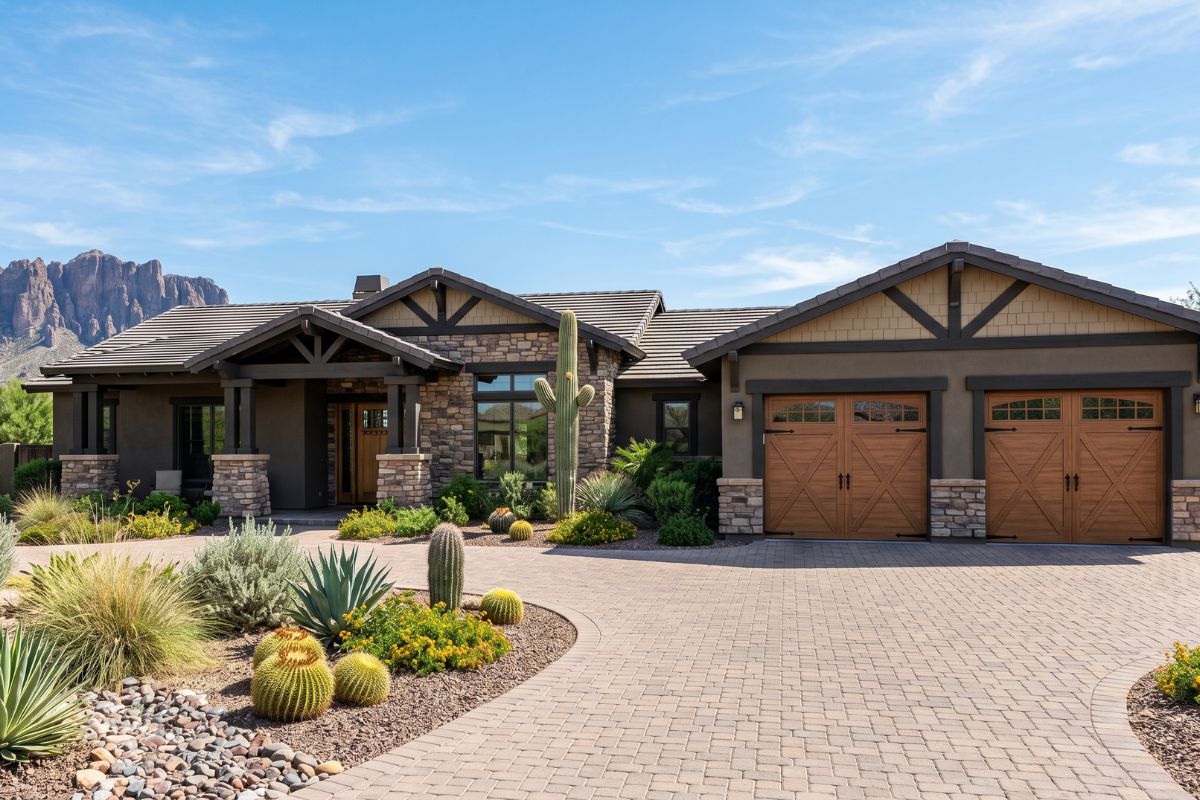
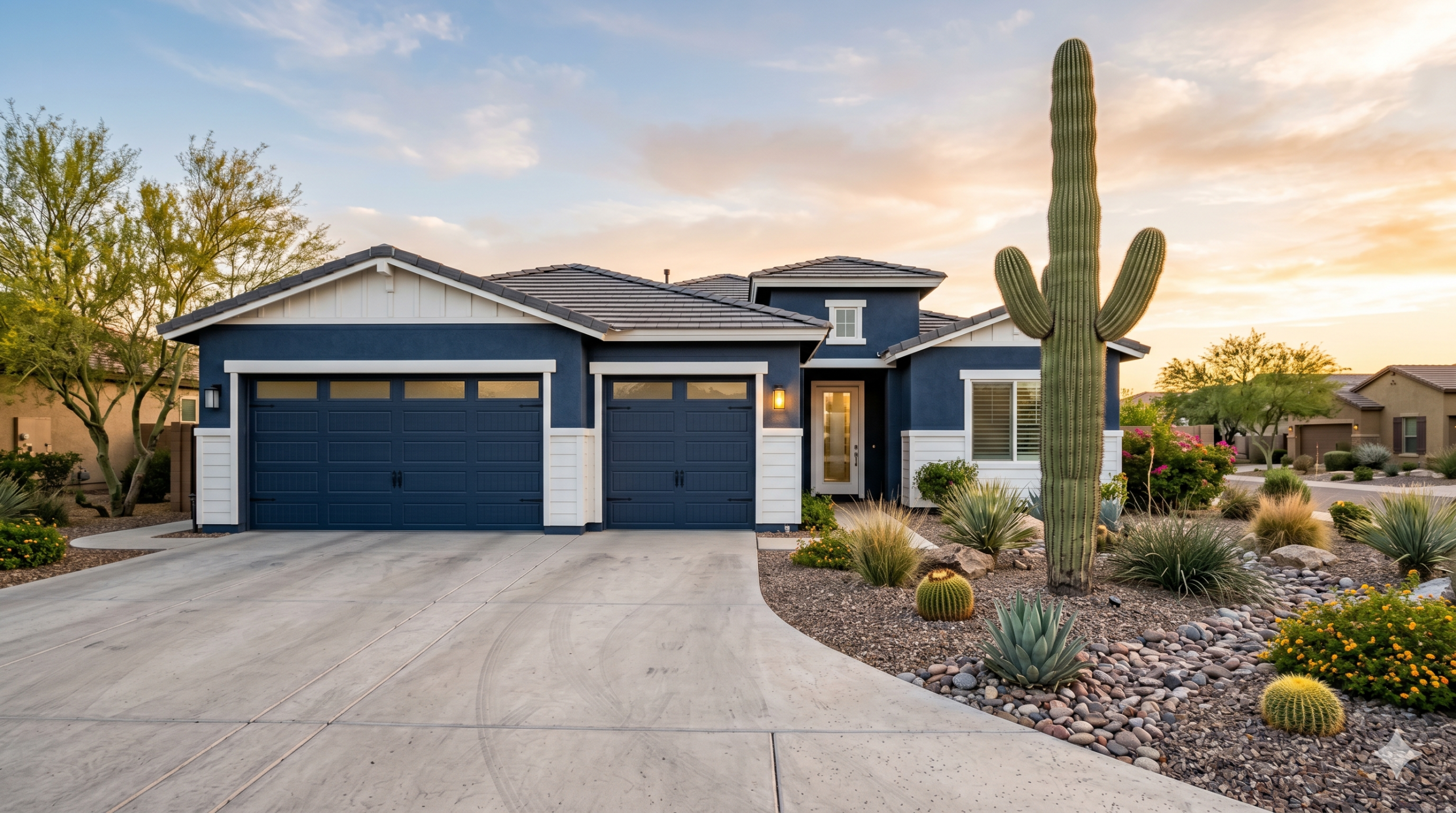
Carriage house garage doors

Carriage House Garage Doors: A Timeless Look for Your Home

Most homeowners spend years upgrading their interiors while their garage door — the largest single panel on the home’s facade — remains a plain, uninspired slab. Carriage house garage doors are the solution: they bring the warmth and character of traditional craftsmanship to modern homes, without sacrificing functionality or security. Read on to discover the styles, materials, and security hardware that turn a garage door into a defining architectural feature.

What Are Carriage House Garage Doors?

Carriage house garage doors are engineered to replicate the swing-out doors that once graced 18th- and 19th-century carriage houses. Today’s models operate on standard overhead tracks — no actual swinging — but the visual design stays faithful to the original, featuring:

  • Crossbuck overlays — the signature X-shaped panel patterns
  • Decorative hardware — strap hinges, clavos (ornamental nail heads), and door handles
  • Window inserts — arched or rectangular glass panels that admit natural light
  • Textured finishes — embossed steel or real wood that replicates timber grain

Unlike flat or standard raised-panel doors, carriage house designs introduce architectural depth that complements craftsman, colonial, farmhouse, and Spanish revival homes — all styles common throughout the Phoenix metro area. For a full overview of our installation services, visit our garage door services page. You can also find us on Google Maps to see verified reviews from homeowners across Phoenix.

Carriage House Garage Door Materials — Feature Comparison

Feature Steel (Wood-Look) Real Wood Composite / Fiberglass
Curb Appeal High Highest High
Heat & Sun Durability Excellent Moderate Good
Maintenance Required Low High Low–Medium
Insulation Options Yes (polyurethane) Limited Limited
Security Hardware Full Full Full
Weight Medium–Heavy Heavy Light–Medium
Rust / Moisture Resistance Excellent Moderate Excellent
Typical Lifespan 20–30 years 15–25 years 15–20 years
Best For Most Phoenix homes Premium custom builds Pool homes & humid zones

Carriage House Garage Doors: Materials and What to Look For

Steel with Wood-Look Finish

Steel doors with embossed wood grain textures are the most popular choice for Arizona homeowners. They resist warping and cracking in extreme heat, require minimal upkeep, and still deliver a convincing carriage house aesthetic. Manufacturers like Clopay and Wayne Dalton offer polyurethane-insulated steel carriage doors built for desert climates. Our garage door installation team can walk you through every available model and finish before you commit.

Real Wood

Genuine wood — typically cedar, redwood, or hemlock — delivers unmatched natural warmth and character. In Phoenix’s intense sun, real wood demands regular sealing and repainting to prevent warping and UV degradation. It’s a premium choice for homeowners who commit to ongoing care. The Woodworking Network provides detailed finishing guides that apply directly to wood garage door maintenance in arid climates.

Fiberglass and Composite

Composite doors made from fiber-reinforced materials offer a strong middle ground. They mimic wood’s appearance without the maintenance burden, and they’re lighter than steel — a practical advantage for homes with older opener motors. They also resist rust, which matters in homes with poolside garages. Our licensed technicians can assess your garage’s specific conditions during an on-site consultation.

Security Hardware for Carriage House Garage Doors

A carriage house door that looks stunning but isn’t properly secured is a liability, not an asset. At AZ Locksmith & Garage Repair, we frequently find that decorative handles and dummy hardware are installed with no actual locking mechanism behind them. The American National Standards Institute (ANSI) grades residential locks on a scale of 1–3, with Grade 1 being the highest residential security standard.

Deadbolt Security

A deadbolt lock is the most effective upgrade for any garage side entry or pedestrian door. A Grade 1 ANSI-rated deadbolt resists kick-in attacks and picking attempts far better than standard knob locks. Deadbolt installation must be performed by a professional locksmith who can verify proper strike plate alignment and door frame integrity — two factors that determine whether a deadbolt actually holds under force.

Thumbturn Lock Systems

A thumbturn lock lets you secure the interior garage-to-home door from the inside without a key. For added security on exterior-facing pedestrian doors, pair a thumbturn lock with a double-cylinder deadbolt so that both sides require a key.

Smart Lock Integration

Modern carriage house hardware is increasingly compatible with smart lock systems that allow keyless entry via PIN pad or smartphone app. Our team at AZ Locksmith & Garage Repair installs and programs smart locks that integrate with most major garage door opener platforms. The Associated Locksmiths of America (ALOA) recommends smart lock systems as part of a layered residential security approach.

Garage Door Lock Bar

A steel security bar that drops into a floor-mounted bracket prevents a garage door from being forced open horizontally, even if the overhead lock is compromised. This is a simple, high-impact addition to any home safety setup. Combined with a properly installed deadbolt on the pedestrian entry, it creates a two-layer physical barrier.

✅ Pro Tip from the Field: After handling hundreds of garage door hardware installs across the Phoenix area, one pattern stands out: decorative pull handles on carriage house doors are almost always the weakest point of entry. If your handle doesn’t have a working keyed cylinder behind it, replace it with a lockable handleset or add a surface-mounted deadbolt immediately. This single step addresses the most common vulnerability we encounter on carriage house door setups.

Choosing the Right Carriage House Style for Your Phoenix Home

Stile-and-rail overlays should be proportionate to the door’s width. A standard two-car door — typically 16 feet wide — looks most natural with a four-panel layout. Wider doors benefit from six-panel configurations that maintain visual balance.

Window inserts add light to the garage and break up the door’s surface. Arched-top windows pair well with Spanish colonial and craftsman homes common in Scottsdale, Chandler, and Gilbert. Square-top inserts suit contemporary or ranch-style properties. The Door & Access Systems Manufacturers Association (DASMA) publishes technical design bulletins worth reviewing before making a final selection.

Hardware finishes — matte black, oil-rubbed bronze, or brushed nickel — should coordinate with your home’s other exterior elements. Explore the full range of styles on our garage door installation page.

Why Professional Installation Matters for Home Safety

Carriage house doors are heavier than standard doors and require precise torsion spring calibration. Springs under tension store significant energy — improper adjustment is a documented cause of serious injury. Every access point introduced by a new garage door should be evaluated for home security by a trained professional.

At AZ Locksmith & Garage Repair, our licensed team handles both the mechanical installation and the complete security hardware setup in a single visit. We’re certified locksmiths trained to assess vulnerabilities most homeowners overlook. The U.S. Department of Homeland Security publishes residential security guidelines aligned with what licensed locksmiths evaluate during a proper home security assessment.

Frequently Asked Questions

Are carriage house garage doors more secure than standard doors?

The door panel itself offers similar structural protection to other steel or wood doors in its category. The real security difference comes from the hardware you pair with it. A carriage house door equipped with a Grade 1 deadbolt, reinforced strike plate, and a garage door lock bar provides substantially better protection than a standard door with only a knob lock. Our team at AZ Locksmith & Garage Repair can evaluate and upgrade your hardware during installation.

What is a thumbturn lock, and do I need one on my garage door?

A thumbturn lock is operated by a small rotating knob from the inside of the door, eliminating the need for a key from within the space. For the interior door connecting your garage to your living space, a thumbturn paired with a deadbolt on the exterior face creates a strong two-layer barrier. We install and configure thumbturn lock systems compatible with most door frames common in Phoenix homes.

Can I install a smart lock on a carriage house garage door?

Yes. Most carriage house doors have standard mortise or cylindrical bore preparations that accept smart lock hardware. Our smart lock installation service covers both the device installation and app configuration, ensuring every access credential is properly set up before we leave.

Do carriage house garage doors perform well in Phoenix’s extreme heat?

Steel carriage house doors with polyurethane insulation are specifically engineered for extreme temperatures. Insulated steel doors with reflective finishes outperform real wood and uninsulated options in Phoenix summers. Ask us about insulation R-value recommendations when you request a garage door consultation.

How do I know if my garage entry needs a deadbolt security upgrade?

If your garage pedestrian entry or the door between the garage and your home interior uses only a knob lock — no deadbolt — it is time for an upgrade. Knob locks can be defeated in seconds. A home security assessment from a licensed locksmith will identify every vulnerable entry point. Contact AZ Locksmith & Garage Repair to schedule an evaluation.

What decorative hardware finishes work best for Phoenix homes?

Matte black is the most versatile finish — it coordinates with both warm Adobe tones and cooler contemporary palettes without showing dust or sun oxidation. Oil-rubbed bronze suits Spanish colonial and Tuscan-style homes. Brushed nickel pairs well with modern or transitional architecture. Consistency with your front entry hardware creates a cohesive look across the entire facade.

Make Your Garage Door Work as Hard as It Looks

Carriage house garage doors are one of the most impactful visual upgrades available to a homeowner. But a beautiful door that isn’t properly secured leaves your property exposed. If you’re planning an upgrade — or want a security audit of your current garage entry — contact AZ Locksmith & Garage Repair today.

Our licensed professionals will evaluate your specific setup, recommend the right residential locksmith services, and make sure your new door performs as well as it looks. You can also schedule a lock rekey at the same time to unify your property’s key system.

📞 Request a consultation — and let’s build an entry point your home can be proud of.

Garage door replacement cost

Garage Door Replacement Cost: Average Prices for a Double Garage Door in Phoenix

Replacing a double garage door in Phoenix typically costs between $800 and $2,500 installed — and knowing exactly what drives that number can save you hundreds of dollars. When a door starts rattling every time the Arizona heat expands its panels, or when a fender-bender leaves a crease that won’t come out, most homeowners jump straight to Google without a clear sense of what fair pricing actually looks like. At AZ Locksmith & Garage Repair, we’ve replaced, installed, and serviced garage doors across the Valley for years, and we’ve put together this honest, line-by-line breakdown so you can make a confident decision before anyone steps on your driveway.

We serve Phoenix homeowners every day from our mobile service fleet — you can find us on Google Maps and read verified customer reviews that reflect our commitment to transparent pricing and reliable work. Whether you’re upgrading for curb appeal, improving home security, or dealing with an outright mechanical failure, this guide covers every cost factor you need to know.

Our garage door services team handles everything from single-panel swaps to full double-door replacements with smart home integration — and we’ll walk you through the numbers before we ever touch a tool.

Understanding the Average Garage Door Replacement Cost

Before we break down individual line items, here’s a realistic snapshot of what Phoenix homeowners pay for a double garage door replacement based on our field experience and current supplier pricing:

Door Type / Material Material Cost Labor Cost Total Installed (Est.)
Steel (Single Layer) $300 – $600 $200 – $350 $500 – $950
Steel (Insulated / Double Layer) $500 – $900 $200 – $400 $700 – $1,300
Steel (Triple-Layer Insulated) $700 – $1,200 $250 – $450 $950 – $1,650
Carriage-Style / Wood-Look Steel $900 – $1,600 $300 – $500 $1,200 – $2,100
Aluminum / Glass Panel $1,000 – $1,800 $300 – $600 $1,300 – $2,400
Wood (Custom) $1,200 – $2,500+ $400 – $700 $1,600 – $3,200+

These figures reflect double-door sizing (typically 16 ft wide × 7 ft tall) with standard installation in the Phoenix metro area. Prices shift based on the factors we detail below — and understanding each one is the key to avoiding surprise invoices.

What Factors Drive Your Garage Door Replacement Cost in Phoenix?

Door Size and Configuration

A double garage door — the most common type in Phoenix neighborhoods — measures 16 feet wide by 7 feet tall. Larger openings (18-ft wide or 8-ft tall “high-lift” configurations) cost more to fabricate and require additional structural hardware. If your home was built with a non-standard opening, expect custom sizing to add $200–$500 to the base price. Our garage door installation team measures every opening precisely before ordering any materials.

Material Selection and Insulation Grade

Steel dominates Phoenix installations for good reason — it resists the warping and cracking that Arizona’s intense UV exposure inflicts on lower-grade materials. However, not all steel doors are equal. Single-layer steel panels offer the lowest upfront cost but no insulation value. In a climate where garage temperatures can hit 150°F in summer, an insulated door (R-value of 9–18) can meaningfully reduce cooling costs in attached garages. Polyurethane-injected triple-layer doors carry the best thermal performance and also reduce noise from the street — a genuine quality-of-life upgrade for Phoenix households near major arterials like I-10 or the 101.

Wood offers unmatched visual warmth and curb appeal, but it demands regular sealing and repainting to survive Phoenix summers. Composite wood-look steel panels offer a practical middle ground that our garage door repair team consistently recommends for homeowners who want the aesthetic without the maintenance burden.

Style and Design Options

Raised-panel steel doors sit at the affordable end of the design spectrum. Carriage-house or barn-style doors — with decorative hinges, windows, and hardware — run $300–$700 more than equivalent plain-panel models. If you’re making a move toward smart home integration, we can pre-plan wiring conduit during installation so a smart garage door opener like a LiftMaster 84501 or Chamberlain B4545T can be added cleanly, either now or in the future.

Hardware: Springs, Tracks, and Rollers

This is where many low-ball quotes hide their true cost. A double garage door replacement that doesn’t include new torsion springs is an incomplete job. Torsion springs bear the full weight of the door and have a rated cycle life (typically 10,000–20,000 cycles). If your existing springs are near end-of-life, installing a new door on old springs is a liability waiting to happen.

⚠️ Safety Warning: Torsion springs are under extreme tension — a broken spring can release hundreds of pounds of force in milliseconds. NEVER attempt to adjust, remove, or replace torsion springs without professional training and proper tools. Every year, DIY spring replacement causes serious injuries across the U.S. Our torsion spring repair technicians are trained and equipped to handle this safely. If your spring breaks, call us — don’t touch it.

New torsion spring sets for a double door run $80–$200 in parts, plus $100–$200 in labor. Tracks, rollers, and cables are typically replaced as a set when doing a full door replacement and add $75–$150 to the total. Our garage door cable repair service addresses these components individually if only partial hardware renewal is needed.

Garage Door Opener: Include It or Not?

A new door pairs naturally with a new opener, especially if yours is more than 10–12 years old. Modern openers from Genie, LiftMaster, and Chamberlain offer Wi-Fi connectivity, battery backup (critical during Phoenix monsoon-season power outages), and integration with Google Home or Amazon Alexa. Budget openers start around $150; mid-range belt-drive units with smart features run $250–$400; commercial-grade or ultra-quiet models top out near $600.

Our garage door opener repair team can assess your current unit and advise honestly whether repair or replacement makes more financial sense for your situation. We work with all major brands and can program new openers to your existing remotes or keypad in most cases.

Removal and Disposal of the Old Door

Disposal of an old double door adds $50–$150 to most quotes. Some contractors include it; some don’t. Ask explicitly before signing anything. At AZ Locksmith & Garage Repair, our quotes include haul-away so you’re not left with a pile of steel panels on your driveway.

DIY vs. Professional Installation: The Real Cost Comparison

We understand the appeal of saving money on labor. But garage door replacement — particularly for a heavy double door — is one of the home improvement projects where DIY creates more risk than reward. Consider the full picture:

  • Torsion spring danger: As noted above, improperly handled springs can cause severe injury. Professional liability and workers’ comp exist for this reason.
  • Structural alignment: A misaligned door binds, wears unevenly, and voids most manufacturer warranties. Getting the tracks perfectly plumb requires experience and calibration tools.
  • Warranty coverage: Most brand warranties (LiftMaster, Clopay, Wayne Dalton) require professional installation to remain valid.
  • Time investment: A crew experienced in residential garage door installation completes a double-door swap in 3–5 hours. First-time DIYers often spend a full weekend — and still need a professional correction visit.
  • Hidden part costs: When you discover mid-installation that you also need a new header bracket, bottom weatherseal, or strut reinforcement, you’re making an emergency hardware run on a Saturday. Professionals carry those parts on the truck.

Our residential garage door services include a written quote, same-day or next-day scheduling across the Phoenix metro, and a warranty on both parts and labor. Visit our service areas page to confirm we cover your neighborhood — we serve Scottsdale, Tempe, Mesa, Glendale, Chandler, Peoria, and surrounding communities.

Additional Cost Factors Phoenix Homeowners Often Overlook

Weatherstripping and Seals

Phoenix dust storms (haboobs) push fine particulate under and around garage doors relentlessly. A full perimeter weatherseal replacement costs $50–$120 and is well worth including in a door replacement project. Our repair team always inspects existing seals during installation and replaces them when worn.

Structural Repairs to the Opening

If your existing header or jamb framing shows rot, insect damage, or deterioration from years of water intrusion (even in Phoenix, monsoon season takes a toll on improperly flashed openings), that framing must be addressed before a new door goes in. Wood repairs to a garage opening run $150–$400 depending on extent. We flag these issues during our pre-installation inspection rather than discovering them mid-job.

Permits

The City of Phoenix generally does not require a permit for a like-for-like garage door replacement unless structural modifications are involved. However, if you’re widening the opening or changing the door type significantly, a permit may be required. We navigate this on your behalf and pull any necessary permits as part of our service.

Smart Home and Security Upgrades

Many Phoenix homeowners pair a door replacement with a home security upgrade — adding a garage keypad, a camera-integrated opener, or a dedicated smart lock on the door-to-home entry. These additions typically cost $100–$350 and meaningfully improve home security beyond the garage door itself.

How to Get an Accurate Quote — and Avoid Getting Overcharged

Three practices protect you when soliciting garage door replacement quotes in Phoenix:

  1. Get itemized quotes. A reputable contractor will break out door cost, hardware cost, opener cost (if applicable), labor, and disposal separately. A lump-sum number with no line items is a warning sign.
  2. Ask about brand and model. “Steel insulated door” is not a specification. Ask for the manufacturer name, model number, R-value, and gauge of steel. You should be able to look it up yourself before you agree.
  3. Verify licensing and insurance. Arizona requires licensed contractors for garage door work. Ask for the ROC (Registrar of Contractors) number and verify it at the Arizona ROC website. Our team is fully licensed, bonded, and insured — details available on our about page.

We also recommend checking a company’s Google review profile before calling. Our listing at Google Maps shows verified reviews from real Phoenix homeowners who have used our garage door services — read what they say about our technicians, our pricing transparency, and our response time.

Frequently Asked Questions About Garage Door Replacement Cost

How much does a double garage door replacement cost in Phoenix?

Most Phoenix homeowners pay between $800 and $2,500 for a full double garage door replacement installed — including removal of the old door. The exact number depends on the material (steel, wood, aluminum), insulation grade, style, hardware condition, and whether you’re also replacing the opener. We provide itemized quotes so there are no surprises on installation day.

Is it cheaper to repair or replace a garage door?

Repair makes sense for isolated issues — a broken torsion spring, a damaged panel, or a worn roller. Replacement becomes the better investment when the door has multiple failing components, significant rust or structural damage, or when it’s simply beyond its useful life (typically 15–30 years depending on material). Our technicians will give you an honest assessment of repair vs. replacement cost before recommending either path.

How long does garage door installation take?

A standard double-door replacement — including removal of the existing door, installation of the new door, hardware, and springs — takes our crew approximately 3 to 5 hours. If we’re also installing a new opener, add 1 to 2 hours. We work efficiently and clean up before we leave so your garage is fully operational the same day.

What is the best garage door material for Phoenix weather?

Insulated steel is our top recommendation for Phoenix homeowners. It withstands extreme UV exposure and temperature swings without warping, requires minimal maintenance, and provides meaningful thermal insulation that helps manage garage temperatures during summer. For homeowners prioritizing aesthetics, carriage-style steel doors with a polyurethane core offer both beauty and durability in our desert climate.

Do I need a permit to replace my garage door in Phoenix?

For a standard like-for-like garage door replacement, the City of Phoenix typically does not require a permit. However, if structural modifications are involved — such as widening the opening or altering the header — a permit may be necessary. We assess permit requirements during our pre-installation review and handle the paperwork on your behalf when needed.

Does a new garage door add value to my home?

Yes — consistently. According to Remodeling Magazine’s annual Cost vs. Value Report, garage door replacement has one of the highest return on investment percentages of any home improvement project, routinely recovering 90–100% of costs at resale. In Phoenix’s competitive real estate market, improved curb appeal from a new door can meaningfully reduce days on market and support listing price.

Can you install a smart garage door opener at the same time?

Absolutely. We install and program smart openers from LiftMaster, Chamberlain, Genie, and other leading brands. Wi-Fi-enabled openers let you monitor and control your garage door from your phone, integrate with existing smart home systems, and receive alerts if the door is left open. We handle the full installation and setup so you leave with a working smart garage on day one.

Are your technicians licensed and insured in Arizona?

Yes. AZ Locksmith & Garage Repair is fully licensed, bonded, and insured in the state of Arizona. Our technicians carry current credentials and complete ongoing training on the latest door systems and opener technology. We also verify identification on every service call and provide written quotes before any work begins.

What You Should Expect to Pay — and Who to Call

Garage door replacement cost in Phoenix is real and manageable — once you know what drives it. Materials, insulation, hardware, labor, and any opener or smart-home additions all factor into the final number, and the range is wide enough that the right door for your home and budget absolutely exists within it. The mistake we see most often is homeowners either going with the cheapest quote without scrutinizing what’s included, or delaying a replacement until a failed spring or collapsed panel becomes a weekend emergency.

If your door is showing its age, rattling through every Phoenix windstorm, or simply looking tired against the rest of your home’s facade, now is a good time to get an honest assessment. Our garage door services team is ready to walk you through your options with no pressure and a written quote you can compare against any other bid you receive. We also recommend reading our related guide on garage door repair vs. replacement — it covers the exact decision criteria we use in the field to help homeowners choose correctly.

We’re licensed, bonded, and insured in Arizona. Our technicians arrive in marked vehicles, carry photo ID, and follow strict professional standards on every job. Verified customer reviews from Phoenix-area homeowners are posted publicly on our Google Business listing — we encourage you to read them before calling anyone.

Ready to get started? Contact AZ Locksmith & Garage Repair today to schedule your free on-site estimate. Same-day and next-day appointments are available throughout Phoenix, Scottsdale, Mesa, Tempe, Glendale, Chandler, and surrounding communities. Call us, fill out our online form, or find us on Google Maps — whichever is easiest for you. We’re ready when you are.

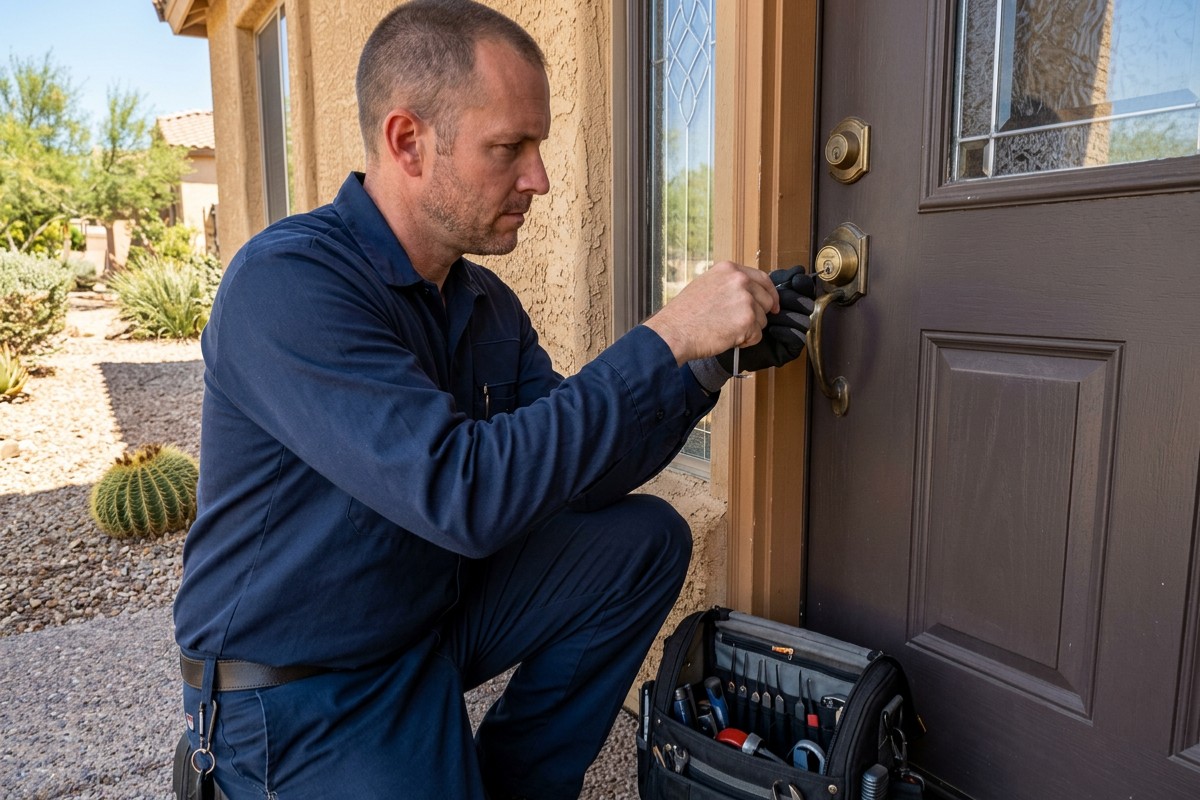
Mobile locksmith opening a residential front door lock during a home lockout service call in Phoenix AZ

Home Lockout Service in Phoenix AZ

Being locked out of your house in Phoenix means one thing: you need a mobile locksmith who can reach you, verify your identity, and get you inside without damaging your door or lock hardware. The method a trained locksmith uses depends on the lock type — a standard pin tumbler deadbolt, a smart lock with a dead battery, or a high-security cylinder all require different techniques. Forcing entry without the right approach damages the lock, the strike plate, and sometimes the door frame itself.

Phoenix adds one layer of urgency that most cities don’t: heat. Standing outside in 110°F+ summer temperatures for an extended period is a genuine health risk, not just an inconvenience. A lockout at 2pm in July is a situation that warrants the same response urgency as a midnight emergency.

Our mobile locksmiths at AZ Locksmith & Garage Repair serve Phoenix homeowners day and night, seven days a week. We dispatch from our base in the Ahwatukee area and cover the full Phoenix metro. Find us on Google Maps and see reviews from Phoenix homeowners who have used our lockout service. We provide a written quote before any work begins and require ID verification before opening any door — no exceptions.

Every lockout call starts with identity confirmation. We verify that you are the resident or authorized occupant before proceeding. This protects you as much as it protects your neighbors — a locksmith who opens doors without verification is a security liability, not a service provider.


What Happens During a Home Lockout Call

The process from your call to your door opening follows a consistent sequence regardless of lock type or time of day.

When you call, we confirm your address, your location relative to the property, and the lock type if you know it. This lets us dispatch the right technician with the right tools already loaded. A standard residential deadbolt requires different picks and tension wrenches than a Schlage Primus, a Medeco, or a smart lock with a failed electronic module.

On arrival, the technician asks for photo ID and proof of residency — a utility bill, lease agreement, or piece of mail with your name and address. This verification step is non-negotiable and takes less than two minutes. After verification, the technician assesses the lock and selects the entry method that causes zero damage to the hardware — picking, bypass, or in rare cases with severely damaged locks, controlled drilling with immediate replacement.

After entry, we inspect the lock to confirm it’s functioning correctly and hasn’t been compromised during the lockout. If the lock needs to be rekeyed — which we recommend any time a lockout involved a lost or stolen key — we can handle that in the same visit. See our rekey house locks service for details on what rekeying covers and when it’s the right call versus a full lock change.


Common Lockout Scenarios in Phoenix — and What Each Involves

Left keys inside on the way out. The most common scenario. The lock is intact, the door is closed, and the key is visible on the counter. Standard pick entry or bypass — 10–20 minutes from arrival.

Key broken in the lock. A broken key jammed in the cylinder prevents normal lock function and blocks entry. Extraction requires specific broken key extractors and, depending on how deep the fragment is and whether the pins have been damaged, may require the cylinder to be removed and replaced. We carry replacement cylinders for all major residential lock brands.

Smart lock with dead battery. Most smart locks have a mechanical key override or an external battery terminal that accepts a 9V battery to power the electronics temporarily. If neither is available or functional, entry through the mechanical bypass or adjacent entry point is the next step. Our locksmiths are trained on all major smart lock platforms including Schlage Encode, Kwikset Halo, and Yale. See our smart lock deadbolt installation service if you want to upgrade to a lock with a more reliable backup access method after your lockout is resolved.

Lock damaged or malfunctioning. Sometimes a lockout happens because the lock itself has failed — a worn cam, a seized tailpiece, or a latch that won’t retract. In these cases entry and lock replacement happen in the same visit. We carry handleset and deadbolt hardware and high-security lock options on every truck for immediate replacement.


Quick Diagnosis — What Your Situation Calls For
Situation Likely Solution What the Tech Does
Left keys inside, door locked Pick entry or bypass ID verification, non-destructive lock entry, 10–20 min
Key broken inside cylinder Broken key extraction Extractor tools, cylinder inspection, replacement if pins damaged
Smart lock — dead battery External power or mechanical bypass 9V terminal test, mechanical key override, platform-specific bypass
Lost or stolen key Entry + rekey same visit Open door, rekey cylinder to new key — old key no longer works
Lock seized or malfunctioning Entry + lock replacement Diagnose failure point, replace deadbolt or handleset same visit
High-security lock — Medeco or Schlage Primus Specialized pick or controlled bypass High-security cylinder techniques, longer service time, ID required

What to Do While You Wait

A few steps make the lockout process faster and safer while you wait for the technician.

Stay in a shaded area or your vehicle with the AC running — Phoenix heat is not a minor factor, and heat exhaustion can develop within 30 minutes of standing in direct sun above 110°F. If you have a neighbor you trust, waiting inside with them is the best option.

Locate your ID and any proof of residency before the technician arrives. A driver’s license plus one piece of mail or a lease document is sufficient. Having this ready saves 5–10 minutes on arrival.

Do not attempt to pick the lock yourself with improvised tools. Hairpins and credit cards are depicted as effective in movies — in reality they damage the pin stacks and cylinder tolerances, which can turn a straightforward pick entry into a cylinder replacement. Do not attempt to remove the door hinges — this rarely works on a properly installed exterior door and damages the frame.

If you believe your home has been broken into rather than that you’ve simply locked yourself out, call the police before calling a locksmith. We will not enter a property where a break-in is suspected until law enforcement has cleared the scene.


Frequently Asked Questions

How long does it take for a locksmith to arrive in Phoenix? +
Response time depends on your location and current technician availability. We dispatch from the Ahwatukee area in south Phoenix, so response is typically faster in the south valley. Call (602) 806-7771 and we’ll give you an honest estimated arrival time based on where our closest available technician is at that moment.
What ID do I need for a home lockout? +
A government-issued photo ID plus one piece of proof of residency — a utility bill, lease agreement, piece of mail, or mortgage statement with your name and the property address. If you’re a tenant and your name isn’t on the lease yet, contact your landlord or property manager who can authorize access. We cannot open a door without completed verification regardless of circumstances.
Will a locksmith damage my lock or door? +
A trained locksmith using proper technique should cause zero damage to a standard residential lock. Pick entry and bypass methods are non-destructive by design. Drilling is a last resort used only when a lock is severely damaged or seized and cannot be opened any other way — and in that case the lock is replaced in the same visit. We will not attempt entry with a method that risks damaging your hardware without explaining the situation and getting your approval first.
Should I rekey my locks after a lockout? +
If your lockout happened because you lost your keys or had them stolen, yes — rekeying is the right call. Rekeying reconfigures the pin tumblers inside the cylinder so the old key no longer works, at a fraction of the cost of replacing the entire lock. If you simply locked yourself out with your key still inside, rekeying is optional. We can handle rekeying in the same visit as the lockout service.
How much does home lockout service cost in Phoenix? +
We provide a written quote before any work begins — you’ll know the full cost before we touch the lock. Cost varies based on lock type, time of day, and whether additional services like rekeying or lock replacement are needed. Call (602) 806-7771 for a phone estimate based on your specific situation.
Do you service the whole Phoenix metro area? +
Yes. We cover the full Phoenix metro including Ahwatukee, Tempe, Chandler, Gilbert, Scottsdale, Glendale, and surrounding areas. Our base is in south Phoenix at 9830 S 51st St, so response times are typically fastest in the south valley, but we dispatch across the entire metro seven days a week from 7:00 AM to 9:30 PM.

What to Do Right Now

If you’re locked out in Phoenix right now, call (602) 806-7771. Our mobile technicians are available Monday through Sunday from 7:00 AM to 9:30 PM and respond to lockout calls across the full Phoenix metro.

AZ Locksmith & Garage Repair dispatches from 9830 S 51st St in the Ahwatukee area — south Phoenix coverage is our fastest response zone, but we serve the full city. We provide a written quote before any work begins, require ID verification before opening any door, and carry replacement hardware on every truck for same-visit lock changes or rekeying if needed.

Visit our home lockout service page for more on what the service includes, or go to our contact page to send a message if your situation is not urgent.

Garage Door Spring Repair in Phoenix AZ

Garage Door Spring Repair in Phoenix AZ

When a garage door spring snaps in Phoenix, the door becomes dead weight — the opener motor alone cannot lift it, and forcing it risks damaging the trolley carriage, bending the track, and burning out the motor within a few cycles. The spring is the load-bearing component of the entire system, and a failure almost always requires same-day repair to restore safe operation.

Phoenix homeowners face accelerated spring failures compared to the national average for one specific reason: thermal cycling. Summer temperatures inside an uninsulated garage routinely exceed 130°F, causing the steel coils to expand and contract with every degree of temperature change. That daily expansion and contraction creates micro-stress fractures inside the coil that accumulate invisibly — until the spring snaps without warning, often with a sound like a gunshot, while the car is parked inside or the door is mid-travel.

Our mobile technicians at AZ Locksmith & Garage Repair respond to spring failures across Phoenix day and night, seven days a week. We arrive with torsion springs sized for all standard residential door heights and weights, and we provide a written quote for your review and approval before any work begins — no surprises, no hidden fees. See our location and read reviews from Phoenix homeowners on Google Maps before you call.

Every spring repair starts with a full inspection of the spring system, cables, drums, and bearing plates — not just the broken coil. A spring rarely fails in isolation, and identifying related wear before it becomes a secondary failure is what separates a one-visit repair from a callback.


Why Phoenix Destroys Garage Door Springs Faster Than Anywhere Else

Torsion springs are rated by cycle count — the number of times the door opens and closes before the spring reaches the end of its designed lifespan. A standard builder-grade spring is rated for 10,000 cycles. In a moderate climate, with a household averaging 4 door cycles per day, that works out to roughly 7 years of service life.

In Phoenix, that math breaks down. The issue isn’t just use frequency — it’s the thermal environment the spring lives in. Steel expands when heated and contracts when cooled. In Phoenix, the delta between a 115°F summer afternoon and a 70°F desert night is roughly 45 degrees. Every day, the spring coil goes through that expansion and contraction cycle on top of its operational wind and unwind cycles. The stationary cone — the fixed anchor point of the torsion spring — is where this combined stress concentrates, and it’s where the vast majority of Phoenix spring failures originate.

Lubrication failure compounds the problem. Garage door springs require periodic lubrication to reduce friction between coil windings during operation. At 130°F, standard spring lubricant breaks down significantly faster than manufacturer service intervals assume. A dry spring in Phoenix generates more internal friction with every cycle, accelerating the micro-fracture process and shortening the effective service life by years.

What this means practically: a builder-grade 10,000-cycle spring installed during home construction in Phoenix may reach failure in 4–5 years rather than 7. If your home was built more than 5 years ago and the springs have never been replaced, they are likely operating well past their safe service life.


Torsion Springs vs. Extension Springs — What Your Phoenix Home Has

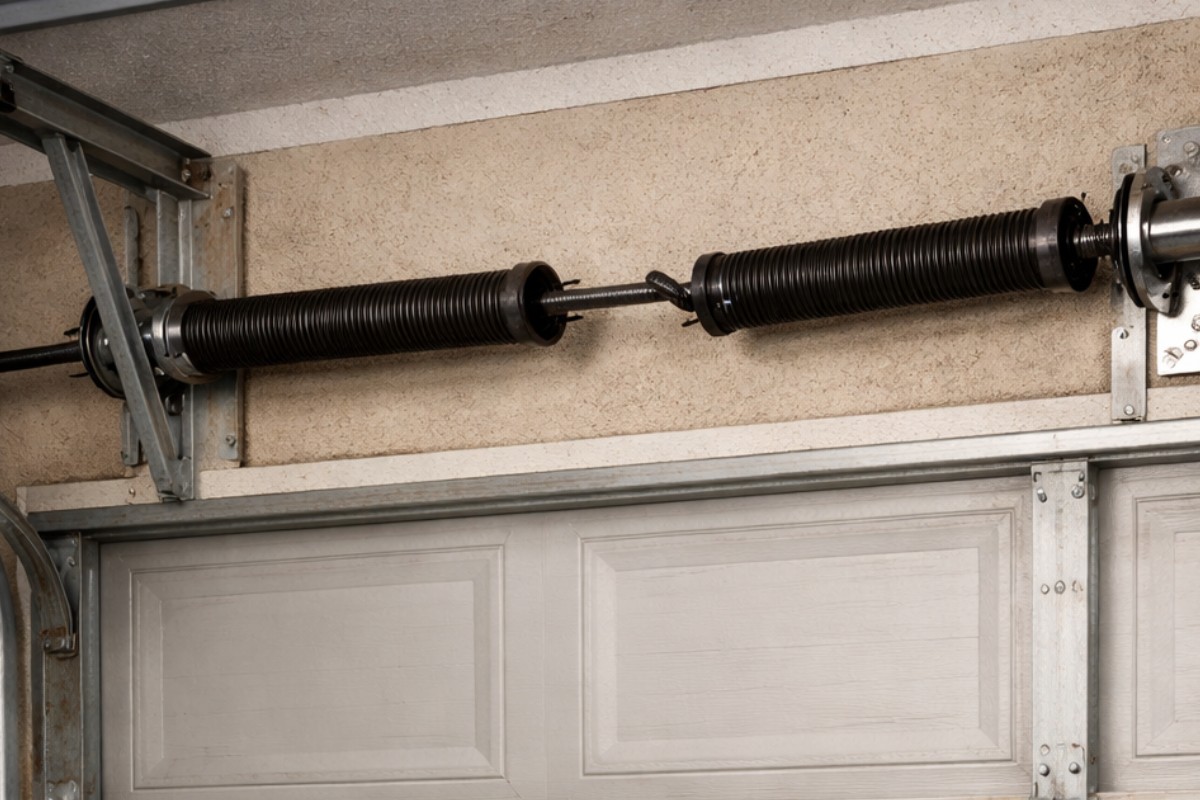
Most Phoenix homes built after the early 1990s use a torsion spring system: one or two springs mounted on a steel shaft centered above the door opening, connected via cables to drums on each end of the shaft. The spring stores energy by winding as the door closes and releases it as the door opens, doing the majority of the lifting work. When a torsion spring fails, the broken coil stays on the shaft — contained and visible as a gap in the coil.

Older homes and lighter single-car doors in Phoenix sometimes use extension springs: two springs mounted horizontally along the upper tracks on each side, stretching as the door closes and contracting as it opens. Extension springs are less expensive but more dangerous when they fail — without a properly installed safety cable running through the spring center, a broken extension spring can become a projectile.

Our garage door torsion spring installation and replacement service covers both types. We stock high-cycle springs rated for 25,000–30,000 cycles — the correct specification for Phoenix’s thermal environment — and we’ll confirm which system your door uses when you call.

Never attempt to remove or wind a torsion spring yourself. A fully wound torsion spring stores enough mechanical energy to cause severe injury or death if a winding bar slips or the spring is disturbed without proper equipment and technique.


Quick Diagnosis — What Your Door Is Telling You
Symptom Likely Cause What a Pro Checks
Loud bang, door won’t move Torsion spring snapped Spring integrity, visible gap in coil, cable tension, drum alignment
Door opens a few inches then stops Opener safety limit triggered by spring load Spring condition, opener force settings, motor thermal state
Door crooked — one side lower One spring failed in dual-spring system Both springs — replace as a matched pair
Door feels extremely heavy manually Spring losing tension near end of life Remaining spring cycles, cable drum wear, balance test
Visible gap in spring coil above door Spring already broken Full spring replacement, safety cable and drum inspection
Cables hanging loose on both sides Spring failure caused cables to unspool Spring, cable, drum, and bearing plate — full system check

What the Spring Repair Process Looks Like

When an AZ Locksmith & Garage Repair technician arrives at your Phoenix home, the repair follows a structured sequence — spring replacement is never just a parts swap.

The first step is a full system assessment: spring type, wire diameter, coil count, drum condition, cable integrity, bearing plate wear, and bottom bracket condition. This takes 10–15 minutes and determines whether the repair is isolated to the spring or whether cables, drums, or other hardware need attention in the same visit. We provide a written quote at this point — you approve the work before anything is touched.

Spring removal is performed using proper winding bars to safely unwind the remaining tension in the broken spring before the hardware is disturbed. The replacement spring — sized to your door’s weight and height — is installed on the shaft, tensioned to the correct wind count, and the cables are re-tensioned to match.

After installation, we run a balance test: the door is released at mid-travel and should hold position without drifting up or down. An unbalanced door means the spring wind count needs adjustment. We then verify the opener’s force calibration settings, since a new spring changes the load profile the motor operates against.

If the garage door track, rollers, or cables took any damage during the spring failure — which happens when the door drops unevenly — we address those in the same visit. Most Phoenix spring repairs are completed in 45–75 minutes. You can also see the full scope of our garage door repair services and our opener installation and repair options if the spring failure caused opener damage.


Frequently Asked Questions

How do I know if my garage door spring is broken? +
The most common signs are a loud bang from the garage followed by a door that won’t move, a visible gap in the spring coil above the door, or cables hanging loose on one or both sides. The opener may still run but the door will only move a few inches before the motor’s safety limit stops it. Do not force the door open manually — without spring tension, the full weight rests on the track and hardware.
Can I use my garage door opener with a broken spring? +
No. Running the opener without spring tension forces the motor to lift 150–300 lbs of dead weight, which overloads the drive gear, triggers the thermal cutoff, and can burn out the motor within a few cycles. Most modern openers will stop the door after a few inches as a safety measure — this is the system working correctly. Leave the door in place and call for service.
How long do garage door springs last in Phoenix? +
Builder-grade springs rated for 10,000 cycles typically last 4–6 years in Phoenix with average daily use. High-cycle springs rated for 25,000–30,000 cycles can reach 15–20 years under the same conditions. Arizona’s extreme heat and daily thermal cycling accelerate metal fatigue significantly faster than the same hardware performs in cooler climates.
Should I replace both springs if only one broke? +
Yes. Both springs have accumulated the same number of cycles and lived through the same thermal stress. If one failed, the other is at the same risk level and will likely fail within weeks or months. Replacing both together costs less than two separate service calls and keeps the door lifting evenly from day one.
What does garage door spring repair cost in Phoenix? +
Cost depends on spring type, wire gauge, cycle rating, and whether one or both springs need replacement. We provide a written quote before any work begins — call (602) 806-7771 and describe what you’re seeing and we’ll give you an estimate before we dispatch. There are no hidden fees and no work starts without your written approval.
Do you service all garage door brands? +
Yes. Our technicians carry springs sized for all standard residential door heights and weights and work on all major brands including Clopay, Amarr, Wayne Dalton, and CHI. Call (602) 806-7771 with your door model if you have it — we’ll confirm parts availability before we dispatch.
How long does spring repair take? +
A standard torsion spring replacement — single or dual — takes 45–75 minutes on most Phoenix residential doors. If cables or drums also need attention, add 20–30 minutes. We carry all standard spring sizes on every truck to complete most jobs in a single visit.

Before You Touch That Spring

A broken torsion spring is one of the few garage door repairs where the risk of DIY is severe enough that no qualified technician will recommend attempting it without proper training and equipment. The right next step is a same-day inspection and written quote — not a parts order.

AZ Locksmith & Garage Repair serves Phoenix homeowners from our base at 9830 S 51st St, B-122 in the Ahwatukee area, with mobile technicians available day and night, seven days a week. We stock high-cycle torsion springs on every truck and provide a written quote before any work begins — no pressure, no hidden fees.

Call (602) 806-7771 to request service. You can also visit our contact page or learn more about our team on our about page. We’re available Monday through Sunday, 7:00 AM to 9:30 PM.

garage door lock replacement cost in Scottsdale (2026)

Garage Door Lock Replacement Cost in Scottsdale (2026)