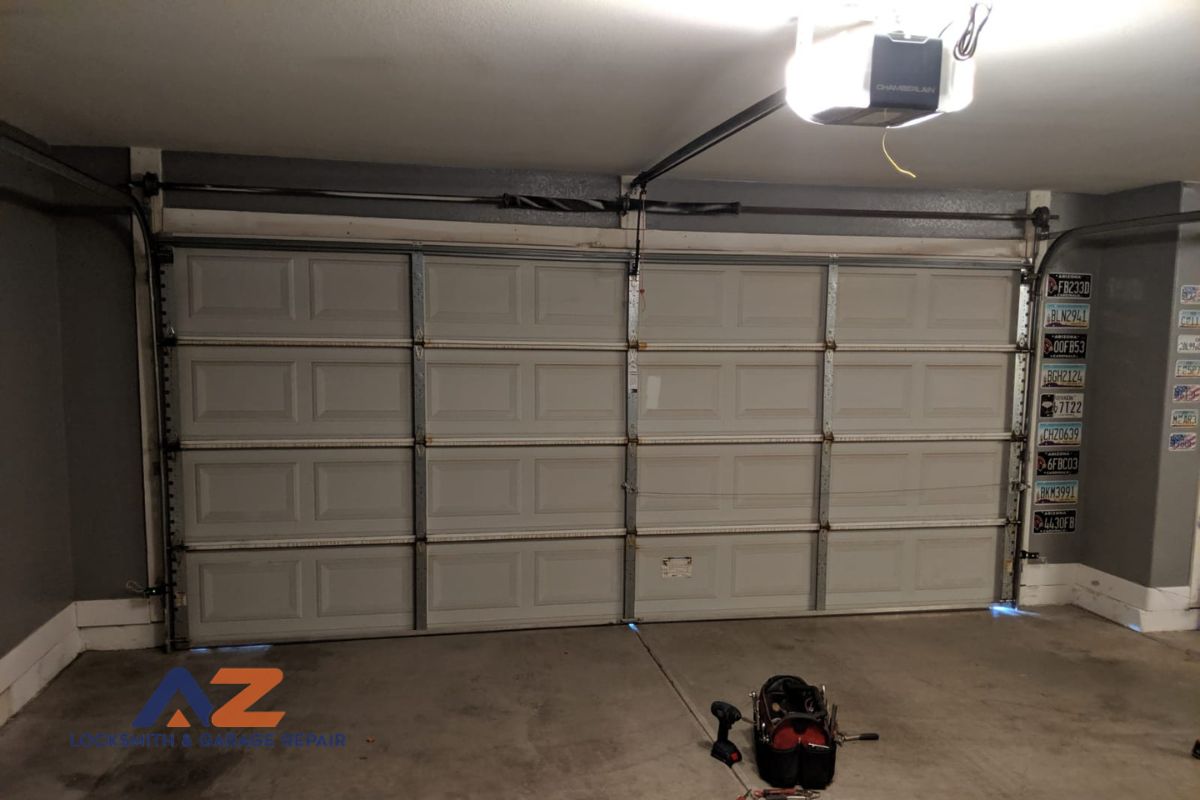
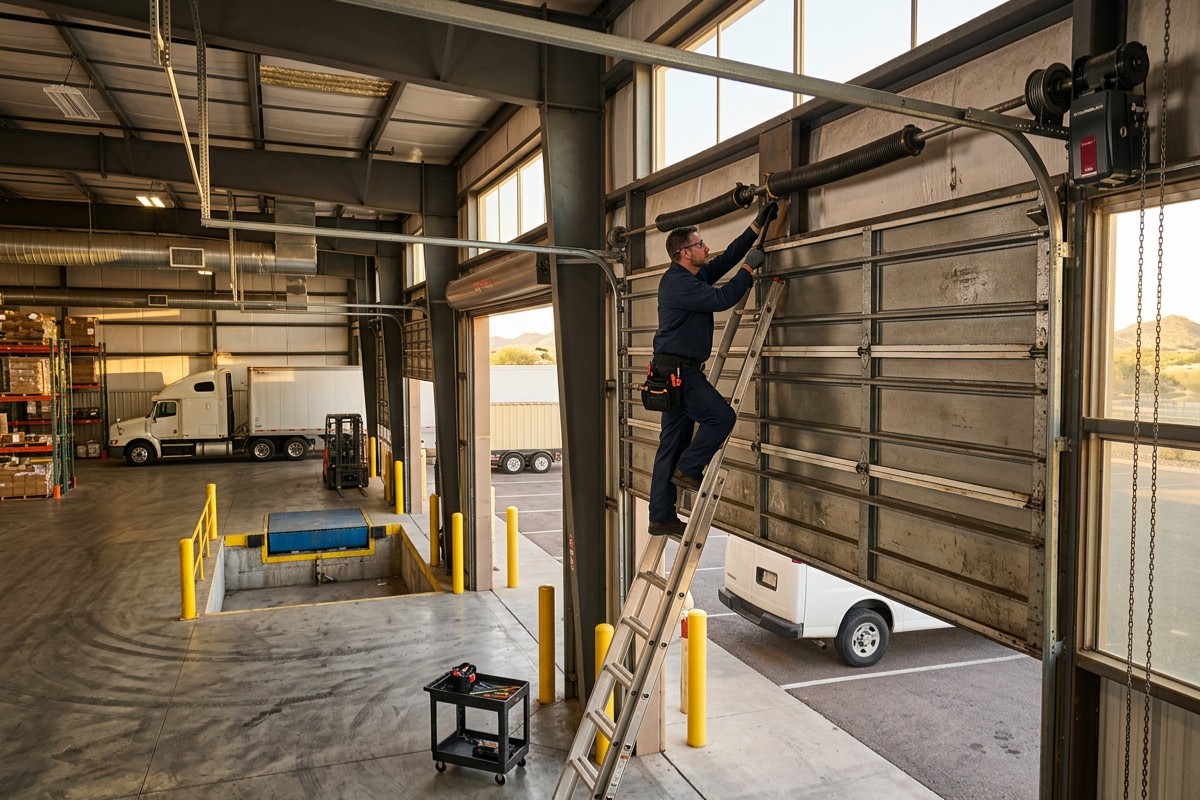
Mobile technician repairing a commercial overhead garage door at a warehouse facility in Phoenix AZ

Commercial Garage Door Repair in Phoenix AZ

A commercial garage door that fails mid-shift doesn’t just cause inconvenience — it stops operations, creates a security gap, and in loading dock or cold storage environments, every hour of downtime has a direct cost. Commercial overhead doors, rolling steel doors, and loading dock systems operate under load cycles that residential hardware isn’t designed for, and the failure modes are correspondingly different. Diagnosing the right component before ordering parts is what determines whether the repair takes one visit or three.

Phoenix conditions accelerate commercial door wear in specific ways. Industrial and warehouse environments in the Phoenix metro regularly see interior temperatures above 120°F in summer, which degrades rubber seals, dries out track lubrication, warps aluminum and steel components under repeated thermal stress, and shortens the cycle life of torsion springs and operator motors. A commercial door running 20–40 cycles per day in a Phoenix warehouse accumulates stress at a rate most manufacturers’ service schedules don’t account for.

Our mobile technicians at AZ Locksmith & Garage Repair respond to commercial door failures across Phoenix day and night, seven days a week. We carry commercial-grade hardware for overhead doors, rolling steel systems, and operator units on every truck. See our location and read reviews on Google Maps before you call — most commercial jobs are assessed and quoted within the first 20 minutes on site.

Every commercial repair starts with a written quote for your review and approval before any work begins. No hidden fees, no surprise line items. We identify the failed component, explain the repair path, and give you the full cost upfront.


Commercial Door Failures Phoenix Businesses See Most

Torsion spring failure is the most common commercial door repair call we receive. Commercial torsion springs are wound to higher torque ratings than residential springs to handle heavier door weights — a standard commercial steel door weighs 300–600 lbs depending on size and insulation. In Phoenix, the combination of high cycle counts and extreme heat shortens commercial spring life significantly. A spring rated for 25,000 cycles under normal conditions may reach failure in 3–4 years on a high-traffic Phoenix loading dock.

Operator motor failure is the second most common call. Commercial door operators — jackshaft, trolley, or hoist-style depending on the door configuration — run under sustained load in high-temperature environments. The motor windings, capacitors, and circuit boards in a standard commercial operator degrade faster at 120°F+ than at the 70°F ambient temperature the unit was tested at. Intermittent operation, slow door movement, and complete motor failure are all common presentations.

Track misalignment and roller failure appear frequently in high-cycle commercial environments. Commercial door rollers are steel rather than nylon, and the tracks are heavier gauge — but both accumulate wear faster when the door is cycling 30+ times per day without scheduled lubrication maintenance. A misaligned track or worn roller that would take years to cause a problem on a residential door can disable a commercial door within weeks under warehouse use conditions.

Bottom seal and weatherstrip failure is a maintenance issue that becomes an operational problem in Phoenix specifically. Commercial door seals keep conditioned air inside refrigerated or climate-controlled facilities. When the rubber degrades in the heat and the seal fails, HVAC costs spike immediately. We replace commercial bottom seals and side weatherstripping as a standalone service or as part of a broader repair visit.


Commercial Door Types We Service in Phoenix

Sectional overhead doors are the most common commercial door type in Phoenix warehouses, distribution centers, and retail service bays. They operate on the same torsion spring and cable system as residential doors, scaled up for heavier panels and higher cycle requirements. Our garage door torsion spring service covers commercial spring replacement at the correct torque specifications for your door weight and height.

Rolling steel doors — also called coiling doors or roll-up doors — use a steel curtain that coils around a barrel above the opening rather than operating on a track system. These doors are common in commercial storage units, fire stations, and retail storefronts. Failure modes include broken spring tension on the barrel, curtain damage from impact, hood misalignment, and operator motor failure. We carry replacement slats, springs, and operator hardware for standard rolling steel configurations.

High-speed doors are increasingly common in Phoenix distribution and cold-chain facilities where cycle frequency and seal integrity are critical. These doors operate at higher speeds and use different drive systems than standard commercial doors — fabric curtains on high-speed drums with soft-stop sensors and variable frequency drives on the operator motor. Repairs on high-speed systems require familiarity with the specific manufacturer’s drive configuration.

Our garage door track, roller, and cable service covers the mechanical components across all three door types. For operator and electrical system repairs, our opener installation and repair service covers both residential and commercial operator units.


Quick Diagnosis — What Your Commercial Door Is Telling You
Symptom Likely Cause What a Pro Checks
Door stuck open — won’t close Operator failure or limit switch fault Operator motor, limit switch calibration, safety sensor alignment
Door stuck closed — won’t open Broken torsion spring or operator motor failure Spring condition, motor response, cable and drum integrity
Door moves slower than normal Spring losing tension or operator motor degrading Spring tension, motor amperage draw, track lubrication
Loud grinding or metal-on-metal noise Worn rollers or dry track Roller wear pattern, track lubrication, hinge condition
Door reverses before fully closing Safety sensor obstruction or limit switch misset Sensor alignment, lens condition, close limit adjustment
Visible gap at bottom when door is closed Bottom seal worn or floor threshold damaged Seal condition, door level, threshold alignment

What a Commercial Repair Call Looks Like

When an AZ Locksmith & Garage Repair technician arrives at your Phoenix business, the assessment follows a structured sequence designed for commercial environments — not a residential checklist applied to a bigger door.

First we identify the operational impact: is the door stuck open, stuck closed, or intermittently failing? A door stuck open is a security and environmental emergency — that gets addressed before anything else. A door stuck closed with product or vehicles trapped inside is an operational emergency. Intermittent failures allow for a more methodical diagnostic approach.

From there we inspect the full mechanical system: spring condition and tension, cable and drum integrity, roller and track wear, operator motor response, limit switch calibration, and safety sensor function. Commercial door systems have more interdependencies than residential systems — a misaligned track affects spring tension, which affects motor load, which affects operator lifespan. We trace the failure to its root cause before recommending parts.

After the inspection we provide a written quote covering all required repairs, with line items for parts and labor. You approve the quote before any work begins. Most standard commercial repairs — spring replacement, operator repair, track realignment — are completed in a single visit. Panel replacement or custom hardware orders may require a second visit for installation.

For ongoing commercial accounts, we can establish a preventive maintenance schedule — typically quarterly inspections covering lubrication, spring tension check, cable condition, roller wear, and operator calibration. Preventive maintenance on a high-cycle Phoenix commercial door costs significantly less than the emergency repair and downtime it prevents.


Frequently Asked Questions

How long do commercial garage door springs last in Phoenix? +
Commercial torsion springs are typically rated for 25,000–100,000 cycles depending on wire gauge and coil diameter. On a Phoenix loading dock running 20–30 cycles per day in sustained heat, a 25,000-cycle spring can reach failure in 3–4 years. Higher-cycle springs cost more upfront but significantly reduce replacement frequency and unplanned downtime on high-traffic doors.
Can you repair our commercial door the same day? +
Most standard commercial repairs — spring replacement, operator repair, track realignment, roller replacement — are completed same-day with parts already on the truck. Custom panel orders or specialty hardware for high-speed or custom-size doors may require a second visit for installation. Call (602) 806-7771 and describe the failure — we’ll confirm parts availability before we dispatch.
Do you provide written quotes for commercial repairs? +
Yes — always. We provide a written quote with line items for parts and labor after the on-site inspection and before any work begins. No work starts without your written approval. This applies to all commercial calls regardless of urgency or job size.
Do you offer preventive maintenance for commercial doors? +
Yes. For high-cycle commercial doors in Phoenix, quarterly preventive maintenance covering lubrication, spring tension check, cable and roller inspection, and operator calibration is the most cost-effective way to avoid emergency repairs and unplanned downtime. Contact us to set up a maintenance schedule for your facility.
What commercial door brands and operator systems do you service? +
We service all major commercial door brands including Clopay, Amarr, Wayne Dalton, CHI, and Cornell, and operator systems including LiftMaster, Chamberlain, Genie, Linear, and Dorma. Call (602) 806-7771 with your door model and operator brand — we’ll confirm compatibility and parts availability before dispatch.
Are you available for after-hours commercial emergencies? +
Yes. We are available Monday through Sunday from 7:00 AM to 9:30 PM for both scheduled repairs and emergency calls. A commercial door stuck open overnight is a security emergency — call (602) 806-7771 and we will dispatch the closest available technician to your Phoenix location.

Keep Your Business Moving

A commercial door failure in Phoenix doesn’t resolve itself — and every hour a loading dock or service bay is out of operation has a measurable cost. The right call is a same-day inspection and written quote from a technician who knows commercial door systems, not a residential crew applying residential solutions to a 400-lb steel door.

AZ Locksmith & Garage Repair serves Phoenix businesses from our base at 9830 S 51st St, B-122 in Ahwatukee, with mobile technicians available day and night, seven days a week. We carry commercial-grade springs, operator components, and track hardware on every truck.

Call (602) 806-7771 to request service. Visit our contact page for non-urgent scheduling, or see our full garage door services menu for the complete scope of what we cover. Our about page has more on how our team operates and what to expect on a service call.
Garage Door Spring Repair in Phoenix AZ

Garage Door Spring Repair in Phoenix AZ

When a garage door spring snaps in Phoenix, the door becomes dead weight — the opener motor alone cannot lift it, and forcing it risks damaging the trolley carriage, bending the track, and burning out the motor within a few cycles. The spring is the load-bearing component of the entire system, and a failure almost always requires same-day repair to restore safe operation.

Phoenix homeowners face accelerated spring failures compared to the national average for one specific reason: thermal cycling. Summer temperatures inside an uninsulated garage routinely exceed 130°F, causing the steel coils to expand and contract with every degree of temperature change. That daily expansion and contraction creates micro-stress fractures inside the coil that accumulate invisibly — until the spring snaps without warning, often with a sound like a gunshot, while the car is parked inside or the door is mid-travel.

Our mobile technicians at AZ Locksmith & Garage Repair respond to spring failures across Phoenix day and night, seven days a week. We arrive with torsion springs sized for all standard residential door heights and weights, and we provide a written quote for your review and approval before any work begins — no surprises, no hidden fees. See our location and read reviews from Phoenix homeowners on Google Maps before you call.

Every spring repair starts with a full inspection of the spring system, cables, drums, and bearing plates — not just the broken coil. A spring rarely fails in isolation, and identifying related wear before it becomes a secondary failure is what separates a one-visit repair from a callback.


Why Phoenix Destroys Garage Door Springs Faster Than Anywhere Else

Torsion springs are rated by cycle count — the number of times the door opens and closes before the spring reaches the end of its designed lifespan. A standard builder-grade spring is rated for 10,000 cycles. In a moderate climate, with a household averaging 4 door cycles per day, that works out to roughly 7 years of service life.

In Phoenix, that math breaks down. The issue isn’t just use frequency — it’s the thermal environment the spring lives in. Steel expands when heated and contracts when cooled. In Phoenix, the delta between a 115°F summer afternoon and a 70°F desert night is roughly 45 degrees. Every day, the spring coil goes through that expansion and contraction cycle on top of its operational wind and unwind cycles. The stationary cone — the fixed anchor point of the torsion spring — is where this combined stress concentrates, and it’s where the vast majority of Phoenix spring failures originate.

Lubrication failure compounds the problem. Garage door springs require periodic lubrication to reduce friction between coil windings during operation. At 130°F, standard spring lubricant breaks down significantly faster than manufacturer service intervals assume. A dry spring in Phoenix generates more internal friction with every cycle, accelerating the micro-fracture process and shortening the effective service life by years.

What this means practically: a builder-grade 10,000-cycle spring installed during home construction in Phoenix may reach failure in 4–5 years rather than 7. If your home was built more than 5 years ago and the springs have never been replaced, they are likely operating well past their safe service life.


Torsion Springs vs. Extension Springs — What Your Phoenix Home Has

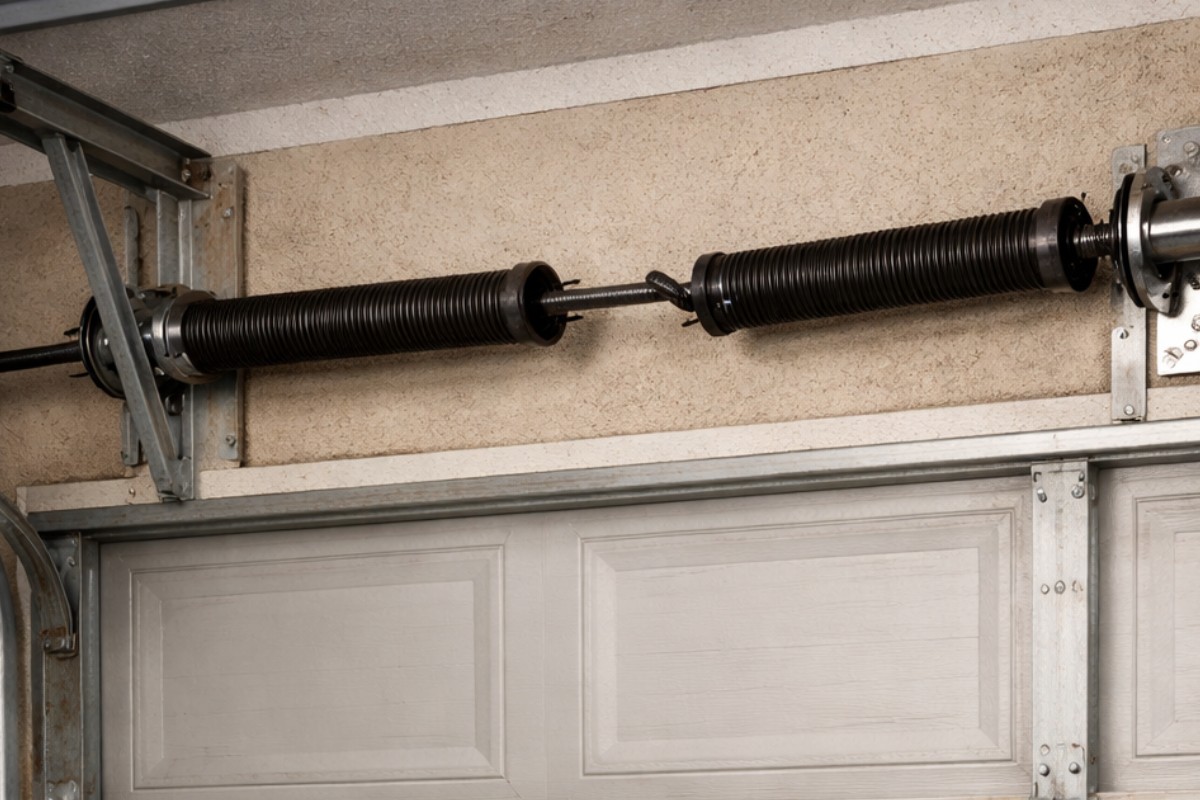
Most Phoenix homes built after the early 1990s use a torsion spring system: one or two springs mounted on a steel shaft centered above the door opening, connected via cables to drums on each end of the shaft. The spring stores energy by winding as the door closes and releases it as the door opens, doing the majority of the lifting work. When a torsion spring fails, the broken coil stays on the shaft — contained and visible as a gap in the coil.

Older homes and lighter single-car doors in Phoenix sometimes use extension springs: two springs mounted horizontally along the upper tracks on each side, stretching as the door closes and contracting as it opens. Extension springs are less expensive but more dangerous when they fail — without a properly installed safety cable running through the spring center, a broken extension spring can become a projectile.

Our garage door torsion spring installation and replacement service covers both types. We stock high-cycle springs rated for 25,000–30,000 cycles — the correct specification for Phoenix’s thermal environment — and we’ll confirm which system your door uses when you call.

Never attempt to remove or wind a torsion spring yourself. A fully wound torsion spring stores enough mechanical energy to cause severe injury or death if a winding bar slips or the spring is disturbed without proper equipment and technique.


Quick Diagnosis — What Your Door Is Telling You
Symptom Likely Cause What a Pro Checks
Loud bang, door won’t move Torsion spring snapped Spring integrity, visible gap in coil, cable tension, drum alignment
Door opens a few inches then stops Opener safety limit triggered by spring load Spring condition, opener force settings, motor thermal state
Door crooked — one side lower One spring failed in dual-spring system Both springs — replace as a matched pair
Door feels extremely heavy manually Spring losing tension near end of life Remaining spring cycles, cable drum wear, balance test
Visible gap in spring coil above door Spring already broken Full spring replacement, safety cable and drum inspection
Cables hanging loose on both sides Spring failure caused cables to unspool Spring, cable, drum, and bearing plate — full system check

What the Spring Repair Process Looks Like

When an AZ Locksmith & Garage Repair technician arrives at your Phoenix home, the repair follows a structured sequence — spring replacement is never just a parts swap.

The first step is a full system assessment: spring type, wire diameter, coil count, drum condition, cable integrity, bearing plate wear, and bottom bracket condition. This takes 10–15 minutes and determines whether the repair is isolated to the spring or whether cables, drums, or other hardware need attention in the same visit. We provide a written quote at this point — you approve the work before anything is touched.

Spring removal is performed using proper winding bars to safely unwind the remaining tension in the broken spring before the hardware is disturbed. The replacement spring — sized to your door’s weight and height — is installed on the shaft, tensioned to the correct wind count, and the cables are re-tensioned to match.

After installation, we run a balance test: the door is released at mid-travel and should hold position without drifting up or down. An unbalanced door means the spring wind count needs adjustment. We then verify the opener’s force calibration settings, since a new spring changes the load profile the motor operates against.

If the garage door track, rollers, or cables took any damage during the spring failure — which happens when the door drops unevenly — we address those in the same visit. Most Phoenix spring repairs are completed in 45–75 minutes. You can also see the full scope of our garage door repair services and our opener installation and repair options if the spring failure caused opener damage.


Frequently Asked Questions

How do I know if my garage door spring is broken? +
The most common signs are a loud bang from the garage followed by a door that won’t move, a visible gap in the spring coil above the door, or cables hanging loose on one or both sides. The opener may still run but the door will only move a few inches before the motor’s safety limit stops it. Do not force the door open manually — without spring tension, the full weight rests on the track and hardware.
Can I use my garage door opener with a broken spring? +
No. Running the opener without spring tension forces the motor to lift 150–300 lbs of dead weight, which overloads the drive gear, triggers the thermal cutoff, and can burn out the motor within a few cycles. Most modern openers will stop the door after a few inches as a safety measure — this is the system working correctly. Leave the door in place and call for service.
How long do garage door springs last in Phoenix? +
Builder-grade springs rated for 10,000 cycles typically last 4–6 years in Phoenix with average daily use. High-cycle springs rated for 25,000–30,000 cycles can reach 15–20 years under the same conditions. Arizona’s extreme heat and daily thermal cycling accelerate metal fatigue significantly faster than the same hardware performs in cooler climates.
Should I replace both springs if only one broke? +
Yes. Both springs have accumulated the same number of cycles and lived through the same thermal stress. If one failed, the other is at the same risk level and will likely fail within weeks or months. Replacing both together costs less than two separate service calls and keeps the door lifting evenly from day one.
What does garage door spring repair cost in Phoenix? +
Cost depends on spring type, wire gauge, cycle rating, and whether one or both springs need replacement. We provide a written quote before any work begins — call (602) 806-7771 and describe what you’re seeing and we’ll give you an estimate before we dispatch. There are no hidden fees and no work starts without your written approval.
Do you service all garage door brands? +
Yes. Our technicians carry springs sized for all standard residential door heights and weights and work on all major brands including Clopay, Amarr, Wayne Dalton, and CHI. Call (602) 806-7771 with your door model if you have it — we’ll confirm parts availability before we dispatch.
How long does spring repair take? +
A standard torsion spring replacement — single or dual — takes 45–75 minutes on most Phoenix residential doors. If cables or drums also need attention, add 20–30 minutes. We carry all standard spring sizes on every truck to complete most jobs in a single visit.

Before You Touch That Spring

A broken torsion spring is one of the few garage door repairs where the risk of DIY is severe enough that no qualified technician will recommend attempting it without proper training and equipment. The right next step is a same-day inspection and written quote — not a parts order.

AZ Locksmith & Garage Repair serves Phoenix homeowners from our base at 9830 S 51st St, B-122 in the Ahwatukee area, with mobile technicians available day and night, seven days a week. We stock high-cycle torsion springs on every truck and provide a written quote before any work begins — no pressure, no hidden fees.

Call (602) 806-7771 to request service. You can also visit our contact page or learn more about our team on our about page. We’re available Monday through Sunday, 7:00 AM to 9:30 PM.

garage door lock replacement cost in Scottsdale (2026)

Garage Door Lock Replacement Cost in Scottsdale (2026)

Garage door maintenance service

Emergency Garage Lockout Help in Mesa: What to Expect

When you’re locked out of your garage in Mesa, it can feel like everything stops at once—car stuck inside, tools inaccessible, and a door that suddenly becomes the biggest obstacle in your day. The good news is that most garage lockouts can be resolved without damage when the situation is handled the right way.

This guide breaks down what “emergency garage lockout help in Mesa” really means, what you should do first, what a professional visit typically looks like, and the smartest ways to prevent a repeat lockout—without risky DIY break-in tactics.

If you need help right now, start here:


What Counts as a “Garage Lockout” in Mesa?

A “garage lockout” usually falls into one of these categories—and identifying the right one helps you get the correct technician and avoid wasted time.

Quick Decision Table

Lockout Type What’s happening Best Service Path
Side door lockout You can’t get in through the garage side door (lost key, jammed lock, broken key) Residential Locksmith + (often) Home Lockout
Overhead garage door won’t open Opener runs but door doesn’t move, door is stuck, or it won’t respond at all Garage Door Repair and/or Garage Door Repair (Service Page)
Car is locked (keys inside / dead fob) The garage may be accessible, but the vehicle isn’t Automotive Locksmith + Open Locked Car Door

What to Do First

Here’s the fastest, safest way to respond—especially if stress is high and you’re tempted to “force it.”

Step 1: Confirm whether this is a lock issue or a door-system issue

  • If your key won’t work on the side door, that’s a locksmith workflow (start with Residential Locksmith).

  • If the overhead door won’t open, treat it as a garage door service call (start with Garage Door Repair).

Step 2: Do a quick “non-invasive” check

These checks don’t risk damage:

  • Confirm you’re using the correct remote/key (sounds obvious, but it happens).

  • If your opener uses a remote or keypad, check for obvious power issues in the garage (lights/outlets).

  • If you have access to the garage side door but it’s not opening, don’t force the key—binding is a sign to stop.

Step 3: Avoid force, prying, or repeated attempts

Garage doors are heavy systems with tight tolerances. Repeated forcing can turn a simple lockout into a bigger repair.

Step 4: Get ready for verification

Professional lockout service typically includes a quick authorization/occupancy check. If possible, have one ready:

  • Driver’s license + matching address

  • Lease agreement

  • Utility bill

  • Property manager authorization (for rentals)

To dispatch the right help, use Contact Us.

What a Professional Visit Looks Like

A clean lockout appointment is predictable. Here’s what you should expect from a pro-level process.

Step 1: Verification and situation assessment

For security reasons, access work usually starts with confirmation that the person requesting service has authorization.

Step 2: Identify the simplest safe access path

The technician determines whether the fastest safe solution is:

  • restoring access through a door lock (locksmith work),

  • restoring access by addressing a garage door system issue (garage door service),

  • or handling vehicle access (automotive locksmith).

Step 3: Resolve the access problem without unnecessary damage

Professional workflows aim to preserve:

  • the door frame,

  • lock hardware,

  • garage door panels,

  • and the opener system.

Step 4: Fix the “why,” not just the “now”

Once you’re back in, a good technician will point out what caused the lockout so it doesn’t happen again—often by recommending a targeted fix or upgrade, not a random upsell.

Helpful next-step pages depending on the root cause:


Common Mesa Lockout Causes

Mesa homes range from older neighborhoods to newer communities—so you’ll see a mix of lock styles, opener types, and hardware wear.

Symptom-to-Service Table

What you notice Common underlying issue Best page to reference
Door won’t lift or feels unusually heavy Counterbalance/spring-related problem Garage Door Torsion Spring
Door moves unevenly / rough travel Rollers, hinges, or alignment wear Garage Door Roller Replacement
Door is damaged or won’t seal right Panel damage or structural misalignment Garage Door Panel Replacement
Opener runs but door won’t open properly Opener setup or hardware strain Garage Door Opener Installation
Side door key won’t turn / lock is jammed Lock wear, alignment, or key issue Residential Locksmith + Home Lockout
You’re locked out of your car (at home/in garage) Keys inside / dead fob / lost keys Open Locked Car Door

Emergency Lockout Expectations: What You’ll Be Asked

When you request emergency garage lockout help in Mesa, you’ll typically be asked for:

  • Your cross streets or neighborhood area in Mesa

  • Whether you’re locked out of the garage door, side door, or vehicle

  • Whether the garage is attached to the home (often changes urgency and verification needs)

  • Proof of authorization/occupancy (common and normal)

To get the fastest routing, use Contact Us and mention the lockout type from the table above.

Prevention: How to Stop Garage Lockouts From Happening Again

Once you’re back inside, prevention usually comes down to two categories: access reliability and key control.

Step-by-step prevention plan

  1. If you moved recently, had contractors, or lost keys:

  2. If the garage side door is the weak link:

  3. If you want a simple garage security upgrade:

  4. If the overhead door is the recurring issue:


Related Services Mesa Customers Often Need (After a Lockout)

Sometimes the lockout is the symptom—not the real issue. These are the most common “next click” services after access is restored.

Automotive follow-ups (if keys were lost or fob failed)

Residential follow-ups (key control + convenience)

Commercial follow-ups (for shops, warehouses, offices in Mesa)

FAQs: Emergency Garage Lockout Help in Mesa

1) Can you help with emergency garage lockout help in Mesa?

Yes—start with Contact Us and specify whether it’s the side door, overhead garage door, or a vehicle lockout.

2) What if the overhead garage door won’t open at all?

That’s usually a garage door service issue. Start with Garage Door Repair and mention any symptoms like heavy lifting, grinding, or uneven travel.

3) Will I need to prove I live here?

Often, yes—especially for lockouts. It’s standard practice and protects property owners.

4) Can you fix the problem so it doesn’t happen again?

In many cases, yes. Common prevention steps include Rekey House Locks, Change Locks, or upgrading access via Install Smart Lock Deadbolt.

5) Is a garage slide lock worth it?

If your door setup is compatible and you want a straightforward security upgrade, see Garage Slide Lock Installation.

6) What if I’m locked out of my car in the garage or driveway?

Start with Open Locked Car Door under Automotive Locksmith.

7) What’s the fastest way to get routed to the right tech?

Use the Services page to identify the category, then book via Contact Us.

8) Where can I learn more about your company policies?

See About Us and Privacy.

Final Takeaway for Mesa Garage Lockouts

An emergency garage lockout in Mesa is usually solvable without damage when it’s scoped correctly from the start: identify whether it’s a door-lock access issue, a garage door system issue, or a vehicle access issue, then route it through the right service path.

Next steps (fast + safe):

  1. Book dispatch: Contact Us

  2. If the overhead door won’t open: Garage Door Repair

  3. If it’s a side door key/lock issue: Residential Locksmith

  4. If it’s your car: Open Locked Car Door