In This Article
Grade 1 deadbolt benefits come down to a single idea: a lock engineered to survive the force a real intruder uses. An ANSI/BHMA Grade 1 deadbolt resists kicking, prying, and drilling far better than the builder-grade hardware bolted onto most front doors, which makes it the strongest residential lock a homeowner can install.
Most break-ins do not start with a picked lock. An intruder kicks the door near the handle, and the basic deadbolt that came with the house splits away at the strike plate. That single weak point is the most common failure our technicians find when we inspect homes across Phoenix. The fix is direct: replace the entry hardware with an ANSI Grade 1 deadbolt built to absorb that impact. In this guide, our team explains how the grading system works, what sets Grade 1 apart, and how to install it correctly. Keep reading to see why this one upgrade does more for your door than almost any other.
What Makes a Deadbolt “Grade 1”?
The grade stamped on a lock is not a marketing label. It comes from a published testing standard created by the American National Standards Institute (ANSI) and the Builders Hardware Manufacturers Association (BHMA). Every deadbolt runs through the same battery of operational, strength, and cycle tests, then earns a grade from 1 to 3 based on how it holds up. You can review the official breakdown on the ANSI blog.
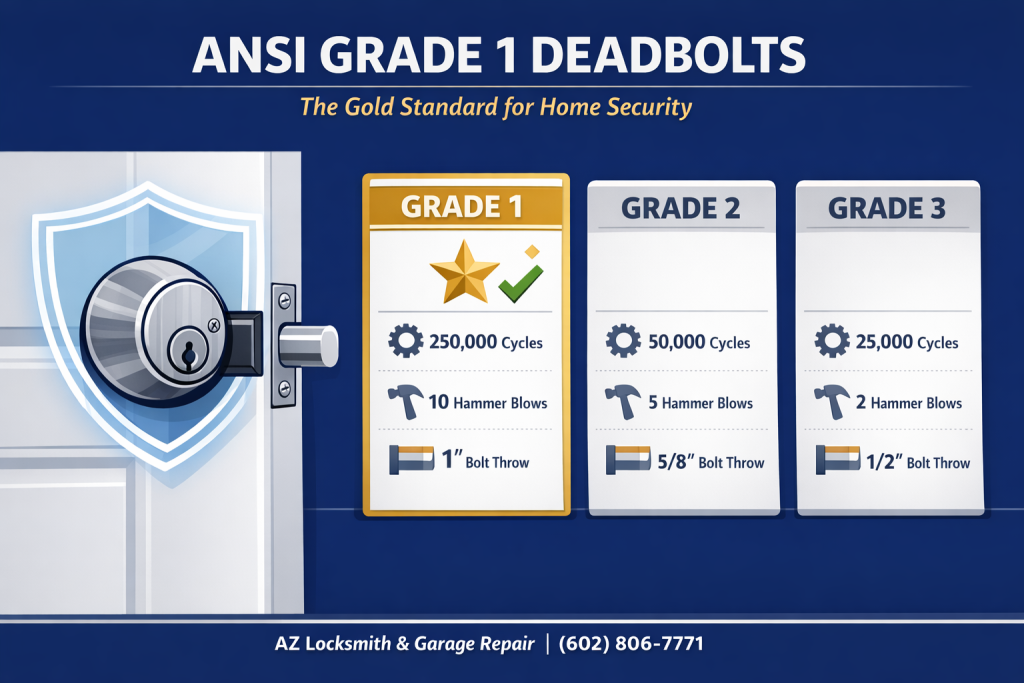
Grade 1 sits at the top of that scale. Grade 3 is the entry-level hardware many builders install by default on new construction. The table below shows how the three grades compare on the measures that decide whether a door actually holds during an attack.
| Feature | ANSI Grade 1 | ANSI Grade 2 | ANSI Grade 3 |
|---|---|---|---|
| Security tier | Maximum (gold standard) | Mid-range | Entry-level |
| Cycle test (open/close) | 250,000 cycles | 150,000 cycles | 100,000 cycles |
| Hammer-strike resistance | 10 strikes | 5 strikes | 2 strikes |
| Bolt throw length | Full 1 inch | 1 inch | 5/8 inch |
| Forced-entry resistance | Highest | Moderate | Minimal |
| Best suited for | Exterior entry doors | Secondary doors | Interior / low-risk doors |
| Typical setting | Homes & businesses | Apartments & rentals | Closets & sheds |
ANSI/BHMA performance grades for residential deadbolts. Source: ANSI/BHMA A156 testing standards.
How the Grades Are Tested
Two numbers matter most. The first is the cycle count, which measures how many times the bolt can throw and retract before the mechanism wears out. The second is impact resistance, which counts how many strikes from a weighted hammer the lock survives. A Grade 1 deadbolt clears 250,000 cycles and 10 full-force strikes. A Grade 3 unit is rated for roughly 100,000 cycles and only 2 strikes. On a door an intruder is throwing a shoulder into, that difference decides the outcome.
Grade 1 Deadbolt Benefits That Protect Your Home
The advantages add up quickly once you understand what the rating represents.
- Forced-entry resistance. The hardened body and reinforced bolt are built to shrug off kicks and pry bars, the two methods behind most residential break-ins.
- A full one-inch bolt throw. A longer bolt seats deeper into the door frame, so the lock has far more material to shear through before it fails.
- Anti-drill and anti-pick construction. Hardened steel inserts and stronger pin stacks defend against drilling and bump attacks that defeat lower-grade cylinders.
- Built for Phoenix conditions. Extreme heat, UV exposure, and fine desert dust wear down lightweight hardware. Grade 1 components hold their tolerance and keep turning smoothly in those conditions.
- A stronger overall door system. Heavier strike-plate hardware spreads impact across the frame instead of concentrating it on two short screws.
For households that want the highest tier available, pairing a Grade 1 deadbolt with a high-security lock and key system adds patented keyways and pick resistance on top of the brute-force protection.
The Thumbturn Lock Advantage
Inside the door, a Grade 1 deadbolt uses a solid thumbturn lock so you can throw the bolt by hand without a key. Most homes use a single-cylinder design with a keyed exterior and a thumbturn interior. Doors with glass sidelights or a nearby window are a different case, because an intruder can break the glass and reach the thumbturn. For those layouts, our residential locksmith team can recommend a double-cylinder option that requires a key on both sides. If you prefer keyless entry, ask about a smart lock or keyless deadbolt that still carries a Grade 1 rating.
Pro Tip: The Bolt Is Only as Strong as the Frame
Here is something a decade of field work has taught us. A Grade 1 deadbolt mounted into a builder-grade strike plate held by half-inch screws is still vulnerable, because the wood splits before the bolt does. Whenever we handle a handleset and deadbolt installation, we swap in a reinforced strike plate secured with three-inch screws that bite into the wall stud behind the jamb, not just the trim. That single detail turns a good lock into a properly hardened entry point, and it is the step most do-it-yourself jobs skip.
How a Professional Locksmith Installs It Correctly
A professional locksmith does more than drop a cylinder into an existing hole. We check the backset, the bore alignment, and the deadbolt throw clearance so the bolt seats fully every time the door closes. A bolt that only extends halfway because of a misaligned frame gives you Grade 3 protection from Grade 1 hardware. We also align the new deadbolt with your other entries, or rekey your existing locks so one key works throughout the home.
The same standards apply to your business. Our commercial locksmith crew installs Grade 1 hardware alongside keypad locks, mortise lock repair, and business lockout support. We also cover automotive locksmith needs and garage door repair, so your whole property is handled by one trained team.
Grade 1 Deadbolt FAQAnswers from the AZ Locksmith & Garage Repair team
What does an ANSI Grade 1 deadbolt mean?
It is the top performance tier in the ANSI/BHMA grading standard. A Grade 1 deadbolt passes the most demanding cycle, strength, and impact tests, which makes it the strongest residential lock you can install on an exterior door.
Is a Grade 1 deadbolt worth it for a home?
Yes. Most break-ins use force at the door, not lock picking. A Grade 1 bolt resists kicks and prying far better than builder-grade hardware, so it is the single most effective upgrade for a front or back entry door.
What is the difference between Grade 1 and Grade 2?
A Grade 1 deadbolt is rated for 250,000 cycles and 10 hammer strikes, while a Grade 2 unit handles 150,000 cycles and 5 strikes. Grade 1 also carries a full one-inch bolt throw for deeper seating in the frame.
Should I choose a single or double-cylinder lock?
Single-cylinder works for solid doors. If glass sits near the lock, a double-cylinder thumbturn lock removes the risk of an intruder reaching through a broken pane. Our technicians help you weigh both against local fire-exit guidance.
Can a Grade 1 deadbolt be a smart lock?
Yes. Several keyless and connected models carry a Grade 1 rating, combining forced-entry strength with keypad or app access. Our team installs and configures these alongside reinforced strike-plate hardware.
Do I need a professional to install it?
A correct install protects the rating. A professional locksmith checks backset, bore alignment, and bolt clearance, then adds three-inch screws into the stud so the frame backs up the lock. A misaligned bolt gives you far less protection than the grade promises.
Make the Grade 1 Upgrade the Right Way
If your front door still wears the lock the builder installed, you are relying on the weakest tier the standard allows. Stepping up to a Grade 1 deadbolt closes that gap, and the full list of Grade 1 deadbolt benefits — forced-entry resistance, a one-inch bolt, hardened internals, and a frame built to back them up — only pays off when the hardware is matched to your door and installed with reinforced anchoring. If you are also weighing a connected lock, our guide to choosing a smart deadbolt is a useful next read.
Talk with a licensed AZ Locksmith & Garage Repair technician about a security review or a Grade 1 installation by calling (602) 806-7771 or reaching out through our contact page. You can also find directions and reviews on our Google Business listing and stop by when it works for you. One conversation is all it takes to turn your most-used door into your strongest one.
Locked Out or Garage Door Stuck?
AZ Locksmith & Garage Repair · Mobile service across Phoenix, 7 days a week, 7 AM–9:30 PM.

AZ Locksmith & Garage Repair
Written by the AZ Locksmith & Garage Repair team — mobile locksmiths and garage door technicians based at 9830 S 51st St in Phoenix, AZ. We handle lockouts, rekeys, car keys, commercial hardware and garage door repair across Phoenix and the East Valley, 7 days a week.