In This Article
Most people have stood at a backyard shed or a gym locker fumbling for a key that slipped to the bottom of a bag, or staring blankly at a combination dial after forgetting the sequence. Lost keys and forgotten codes are one of the most common security headaches we see in Phoenix homes. Biometric padlocks solve that frustration by replacing keys and codes with something you always carry: your fingerprint. As a professional locksmith team with more than ten years protecting Arizona properties, we want to show you how these locks actually work, where they shine, and where a traditional lock still wins. Keep reading to learn if a fingerprint padlock is the right fit for your shed, gym locker, or gate.
What Biometric Padlocks Are and How They Work
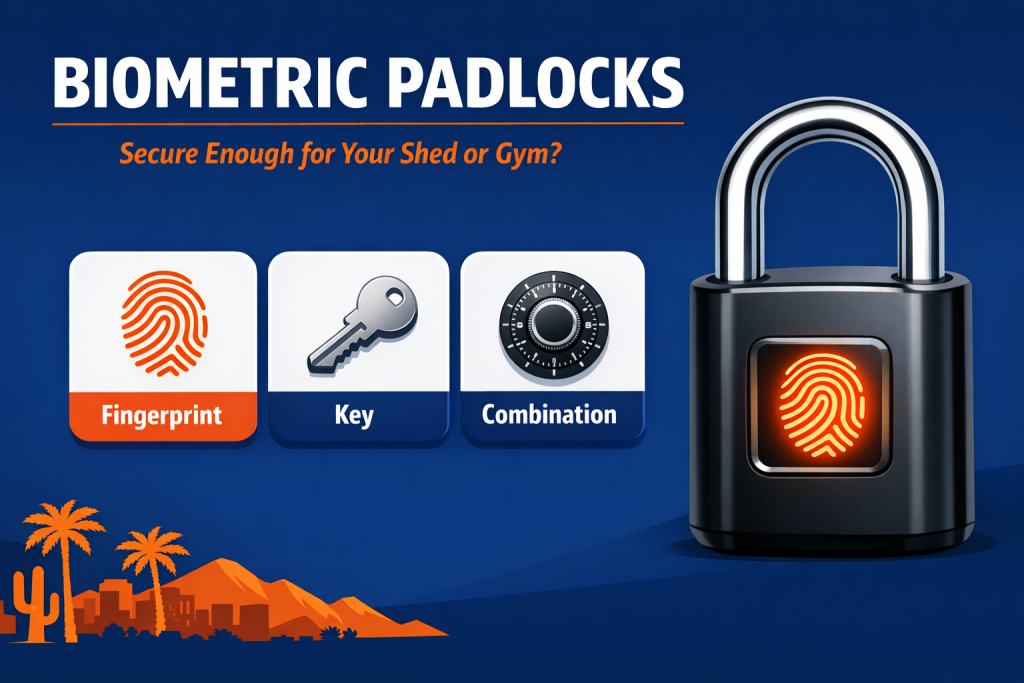
A biometric padlock uses a small optical or capacitive sensor to read the unique ridges of your fingerprint. When you register a print, the lock does not store a photo of your finger. Instead, it converts the pattern into an encrypted mathematical template, then compares each touch against that template. A match drives a tiny internal motor that retracts the shackle, and the lock opens.
Most models store between ten and fifty prints, so every family member or trusted employee can have access without copying a single key. Because there is no keyway, common attacks like lock picking and bumping simply do not apply. That is a meaningful upgrade in home safety, especially for outdoor storage that thieves often see as an easy target. Our residential security technicians install and test these units across the Valley, and we have watched the technology mature from a novelty into a dependable everyday tool. Here is how a fingerprint model stacks up against the locks it usually replaces:
Biometric vs. Keyed vs. Combination Padlocks
| Feature | Biometric Padlock | Keyed Padlock | Combination Padlock |
|---|---|---|---|
| Access method | Fingerprint sensor | Physical key | Numeric dial or buttons |
| Pick / bump resistance | Excellent (no keyway) | Varies by grade | Not applicable |
| Shared access | Up to 10-50 prints | Requires copied keys | One shared code |
| Risk of lockout | Low (backup methods vary) | Lost-key lockout | Forgotten-code lockout |
| Weather exposure tolerance | Good with IP65+ rating | Excellent | Excellent |
| Brute-force resistance | High with hardened shackle | Depends on shackle grade | Shim-vulnerable on cheap units |
| Best use | Sheds, gyms, gates, lockers | High-security gates | Low-risk shared storage |
Biometric vs. Traditional Padlocks: What the Comparison Tells You
Choosing a lock comes down to matching the security level to the risk. No single lock wins every category, which is why we look at the specific door, gate, or locker before recommending one. A backyard shed in full Arizona sun has very different needs than an indoor gym locker, and the right answer depends on the threats each space actually faces.
Are Fingerprint Locks Secure Enough for a Shed or Gym?
For a shed, gym locker, or side gate, a quality biometric padlock is more than secure enough. The realistic threats in these settings are opportunistic grab-and-go theft, not a determined attacker with specialized tools. By removing the keyway, you eliminate the easiest entry method, and by removing a written code, you stop shoulder-surfing.
The two things that actually matter are build quality and the sensor. Look for a hardened steel or boron shackle, a body rated IP65 or higher for dust and rain resistance, and a sensor with a published false-acceptance rate. The National Institute of Standards and Technology maintains the research standards behind fingerprint matching, and reputable manufacturers design to those benchmarks. We also recommend hardware that carries an ANSI/BHMA grade so you know the lock body has passed independent durability testing rather than relying on marketing claims alone.
Where biometric padlocks fall short is extreme security. A jewelry safe or a commercial storefront still deserves a heavy deadbolt security setup, often paired with a reinforced strike and a thumbturn lock on the interior. Think of the fingerprint padlock as the right tool for moderate-risk storage, not a replacement for a graded entry-door system.
Understanding the Thumbturn Connection
People often ask how a keyless padlock relates to the thumbturn lock on their back door. Both are keyless by design, but a thumbturn only secures from the inside, while a biometric padlock secures a shackle from the outside. Many homeowners pair the two: a thumbturn deadbolt on the door for interior control, and a fingerprint padlock on the shed or gate for exterior storage. Our commercial and residential team can map both into one coherent plan.
Pro Tip From Our Technicians
After installing hundreds of these units, here is the lesson that saves the most headaches: always register the same finger at two different angles, and enroll a second backup finger. Sensors read a slightly different print when your hand is dry, sweaty after a workout, or dusty from yard work. Enrolling multiple captures of the same finger dramatically reduces failed reads in real conditions.
We also tell every client to keep the backup access method documented in a safe place. Better biometric padlocks include a mechanical key override or a backup code port, and a USB-C charge point so a drained battery never traps your belongings inside. During any security audit, we test the override path first, because a lock you cannot open in a pinch is not protecting anything.
Common Mistakes That Weaken a Good Lock
Even the best hardware fails when it is installed carelessly. The most frequent issue we correct is mounting a padlock through a flimsy hasp. A premium fingerprint lock on a thin aluminum hasp gives a thief the weakest link to attack, so we upgrade the hasp and use carriage bolts that cannot be unscrewed from the outside.
The second mistake is skipping firmware and battery checks. Treat the lock like any electronic device: keep it charged and update the firmware when the manufacturer releases a fix. A short check during your seasonal home maintenance keeps the sensor accurate and the motor responsive. If you would rather hand that off, our Phoenix locksmith specialists fold it into routine service visits.
Frequently Asked Questions About Biometric Padlocks
Do biometric padlocks store an image of my fingerprint?
No. The sensor converts your fingerprint into an encrypted mathematical template and compares each touch against it. No actual photo of your finger is saved on the device.
Will a fingerprint padlock work outdoors in Arizona heat?
Yes, as long as you choose a model rated IP65 or higher for dust and water resistance. That rating is what lets the lock hold up to sun, monsoon rain, and blowing dust on a shed or gate.
What happens if the battery runs out?
Quality models include a USB-C charge port and a mechanical key or backup-code override, so a drained battery never traps your belongings inside. We always test that override path during a security audit.
Are fingerprint padlocks secure enough for a gym locker?
For a gym locker or shed, a well-built biometric padlock is more than enough. Removing the keyway stops picking and bumping, and removing a written code stops shoulder-surfing.
Can more than one person open the same lock?
Yes. Most units store between ten and fifty fingerprints, so every family member or trusted employee can have access without anyone copying a key.
Should I replace my deadbolt with a biometric lock?
Not for a main entry door. Pair a biometric padlock with strong deadbolt security and a thumbturn lock on interior doors. The padlock is best for moderate-risk storage like sheds and gates.
Securing Your Shed and Gym the Smart Way
A biometric padlock earns its place on a shed, gate, or gym locker by erasing the two oldest weak points in security: the lost key and the forgotten code. Match it to a hardened shackle, a weather rating built for Arizona heat, and a properly reinforced hasp, and you have a setup that stands up to the threats these spaces actually face. For higher-stakes doors, layer it with deadbolt security and a thumbturn lock instead of relying on the padlock alone.
If you want a second opinion before you buy, our licensed technicians are ready to help. We can evaluate your property, recommend the right grade of hardware, and handle the installation so nothing is left to chance. Reach out to AZ Locksmith & Garage Repair for a hands-on security audit, and find us on our Google Business listing to see how Phoenix homeowners rate our work. Let us help you lock down your shed, gym, and gate the right way.
Locked Out or Garage Door Stuck?
AZ Locksmith & Garage Repair · Mobile service across Phoenix, 7 days a week, 7 AM–9:30 PM.

AZ Locksmith & Garage Repair
Written by the AZ Locksmith & Garage Repair team — mobile locksmiths and garage door technicians based at 9830 S 51st St in Phoenix, AZ. We handle lockouts, rekeys, car keys, commercial hardware and garage door repair across Phoenix and the East Valley, 7 days a week.